
Guide
APS-C Lens on a Full-Frame Sony: Crop Mode Explained
Using an APS-C lens on a full-frame Sony: how crop mode works, how many megapixels remain on the A7 IV and A7R V, and when the combination pays off.
Last update: 5 min read

Table of contents
Yes, Sony E-mount lenses made for APS-C (named "E") fit every full-frame camera with an E mount. In the default Auto setting the camera then switches to APS-C size and uses only the center of the sensor[1]. The view is the focal length times 1.5, and you keep only about 43% of the pixels: the Sony A7 IV records 14 instead of 33 megapixels, the A7R V 26 instead of 60.
How APS-C mode works on a Sony
Full-frame and APS-C cameras share the E mount, so the lens fits mechanically. Sony names lenses by format: "FE" stands for full frame, "E" for APS-C. On a full-frame camera, the angle of view with an E lens is cropped to APS-C size[2]. The reason is the image circle: an APS-C lens only covers a smaller sensor (more in our article APS-C vs. full frame).
The camera controls the crop with a dedicated setting. Depending on the model it is called "APS-C S35 Shooting" or "APS-C/Super 35mm"; on the A7 IV you find it under MENU, Shooting, Image Quality[1]. It has three values[3]:
- Auto: The camera sets the capture range from the lens and the camera settings. This is the default.
- On: The camera always records at APS-C size (Super 35mm size for video). The view is then about 1.5 times the focal length.
- Off: The camera always uses the whole full-frame sensor.
Resolution in APS-C mode
In crop mode the camera uses only the center of the sensor, so the file gets smaller. The largest full-frame JPEG size (L) cannot be selected in APS-C mode, where size M applies[4][5]:
| Camera | Full frame (L) | APS-C mode (M) | Share |
|---|---|---|---|
| Sony A7 IV | 33 MP (7008 × 4672) | 14 MP (4608 × 3072) | about 43% |
| Sony A7R V | 60 MP (9504 × 6336) | 26 MP (6240 × 4160) | about 43% |
A high-resolution body therefore handles the crop better: the A7R V in APS-C mode delivers 26 MP, as many as a Sony A6700 with its APS-C sensor[6]. On the A7 IV, by contrast, you trade resolution for a smaller lens. Autofocus is affected too: according to its spec sheet the A7 IV has 759 phase-detection AF points at full frame, 713 in APS-C mode with an FE lens and 575 with an APS-C lens[7].
What if you turn the crop off?
With the setting on Off and an APS-C lens you may not get optimal results, for example the edges of the image can turn darker[3]. The lens's image circle does not fully cover the sensor. How noticeable it is depends on the lens and the focal length. If you see dark corners, Sony advises checking the setting, as it may be on Off[1].
For lenses from other makers, check their notes. For the 18-50mm F2.8 DC DN, Sigma says to switch to APS-C crop mode when using it on full-frame cameras[8].
Focal length and look of the image
Multiply the focal length by 1.5 to compare with full frame:
- 16 mm looks like 24 mm
- 35 mm looks like 52.5 mm
- 56 mm looks like 84 mm
- 70 to 350 mm looks like 105 to 525 mm
The f-number stays the same. The picture behaves like one from an APS-C camera: the same angle of view[3], and the depth of field also acts like APS-C. Our article APS-C vs. full frame explains both in detail, and the field of view simulator shows the difference.
Video: the Super 35 crop
For video the crop costs less. A 4K frame (3840 × 2160) is only about 8.3 megapixels, so a Super 35mm crop still has enough pixels. Some modes even require the crop: on the A7 IV the setting is locked to On for 4K at 60p or 50p[3]. An APS-C lens is designed for exactly this area and can be smaller and lighter than a full-frame lens[9].
When it makes sense and when it does not
It makes sense when:
- you already own APS-C lenses and are moving to a full-frame body,
- the camera is high-resolution and the pixels in the crop are still enough,
- size and weight matter, for example when traveling or on a gimbal: APS-C lenses can be smaller and lighter[9],
- you shoot a lot of video in Super 35mm.
It makes less sense if you need the full sensor area, for example for wide angles or the shallow depth of field of full frame. In the catalog you find Sony E APS-C, Sony E full frame and the Sony E wide-angle page with both formats. The overview is on the Sony E mount page.
The reverse: full-frame lenses on Sony APS-C cameras
This works without any setting. Sony lists FE lenses as compatible with APS-C cameras[1]. The camera uses the center of the image circle, and the focal length acts longer by the usual APS-C factor of 1.5: a 50 mm FE lens shows an image like 75 mm on full frame. The lens itself is built for the larger sensor and is therefore often larger. See Sony E full frame for the selection.
Frequently asked questions
Can you use an APS-C lens on the Sony A7 IV?
Yes. Every E lens fits. With Auto the camera switches to APS-C size, and the A7 IV then records about 14 instead of 33 megapixels[4].
How many megapixels are lost in APS-C mode?
About 57%. 33 MP becomes 14 MP, and 60 MP becomes 26 MP[4][5].
What happens with an APS-C lens without crop mode?
The lens does not cover the full-frame sensor, and the edges of the image turn darker[3]. Leave the setting on Auto or set it to On.
Can you use full-frame lenses on Sony APS-C cameras?
Yes. Sony lists FE lenses as compatible with E-mount APS-C cameras[1]. The focal length acts longer there by a factor of 1.5.
Sources
- [1] Sony: Are APS-C and full frame cameras and lenses interchangeable? (E-mount). Accessed October 14, 2026.
FE/E compatibility, Auto default, vignetting note, menu paths
- [2] Sony: What information does the lens model name provide? Accessed October 14, 2026.
Designations E (APS-C) and FE (full frame), crop to APS-C size
- [3] Sony: ILCE-7M4 Help Guide: APS-C S35 (Super 35mm) Shooting. Accessed October 14, 2026.
On/Auto/Off, factor 1.5, darker edges with Off, locked to On for 4K 60p
- [4] Sony: ILCE-7M4 Help Guide: JPEG Image Size/HEIF Image Size. Accessed October 14, 2026.
A7 IV image sizes: L 33 MP, M 14 MP; L not selectable in APS-C mode
- [5] Sony: ILCE-7RM5 Help Guide: JPEG Image Size/HEIF Image Size. Accessed October 14, 2026.
A7R V image sizes: L 60 MP, M 26 MP
- [6]
- [7] Sony: ILCE-7M4 Specifications. Accessed October 14, 2026.
Sensor 35.9 x 23.9 mm, 33 MP, AF points in APS-C mode
- [8] Sigma: 18-50mm F2.8 DC DN | Contemporary. Accessed October 14, 2026.
Note to switch to APS-C crop mode on full-frame cameras
- [9] Canon Europe: APS-C vs full-frame - the difference explained. Accessed October 14, 2026.
Sensor sizes (36 x 24 mm, APS-C 22.2 x 14.8 mm), crop factor 1.6, examples for reach, weight, noise, RF-S on full frame with automatic crop
Matching lenses
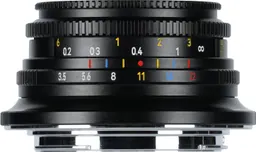
7Artisans 10mm F3.5
10mm · f/3.5
Sony E
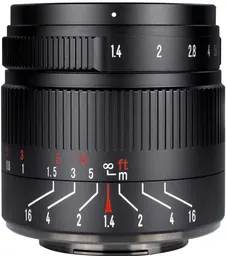
7artisans 55mm F1.4 Mark II
55mm · f/1.4
Sony E
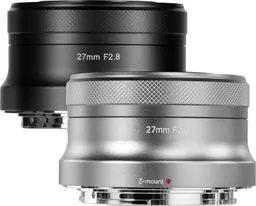
AstrHori AF 27mm f/2.8
27mm · f/2.8
Sony E
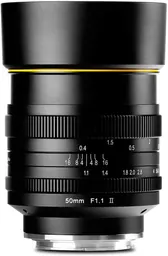
Kamlan 50mm F1.1
50mm · f/1.1
Sony E
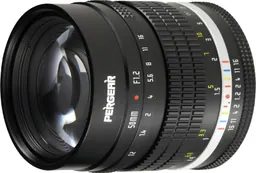
Pergear 50mm F1.2
50mm · f/1.2
Sony E
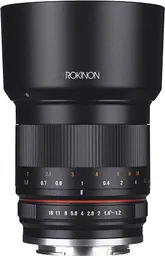
Samyang / Rokinon 50mm F1.2 ED AS UMC CS
50mm · f/1.2
Sony E
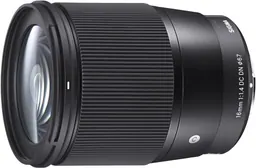
Sigma 16mm F1.4 DC DN | Contemporary
16mm · f/1.4
Sony E
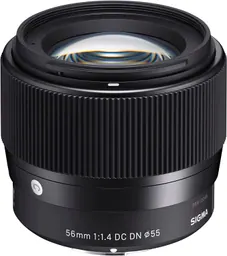
Sigma 56mm F1.4 DC DN | Contemporary
56mm · f/1.4
Sony E