
Canon RF Autofocus
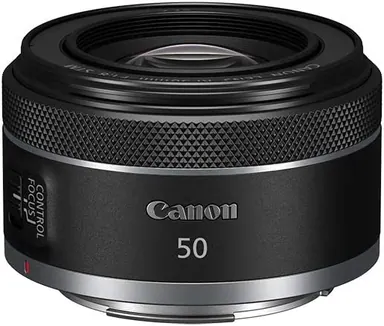
Canon RF 50mm F1.8 STM
- Focal length
- 50 mm
- Aperture
- f/1.8
- Weight
- 160 g
- Filter diameter
- 43 mm
- Min. focus distance
- 30 cm
- Length
- 40.5 mm
Overview
The Canon RF 50mm F1.8 STM is a compact standard prime for the RF mount. It is built for full-frame EOS R cameras and also fits the APS-C bodies of the system, where the field of view becomes narrower. It combines a f/1.8 maximum aperture with a very small body, which makes it a typical first prime for portraits, street photography and indoor scenes. Canon announced it in November 2020, together with the RF 70-200mm F4L IS USM.
Optical design
According to Canon, the lens has 6 elements in 5 groups, including one PMo aspherical element. The aperture range runs from f/1.8 to f/22, and the diaphragm has 7 blades in a circular shape. Canon says that the lens placement and the coatings help with color balance and keep ghosting and flare low. Maximum magnification is 0.25x.
Autofocus and handling
Focusing is done by a gear-type stepping motor (STM). Canon describes the autofocus as smooth and quiet for both stills and video, including continuous AF while recording. The minimum focus distance is 0.30 m. A control ring on the barrel gives direct access to camera settings. The lens has no optical stabilizer of its own, so shake correction depends on the camera body.
Build and size
The lens weighs 160 g and measures 69.2 mm in diameter and 40.5 mm in length. The filter thread is 43 mm. Canon does not claim any dust or weather sealing on the product page, so it is best treated as a lens for normal conditions.
Where it fits
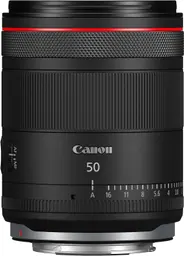
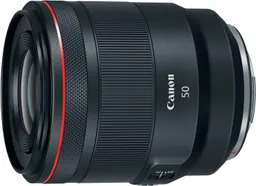
Within the RF system it sits below the RF 50mm F1.4 L VCM (580 g in our database) and the RF 50mm F1.2L USM (950 g), which are larger L-series lenses. The RF 35mm F1.8 IS STM Macro is the neighbor with a stabilizer and closer focusing, and the RF 45mm F1.2 STM offers a much wider aperture at a higher weight of 346 g. EF shooters know the Canon EF 50mm F1.8 STM, which has the same 6 elements in 5 groups but needs an adapter on mirrorless bodies.
Pros and cons
Pros
- Very light at 160 g and only 40.5 mm long
- Bright f/1.8 aperture for low light and background blur
- Quiet STM autofocus suited to video
- Control ring for direct setting changes
- 0.25x maximum magnification and 0.30 m minimum focus distance
- Small 43 mm filter thread
Cons
- No in-lens stabilizer
- Only 7 aperture blades
- No dust or weather sealing mentioned by Canon
- Not an L-series lens, so the build is plainer than on the 50mm L primes
Verdict
The RF 50mm F1.8 STM is the simple, small choice for a standard prime on Canon RF. It gives up stabilization and sealing, but it keeps autofocus, a control ring and a bright aperture in a body of 160 g. For a faster aperture or a more robust build, look at the 45mm F1.2 STM or the L-series 50mm lenses.
Technical Specifications
- min focal length
- 50 mm
- max focal length
- 50 mm
- max f (min zoom)
- f/1.8
- max f (max zoom)
- f/1.8
- min. aperture
- f/22
- Elements
- 6
- Groups
- 5
- Weight
- 160 g (0.35 lb)
- Filter diameter
- 43 mm
- min focus distance
- 30 cm (11.81 in)
- Length
- 40.5 mm (1.59 in)
- Diameter
- 69.2 mm (2.72 in)
Which cameras does the Canon RF 50mm F1.8 STM fit?
The Canon RF 50mm F1.8 STM is a full-frame lens for Canon RF cameras. On full-frame bodies it uses the whole sensor; on APS-C Canon RF cameras its field of view equals 80 mm in full-frame terms.
Canon RF cameras
- Full frame:
- Canon EOS R6 V, Canon EOS R6 Mark III, Canon EOS C50, Canon EOS R1, Canon EOS R5 Mark II, Canon EOS C400, Canon EOS C80, Canon EOS R8, Canon EOS R6 Mark II, Canon EOS R5 C, Canon EOS R3, Canon EOS R5, Canon EOS R6, Canon EOS Ra, Canon EOS RP, Canon EOS R
- APS-C:
- Canon EOS R50 V, Canon EOS R100, Canon EOS R50, Canon EOS R7, Canon EOS R10, Canon EOS C70
Canon RF 50mm F1.8 STM compared
Key specs side by side with the most similar Canon RF lenses.
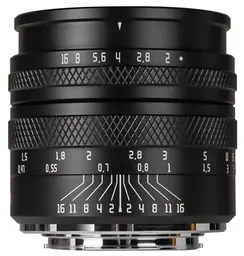
| Lens | Canon RF 50mm F1.8 STM | Canon RF 50mm F1.4 L VCM | Canon RF 50mm F1.2L USM | AstrHori 50mm f/2 |
|---|---|---|---|---|
| Focal length | 50 mm | 50 mm | 50 mm | 50 mm |
| Max. aperture | f/1.8 | f/1.4 | f/1.2 | f/2 |
| Weight | 160 g | 580 g | 950 g | 310 g |
| Filter diameter | 43 mm | 67 mm | 77 mm | 52 mm |
| Min. focus distance | 30 cm | 40 cm | 40 cm | 50 cm |
| Length | 40.5 mm | 99 mm | 108 mm | 52 mm |
| Autofocus | yes | yes | yes | no |
| Image stabilization | no | no | no | no |
Canon RF 50mm F1.8 STM: FAQ
Does the Canon RF 50mm F1.8 STM have autofocus?
Yes, the Canon RF 50mm F1.8 STM has autofocus.
Does the Canon RF 50mm F1.8 STM have image stabilization?
No, the Canon RF 50mm F1.8 STM has no stabilization of its own. On cameras with in-body image stabilization (IBIS) the image is still stabilized.
How much does the Canon RF 50mm F1.8 STM weigh?
The Canon RF 50mm F1.8 STM weighs 160 g. It is 40.5 mm long with a diameter of 69.2 mm.
What filter size does the Canon RF 50mm F1.8 STM use?
The Canon RF 50mm F1.8 STM takes 43 mm screw-in filters.
How close can the Canon RF 50mm F1.8 STM focus?
The minimum focus distance of the Canon RF 50mm F1.8 STM is 30 cm, measured from the sensor plane.
Is the Canon RF 50mm F1.8 STM a full-frame lens?
Yes, the Canon RF 50mm F1.8 STM covers full frame. On APS-C cameras its field of view equals 80 mm in full-frame terms.
Similar lenses
Canon RF 50mm F1.4 L VCM
50mm · f/1.4
Canon RF 50mm F1.2L USM
50mm · f/1.2
AstrHori 50mm f/2
50mm · f/2
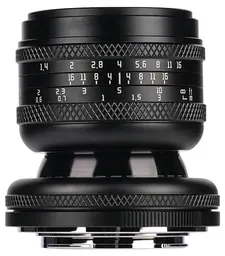
AstrHori 50mm f/1.4 Tilt
50mm · f/1.4
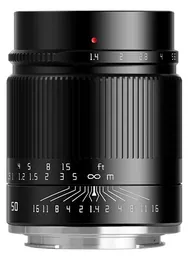
TTArtisan 50mm f/1.4 ASPH
50mm · f/1.4
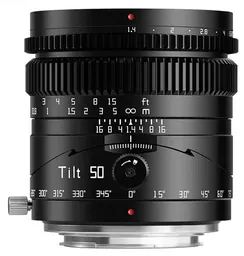
TTArtisan Tilt 50mm f/1.4
50mm · f/1.4

Canon RF 45mm F1.2 STM
45mm · f/1.2

Meyer-Optik Gorlitz Trioplan 50mm f/2.8 II
50mm · f/2.8
Related guides
What does the f mean in camera lenses?
When it comes to photography, understanding the basics of f-stop is essential. F-stop is a critical component of a camera lens that…
How to clean a camera lens
Keeping your camera lenses clean is essential for getting clear, sharp, and high-quality images. Even the smallest speck of dust, dirt, or…
All camera lens types explained: Uses and functions
In this article, we'll explore the various types of camera lenses, their defining features, and when to use them. We'll also cover the…