
Guide
Types of Camera Lenses Explained: Uses and Differences
Types of camera lenses explained: wide-angle, standard, telephoto, prime, zoom, macro and more, with focal length ranges and typical uses.
Last update: 6 min read
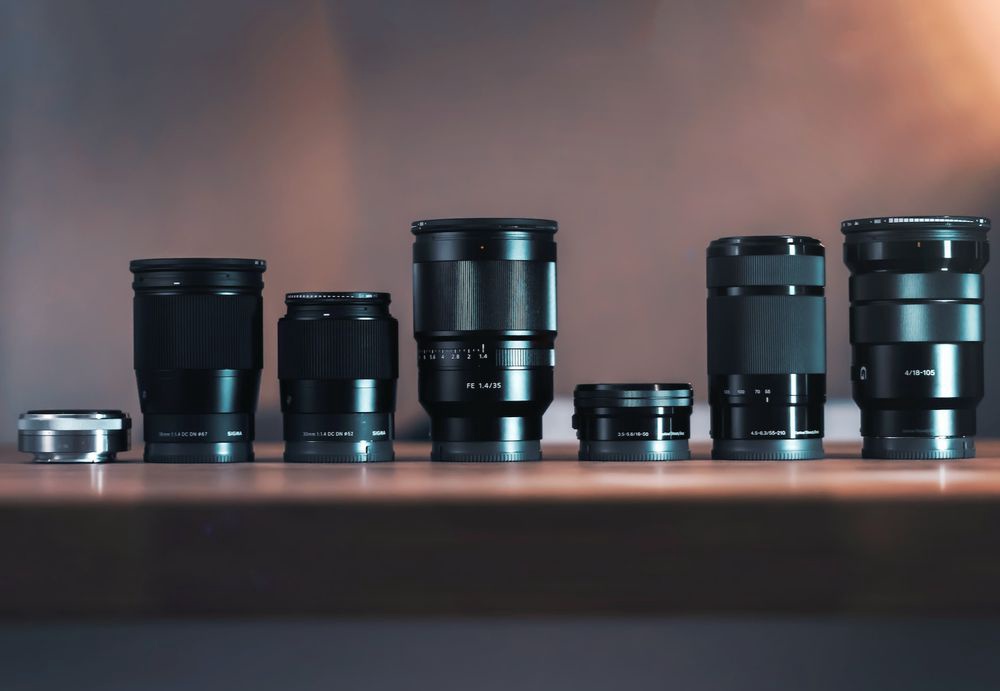
Camera lenses are sorted by focal length (ultra-wide, wide-angle, standard, telephoto), by design (prime or zoom), by purpose (macro, fisheye, tilt-shift) and by the mount and sensor format they are made for. The focal length decides how much of a scene you see, so it is the most important of these criteria. All focal lengths below are given in full-frame terms.
Lens types by focal length
Canon divides lenses by field of view into three broad groups, wide-angle, standard and telephoto[1]. The table combines Canon's definitions into six practical classes:
| Type | Focal length (full-frame equivalent) | Typical subjects |
|---|---|---|
| Ultra-wide-angle | below about 24 mm | Large interiors, architecture, expansive landscapes |
| Wide-angle | up to about 35 mm | Landscapes, cityscapes, group shots |
| Standard | around 50 mm, in the broader sense 35 to 85 mm | Travel, street, everyday use, portraits |
| Medium telephoto | 70 to under 135 mm | Portraits, events |
| Telephoto | 135 mm and longer | Sports, wildlife, distant details |
| Super-telephoto | 300 mm and longer | Wildlife, motorsport, birds |
The limits come from Canon's own pages and overlap slightly: wide-angle up to about 35 mm, ultra-wide below about 24 mm, medium telephoto from 70 mm, telephoto from 135 mm and super-telephoto from 300 mm[2], while Canon Europe puts the start of the telephoto range at around 85 mm[1]. Treat them as conventions, not hard borders.
Focal length changes more than the field of view:
- Wide-angle lenses capture more of the scene, exaggerate perspective, have a larger depth of field, and make background blur less obvious[2].
- Telephoto lenses bring distant subjects closer, compress perspective, produce less distortion than wide-angle lenses, and can create larger background blur[2].
- Standard lenses around 50 mm are said to give a "natural" perspective comparable to the human eye, although the field of view is not exactly the same[1].
The field of view simulator shows how the same scene looks at 24, 50 and 135 mm.
Prime vs. zoom lenses
A prime lens has one fixed focal length, a zoom lens covers a range. Zooms are more convenient for adjusting the framing, while primes mostly have larger ("brighter") maximum apertures, which suits shallow depth of field and low light[2].
Common zoom classes:
- Standard zoom: it covers 50 mm and a bit wider and narrower. Classic ranges are 24 to 70 mm, 28 to 70 mm and 24 to 105 mm for full frame and 18 to 45 mm for APS-C[3].
- Wide-angle and telephoto zooms: they stay within one of the classes in the table above.
- Superzoom: it spans wide-angle to telephoto in one lens, for example 24 to 240 mm[1].
Zoom lenses come with a constant or a variable aperture. A constant-aperture zoom keeps its maximum aperture across the range, a variable-aperture zoom becomes darker as you zoom in. Superzoom lenses and the most compact, budget-friendly standard zooms are usually variable-aperture lenses[3]. The lens name shows it: f/4 to f/6.3 means the maximum aperture changes with the focal length.
The aperture itself is the focal length divided by the diameter of the opening, and a smaller f-number means a wider aperture[4]. More in What does the f mean in camera lenses.
Special-purpose lenses
Macro lenses
Macro lenses focus very close and have a high magnification ratio. Canon describes them by a magnification of at least 0.5x, and true macro lenses by at least life size (1x)[2]. Some lenses called macro, such as the Canon RF 24mm F1.8 Macro IS STM, reach 0.5x[4]. At close range the depth of field becomes very shallow, so a higher f-number or focus bracketing is needed to get more in focus[2]. Browse them on the Sony E macro page or the Canon RF macro page.

Fisheye lenses
Fisheye lenses cover about 180° and render straight lines as curves. They come as circular or diagonal fisheyes, depending on focal length and sensor. Details are in the fisheye lens guide.
Tilt-shift lenses
A tilt-shift lens lets you move parts of the optics. Shifting eliminates perspective distortion, which suits architecture and products. Tilting adjusts the area in focus in a way a conventional lens cannot, for a miniature effect or to bring a scene with much depth into focus[5].
Lenses by sensor format and mount
Lenses are designed for a sensor format and a mount, and both limit what fits on your camera. The focal length in the lens name is usually given in full-frame terms, so on a smaller sensor the field of view is narrower by the crop factor:
| Sensor format | Crop factor |
|---|---|
| Full frame | 1.0x |
| APS-C (Sony, Nikon, Fujifilm) | 1.5x |
| APS-C (Canon) | 1.6x |
| Micro Four Thirds | 2.0x |
The factors are stated by[6],[7],[8],[2] and[9]. A Canon RF 50mm f/1.8 STM on an APS-C Canon camera, for example, gives a field of view similar to 80 mm on full frame, so it moves from the standard class toward the medium telephoto class[2]. Details in APS-C vs. full frame.
The mount decides whether a lens physically and electronically fits. Canon states that RF lenses do not fit EOS DSLRs or EOS M cameras, that DSLR lenses need the EF-EOS R adapter on R cameras, and that RF-S lenses can be used on full-frame R cameras in 1.6x crop mode[2]. For other systems, see using APS-C lenses on full-frame Sony cameras and the EF vs. EF-S guide. Our mount pages list all lenses per system: Sony E, Canon RF, Nikon Z, Fujifilm X and Micro Four Thirds.
Which lens type for which subject
| Subject | Lens type | Why |
|---|---|---|
| Landscapes, architecture, interiors | Wide-angle or ultra-wide-angle | Large field of view, includes more of the scene[2] |
| Travel, everyday use, portraits | Standard lens or standard zoom | Natural perspective, flexible range[1] |
| Sports, wildlife | Telephoto or super-telephoto | Fills the frame from a distance[2] |
| Plants, insects, small objects | Macro | High magnification, short focus distance[2] |
| Buildings without converging lines | Tilt-shift | Shift corrects perspective[5] |
Per mount, the wide-angle, prime, zoom and telephoto pages help narrow it down, for example on Sony E or Canon RF.
Frequently asked questions
What are the main types of camera lenses?
By focal length: wide-angle, standard and telephoto. By design: prime and zoom. By purpose: macro, fisheye and tilt-shift lenses. In addition, every lens is made for a specific mount and sensor format.
What is the difference between a prime and a zoom lens?
A prime has a fixed focal length, a zoom covers a range. Zooms offer more flexibility, primes mostly have larger maximum apertures.
Which focal length is a standard lens?
Around 50 mm on full frame, in the broader sense 35 to 85 mm. On APS-C cameras, a standard field of view needs around 32 mm[3].
What is a macro lens?
A lens that focuses very close and reproduces a subject at a high magnification. Canon sets the threshold at 0.5x, and true macro lenses reach at least life size (1x).
Does the crop factor change the lens type?
Yes. A lens keeps its focal length, but on a smaller sensor it shows a narrower view. A 50 mm lens on a Canon APS-C camera shows about what an 80 mm lens shows on full frame.
Sources
- [1] Canon: Understanding focal length in photography. Accessed October 14, 2026.
Wide-angle, standard and telephoto classes, boundaries, standard perspective, superzoom example
- [2] Canon: Lenses 101. Accessed October 14, 2026.
Focal length classes, traits of wide-angle and telephoto lenses, macro magnification, prime vs zoom, mount and 1.6x crop factor
- [3] Canon: Lens Basics #7: Standard Zoom & Superzoom Lenses. Accessed October 14, 2026.
Standard zoom ranges, variable and constant aperture, standard focal length on APS-C
- [4] Canon: A beginner's guide to choosing a lens. Accessed October 14, 2026.
Aperture formula (focal length divided by f-number), macro at 0.5x with the RF 24mm as example
- [5] Canon: What You Didn't Know About the Shift Function on Tilt-Shift Lenses. Accessed October 14, 2026.
Function of shift and tilt
- [6] Sony: How do I determine the 35mm-equivalent focal length of a lens? Accessed October 14, 2026.
1.5x crop factor on APS-C
- [7]
- [8]
- [9] OM System: E-PL1 Instruction Manual. Accessed October 14, 2026.
Micro Four Thirds focal length equivalent to twice that of 35 mm