
Last update: October 12, 2026
APS-C vs. Full Frame: Which Sensor Is Right for You?
Guide
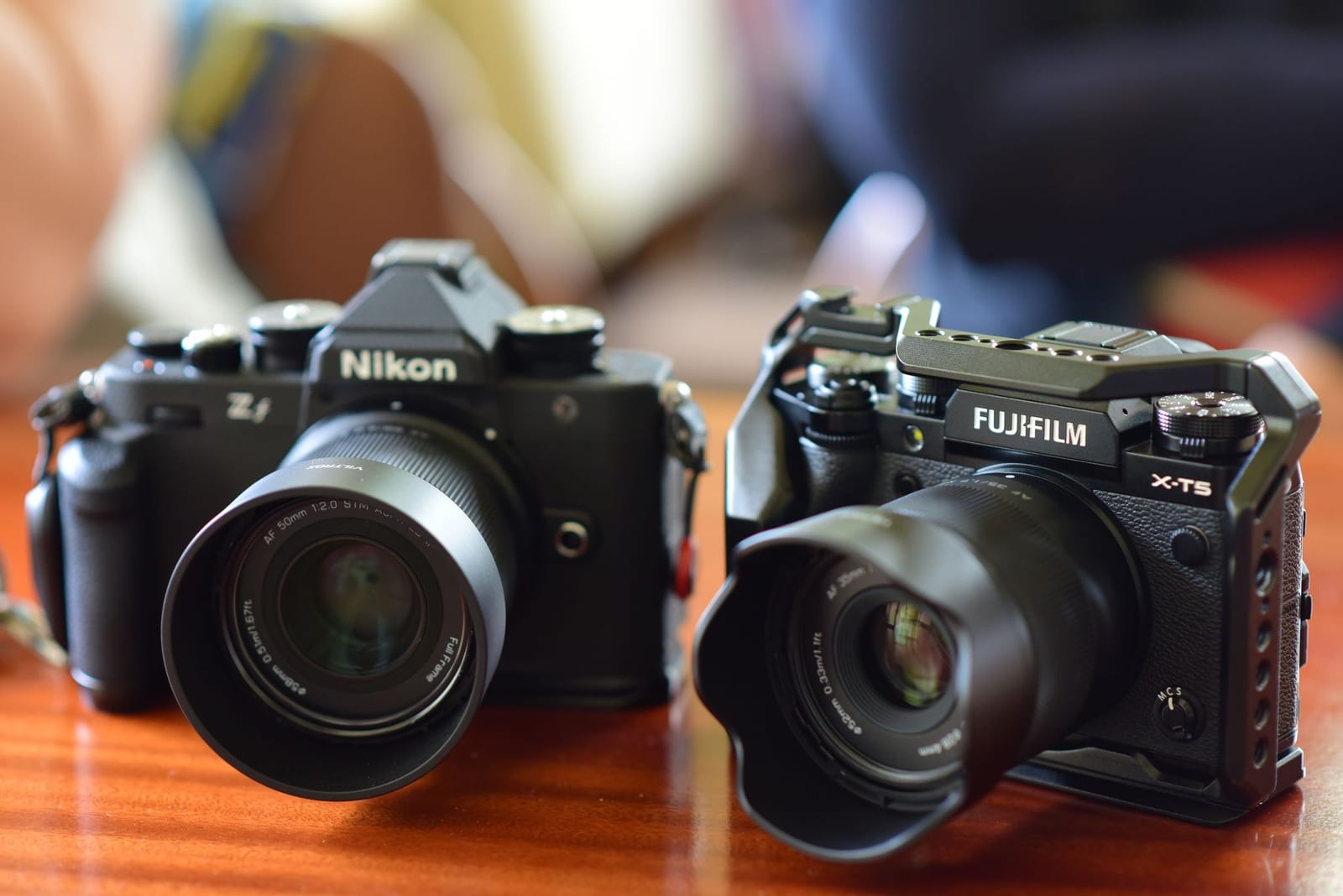
Image credit: Sóc Năng Động / Pexels · Image source · Image usage notes
Full frame (about 36 x 24 mm) is the larger sensor: it gives a wider view with the same lens, shallower depth of field and usually cleaner images in low light. APS-C (about 23.5 x 15.6 mm, crop factor 1.5, or 1.6 at Canon) means smaller, lighter cameras and lenses and extra telephoto reach. Neither format is better overall: pick full frame if you shoot in dim light or want maximum background blur, and APS-C if size, weight and reach matter more to you.
Sensor sizes and crop factor
A full-frame sensor is about the size of a frame of 35 mm film, roughly 36 x 24 mm. APS-C sensors are smaller, around 23 to 24 mm wide and 15 to 16 mm tall. The exact dimensions differ slightly from model to model, as these current examples from the manufacturers' spec pages show:
| Format | Example camera | Sensor size (manufacturer) | Crop factor |
|---|---|---|---|
| Full frame | Sony A7 IV | 35.9 x 23.9 mm | 1.0 |
| Full frame | Canon EOS R6 Mark II | 35.9 x 23.9 mm | 1.0 |
| Full frame | Nikon Z6III | 35.9 x 23.9 mm | 1.0 |
| APS-C | Sony A6700 | 23.3 x 15.5 mm | 1.5 |
| APS-C | Nikon Z50 II (DX) | 23.5 x 15.7 mm | 1.5 |
| APS-C | Fujifilm X-T5 | 23.5 x 15.7 mm | about 1.5 |
| APS-C | Canon EOS R7 | 22.3 x 14.8 mm | 1.6 |
The crop factor tells you how many times smaller a sensor is than full frame, measured along the diagonal. Sony, Nikon and Fujifilm APS-C cameras have a crop factor of about 1.5. Canon's APS-C sensors are slightly smaller, so Canon uses 1.6. Measured by area, a full-frame sensor is roughly 2.3 to 2.6 times as large as an APS-C sensor, depending on the model.
Angle of view and 35 mm equivalent focal length
A lens keeps its focal length on every camera, but a smaller sensor records only the centre of the image the lens projects. The result looks like a tighter crop, as if you had zoomed in. To compare the view, manufacturers use the 35 mm equivalent focal length: multiply the focal length by the crop factor. Sony's example: a 50 mm lens on an APS-C camera gives the same view as a 75 mm lens on full frame. Canon's: 50 mm becomes 80 mm.
| Lens focal length | Equivalent on APS-C (x 1.5) | Equivalent on Canon APS-C (x 1.6) |
|---|---|---|
| 16 mm | 24 mm | 25.6 mm |
| 24 mm | 36 mm | 38.4 mm |
| 35 mm | 52.5 mm | 56 mm |
| 50 mm | 75 mm | 80 mm |
| 85 mm | 127.5 mm | 136 mm |
| 100 mm | 150 mm | 160 mm |
| 200 mm | 300 mm | 320 mm |
You can see the effect yourself: try it in our focal length comparison, which shows a 50 mm lens on full frame and on APS-C.
The same maths works against you at the wide end. To get a 24 mm view on an APS-C camera with a crop factor of 1.5, you need a 16 mm lens. That is why APS-C cameras have their own wide-angle lenses, and why very wide views are easier on full frame.
Depth of field and background blur
Full frame makes a shallow depth of field easier, as Canon also notes. A fair comparison needs the same framing: the same subject, filling the picture in the same way.
For the same framing from the same position, you need a shorter focal length on APS-C, and a shorter focal length gives more depth of field. As a rule of thumb, you then also multiply the f-number by the crop factor to compare depth of field:
- A 35 mm f/1.8 lens on APS-C (crop 1.5) frames like a 52.5 mm lens and gives a depth of field similar to about f/2.7 on full frame.
- To match the background blur of a 50 mm f/1.8 on full frame, an APS-C camera would need a lens of about 33 mm at f/1.2.
In stops, full frame gains roughly 1.2 stops of extra background blur at a crop factor of 1.5 and about 1.4 stops at 1.6. The exposure itself does not change: f/1.8 on APS-C is exactly as bright as f/1.8 on full frame at the same shutter speed and ISO. Only the depth of field differs.
Shallow depth of field is not always what you want. For landscapes, architecture and group photos, the wider depth of field of APS-C helps to keep everything sharp at a larger aperture. You can try the effect with our depth of field calculator and lens simulator.
Low light and dynamic range
Because a full-frame sensor is larger, it collects more light in total for the same framing and the same f-number. If you view both pictures at the same output size, the full-frame image usually has less noise, especially at high ISO. Canon makes the same point: with the same number of megapixels, the individual photosites on a full-frame sensor are larger and can capture more light with less noise.
The size of the difference depends a lot on the camera. A recent APS-C sensor can be cleaner than an older full-frame sensor, and the sensor generation, the lens and the image processing matter as much as the format. The same is true for dynamic range: larger sensors tend to have more headroom in highlights and shadows, but you should compare two specific camera models rather than the formats in general.
In practice, full frame pays off most for events, indoor sports, night photography and astrophotography. In daylight and on a tripod, the difference is small for most people.
Size, weight, price and lens choice
- Size and weight: APS-C lenses need to cover a smaller image circle, so they can be smaller and lighter. That helps for travel, hiking and street photography. Compact full-frame bodies exist too, and Canon points out that its EOS R8 Mark II is similar in size to an APS-C DSLR. The lens often makes the bigger difference to the weight of your bag.
- Price: APS-C bodies and lenses are typically cheaper, and Canon notes that the smaller lenses can be more affordable. Prices change quickly, so compare the current offers for the exact models you have in mind.
- Reach: For wildlife and sports, the crop factor is an advantage. Canon's example: a 100 to 400 mm lens behaves like a 160 to 640 mm lens on an APS-C body. Full-frame cameras can crop in to APS-C size, but the image then has fewer pixels.
- Lens choice: Full frame has the broader choice of ultra-wide and very fast lenses. Some lenses, such as circular fisheyes, only make full use of a full-frame sensor.
Full-frame lenses on APS-C bodies of the same mount work without problems. They just act as if they were longer, as Sony and Nikon both state (the focal length is multiplied by 1.5).
APS-C lenses on full-frame bodies also work in most systems, but the camera switches to a crop mode and records only the centre of the sensor. Nikon and Canon do this automatically, and so does Sony in the default Auto setting of its APS-C/Super 35 mode. You lose resolution, and without the crop the corners can turn dark. We explain this in detail in our articles Can you use APS-C lenses on full-frame Sony cameras? and Canon: EF and EF-S lenses.
Browse the lens database by sensor size:
- Sony E: APS-C lenses and full-frame lenses
- Nikon Z: APS-C lenses and full-frame lenses
- Canon RF: APS-C lenses and full-frame lenses
- Canon EF: APS-C lenses and full-frame lenses
- Nikon F: APS-C lenses and full-frame lenses
- L-Mount: APS-C lenses and full-frame lenses
- Fujifilm X: all lenses (the system is built around APS-C sensors)
Which sensor suits which photographer?
- Beginners: Both work well. APS-C usually keeps the starting budget lower, and a kit zoom is small and easy to carry. Full frame is worth it if you already know you want maximum blur or low-light performance.
- Travel and street: APS-C bodies and lenses are small and light. A compact full-frame body with a small prime is a good alternative if you want the larger sensor.
- Portraits: Full frame makes a shallow depth of field easier. A fast prime on APS-C still gives pleasing separation, and the crop factor turns a 50 mm lens into a classic short telephoto.
- Landscape and architecture: Full frame gives wider views and a larger choice of ultra-wide lenses. APS-C is fine on a tripod at low ISO, and its wider depth of field is helpful.
- Wildlife and sports: APS-C gives extra reach with smaller lenses. Full frame is better at high ISO, for example in the early morning or in a dim hall.
- Video: Super 35, the common cinema format, corresponds to APS-C. Full frame gives shallower depth of field and often better low-light results. Check the video modes of your camera, because some apply a crop (for example 4K 60p on the Sony A7 IV, according to Sony's Help Guide).
FAQ
Is full frame better than APS-C?
Not in every respect. Full frame offers shallower depth of field, a wider view per focal length and usually less noise at high ISO. APS-C is smaller, lighter and often cheaper, and it gives more reach. The best choice depends on what you shoot and how much weight and money you want to invest.
What is the crop factor of APS-C?
For Sony, Nikon and Fujifilm APS-C cameras it is about 1.5. Canon's APS-C sensors are a little smaller and have a crop factor of 1.6. Multiply the lens focal length by this number to get the 35 mm equivalent.
Can I use full-frame lenses on APS-C cameras?
Yes, as long as the lens fits the mount (or you use an adapter). The lens uses only the centre of its image circle, so the view is cropped. A 50 mm lens behaves like a 75 mm lens on a camera with a crop factor of 1.5.
Does APS-C have more depth of field?
With the same framing and the same f-number, yes: about 1.2 to 1.4 stops more, depending on the crop factor. To compare, multiply the f-number by the crop factor. With the same lens at the same distance, the APS-C picture is just a tighter crop and does not gain depth of field, because the smaller image is enlarged more.
Does the f-number change on APS-C?
No. An f/2.8 lens is still f/2.8 and gives the same exposure on both formats. Only the depth of field and the field of view differ, so the "equivalent" values are for comparison and are not what the camera meters.
Sources
- ILCE-6700 Specifications — Sony (Accessed: 2026-10-12)
Sensor type APS-C 23.3 x 15.5 mm (example APS-C sensor size)
- ILCE-7M4 Specifications — Sony (Accessed: 2026-10-12)
35 mm full frame 35.9 x 23.9 mm (example full-frame sensor size)
- ILCE-7M4 Help Guide: APS-C S35 (Super 35mm) Shooting — Sony (Accessed: 2026-10-12)
Full-frame body in APS-C crop mode: angle of view about 1.5x focal length, dark edges with APS-C lenses when crop is off, locked to On for 4K 60p/50p
- How do I determine the 35mm-equivalent focal length of a lens used with an APS-C sensor camera? — Sony (Accessed: 2026-10-12)
Multiply focal length by 1.5; 50 mm becomes 75 mm; 35mm equivalent is used by all manufacturers
- Can I Use a Full Frame E-Mount Lens (FE Lens) on a Camera with an APS-C Size Sensor? — Sony (Accessed: 2026-10-12)
Full-frame lens on APS-C body works, image is cropped, focal length multiplied by 1.5
- Specifications & Features - Canon EOS R6 Mark II — Canon Europe (Accessed: 2026-10-12)
Sensor 35.9 x 23.9 mm; 1.0x with RF/EF lenses, 1.6x with RF-S/EF-S
- Specifications & Features - Canon EOS R7 — Canon Europe (Accessed: 2026-10-12)
Sensor approx. 22.3 x 14.8 mm (APS-C); equivalent to 1.6x the lens focal length
- APS-C vs full-frame - the difference explained — Canon Europe (Accessed: 2026-10-12)
Crop factor 1.6 (50 mm becomes 80 mm), depth of field, larger photosites and noise, smaller APS-C lenses, 100-400 mm becomes 160-640 mm, automatic crop with RF-S lenses on full frame, fisheye needs full frame, EOS R8 Mark II size comparison
- Specifications - Nikon Z50II Online Manual — Nikon (Accessed: 2026-10-12)
Sensor 23.5 x 15.7 mm (Nikon DX format)
- Image recording options (image area, quality, and size) - Nikon Z50II Online Manual — Nikon (Accessed: 2026-10-12)
DX image area 23.5 x 15.7 mm; multiply by 1.5 for 35mm-format focal length
- Specifications - Nikon Z6III Online Manual — Nikon (Accessed: 2026-10-12)
Sensor 35.9 x 23.9 mm (full-frame/FX)
- The DX and FX Formats — Nikon USA (Accessed: 2026-10-12)
1.5x crop factor, 24 mm becomes about 36 mm, automatic DX crop mode when a DX lens is mounted on an FX camera
- X-T5 Specifications — Fujifilm (Accessed: 2026-10-12)
Image sensor 23.5 x 15.7 mm (APS-C)
- FUJINON XF33mmF1.4 R LM WR — Fujifilm (Accessed: 2026-10-12)
33 mm lens matches the field of view of 50 mm in 35mm format (supports a crop factor of about 1.5)