
Guide
What does the f mean in camera lenses? f/2.8 explained
The f in f/2.8 is the f-number: focal length divided by aperture diameter. Learn why lower means more light and how the f-stop scale works.
Last update: 6 min read
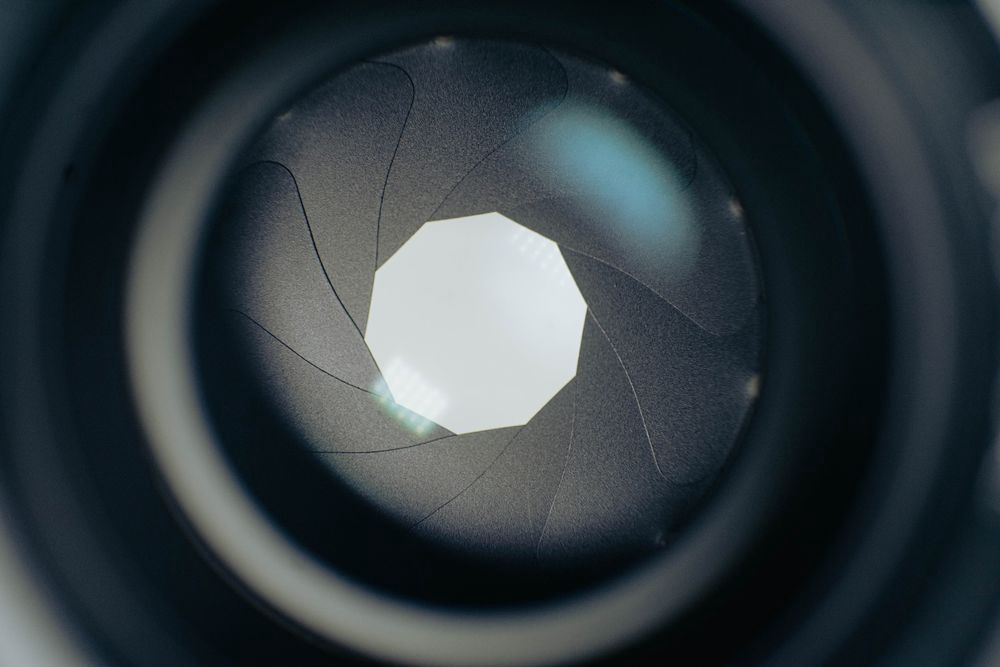
The "f" in f/2.8 stands for the f-number: the focal length divided by the diameter of the opening that lets light into the lens. A small f-number such as f/1.8 means a wide opening, more light and a shallower depth of field. A large one such as f/16 means a narrow opening, less light and a deeper depth of field.[1]
What the f in f/2.8 means
The f-number is a fraction: the diameter of the aperture equals the focal length divided by the f-number. That is why it is written with a slash, as in f/2.8 or f/16, and why a smaller number means a bigger opening.[1] The letter comes from the focal length; Canon says the term f-stop derives from "focal-stop".[1]
Strictly speaking, the standard ISO 517 does not use the physical hole between the blades but the entrance pupil, the image of that opening as seen through the front of the lens. The standard covers the aperture properties that determine the illuminance at the centre of the image.[2]
Because the focal length is part of the fraction, the same f-number means a different opening on lenses of different focal length:
| Focal length | f-number | Diameter of the opening |
|---|---|---|
| 35 mm | f/1.8 | about 19 mm |
| 50 mm | f/1.8 | about 28 mm |
| 50 mm | f/4 | about 12.5 mm |
| 200 mm | f/2.8 | about 71 mm |
| 200 mm | f/4 | 50 mm |
| 600 mm | f/4 | 150 mm |
The values are plain arithmetic from the formula. They show why a long lens with a small f-number needs a very wide opening.
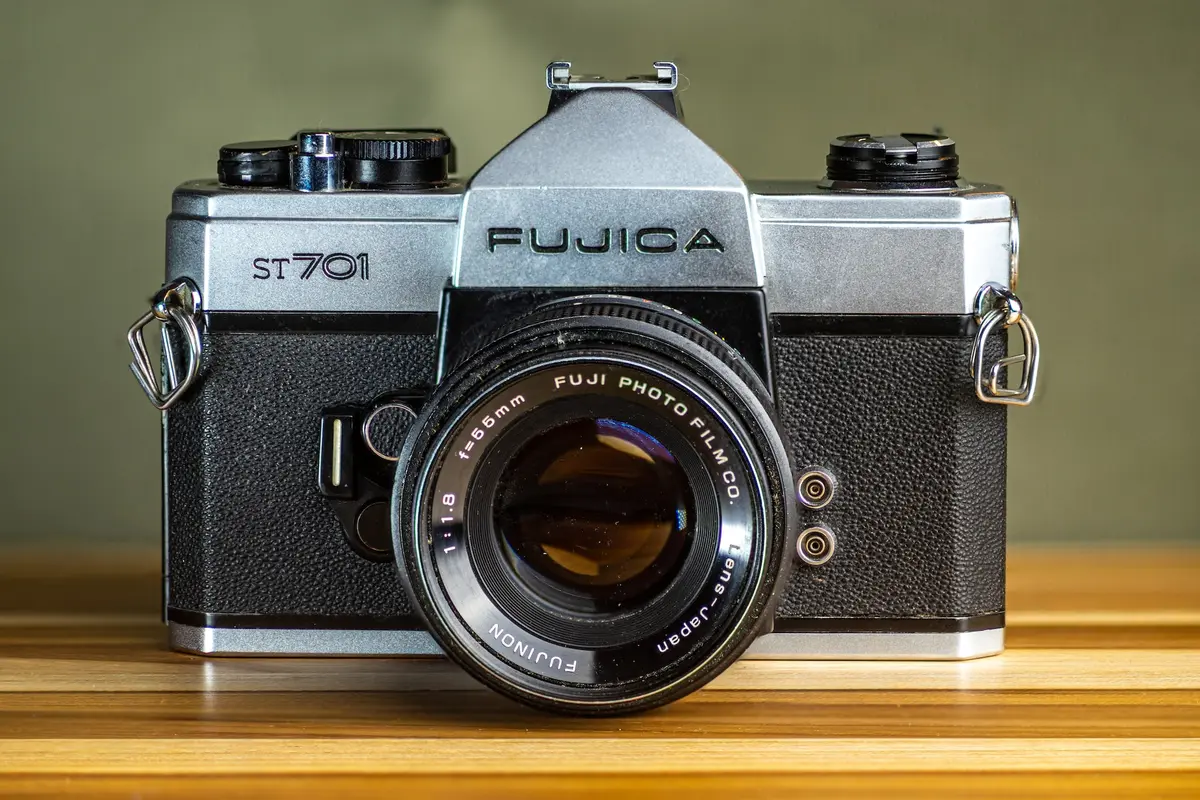
On the lens, the value appears as f/2.8, F2.8 or 1:2.8. ISO 517 designates the relative aperture as 1:2.8 and allows f/2.8 as an alternative.[2]
The f-stop scale: each step halves the light
The standard series of f-numbers is 1, 1.4, 2, 2.8, 4, 5.6, 8, 11, 16, 22 and so on.[2] Each step multiplies the number by about 1.4, the square root of 2, and halves the amount of light that reaches the sensor. One such step is called one stop.[1] The area of the opening grows with the square of its diameter, which is why the numbers are not simply 1, 2, 3, 4.
| f-number | Light compared with f/4 |
|---|---|
| f/1.4 | 8 times |
| f/2 | 4 times |
| f/2.8 | 2 times |
| f/4 | 1 (reference) |
| f/5.6 | half |
| f/8 | a quarter |
| f/11 | an eighth |
| f/16 | a sixteenth |
| f/22 | a thirty-second |
Cameras also offer third-stop steps between the whole stops, for example f/3.2 and f/3.5 between f/2.8 and f/4.[2]
The stops tie directly to the shutter: stopping down from f/2.8 to f/4 halves the light, so the same exposure needs a shutter that stays open twice as long.[3]
What the f-number changes in your photos
Brightness and shutter speed
A lower f-number lets more light through, so a shorter exposure time is enough. A higher f-number needs a longer one. Aperture, shutter speed and ISO work together: if you change one, you have to compensate with the others to keep the exposure.[1]
Depth of field
The lower the f-number, the shallower the depth of field and the blurrier the background. The higher the f-number, the deeper the zone of acceptable sharpness.[4]

Aperture is only one factor. A shorter subject distance also makes the depth of field shallower, and the focal length plays a role as well.[5] In our lens simulator you can set lens, camera, aperture, focal length and distance and see the effect on the blur and the depth of field numbers.
Image quality at the extremes
Very wide apertures can slightly reduce overall sharpness because of lens aberrations, and very small apertures because of diffraction. As a rule of thumb, many lenses work best about two stops down from their widest aperture. How strong the effect is varies from lens to lens.[1]
Fixed and variable maximum aperture on zoom lenses
The widest aperture a lens can reach is the number in its name.[1] A prime such as a 50mm f/1.8 has one value. Many zoom lenses keep the same maximum aperture across the whole zoom range, for example 24-70mm f/2.8: you can open to f/2.8 at 24 mm and at 70 mm.[1]
Other zooms have a variable maximum aperture. A 24-105mm F4-7.1 lens opens to f/4 at 24 mm but only to f/7.1 at 105 mm.[1] On the lens barrel this often appears as f/3.5-5.6 or 1:3.5-5.6. The two numbers are the widest aperture at each end of the zoom range.[6]
With a constant aperture, exposure and depth of field stay comparable when you zoom. Variable-aperture zooms often are more compact, but you may have to adjust the exposure settings as you zoom.[1]
In the lens lists on LensFinder you can sort by aperture, fastest first, for example for Sony E lenses.
Fast lenses and T-stops
A "fast" lens is one with a large maximum aperture. The word has nothing to do with autofocus speed or shutter speed: it describes how much light passes through the lens.[7] A wider maximum aperture allows a shorter exposure time for the same scene.[4]
The f-number describes the size of the opening relative to the focal length, but some light is absorbed or reflected inside the lens. The T-stop (transmission stop) relates to the light that actually reaches the sensor. Two lenses at f/2.8 can transmit slightly different amounts. Photo lenses are marked in f-stops. T-stops are mainly used in cinematography, where consistent exposure across different lenses matters.[1]
Frequently asked questions
What does f/2.8 mean on a lens?
The aperture diameter is the focal length divided by 2.8. On a 50 mm lens that is about 18 mm, on a 200 mm lens about 71 mm. The lens can open this far at most, and it lets in twice as much light as f/4.[1]
Does a higher f-number mean a bigger aperture?
No, it is the other way round. A higher f-number means a smaller opening, less light and a deeper depth of field. f/16 is a much narrower opening than f/2.[1]
What does f/4-5.6 mean on a zoom lens?
The maximum aperture changes with the focal length: f/4 at the wide end and f/5.6 at the long end of the zoom range.[6]
Is a lower f-number always better?
It depends on what you need. A low f-number gives more light and a shallower depth of field. A high one gives more depth of field. Very wide and very small apertures also have optical drawbacks, and the physical opening for a given f-number grows with the focal length.[1]
What is the difference between f-stop and T-stop?
The f-stop is a geometric ratio of opening to focal length. The T-stop also accounts for the light lost inside the lens and is mainly used for film lenses.[1]
Sources
- [1] Canon Europe: Aperture explained. Accessed October 14, 2026.
f-number formula, stop scale, constant/variable aperture, T-stop, sharpness at the extremes
- [2] ISO: ISO 517:2008 Photography, Apertures and related properties pertaining to photographic lenses, Designations and measurements. Accessed October 14, 2026.
Entrance pupil, notation 1:2.8 and f/2.8, standard series, third stops
- [3] Canon Australia: Aperture Definition. Accessed October 14, 2026.
Relation between stops and exposure time
- [4] Nikon: What is aperture in photography? Accessed October 14, 2026.
f-number and depth of field, fast lens
- [5] Canon Europe: Depth of field. Accessed October 14, 2026.
Factors of depth of field: aperture, distance, focal length
- [6] Nikon USA: Understanding Maximum Aperture. Accessed October 14, 2026.
Maximum aperture marking on the lens barrel (1:3.5-5.6)
- [7] ZEISS: Lens speed and aperture – What is a fast lens? Accessed October 14, 2026.
Meaning of fast lens