

Pergear 100mm F2.8 2X Macro
- Focal length
- 100 mm
- Aperture
- f/2.8
- Weight
- 790 g
- Filter diameter
- 67 mm
- Min. focus distance
- 30 cm
- Length
- 157 mm
Overview
The Pergear 100mm F2.8 2X Ultra Macro is a manual focus macro lens for full frame cameras. It is offered for Sony E, Nikon Z, Canon RF, Canon EF and Leica L mount. Its main feature is a maximum magnification of 2:1, which means the subject is reproduced at twice its life size on the sensor. At the same time it works as a short telephoto lens of 100 mm, so Pergear markets it for macro, portrait and food photography.
Optical design
According to Pergear, the lens has 14 elements in 9 groups, including 4 low-dispersion ED elements and 3 high-refractive-index elements. The company says this design is meant to control spherical aberration and distortion. The diaphragm has 13 blades and the aperture range is f/2.8 to f/22. The closest focus distance is 0.3 m. Pergear gives the working distance at 2:1 as about 11 cm.
Focusing and handling
The lens is fully manual: focus and aperture are set on rings, and there are no electronics. Pergear states that focal length and aperture are therefore not written to the image data. The aperture ring is clickless, which Pergear recommends for smooth exposure changes in video. The focus ring turns about 130 degrees, with only about 15 degrees covering the range from 1 m to infinity. This matters for general shooting but not for macro work, where focusing is done close up.
Build and size
The body is all metal, according to Pergear. It is long and slim at roughly 157 mm and about 71 mm in diameter. The lens weighs about 790 g. The filter thread is 67 mm.
Where it fits
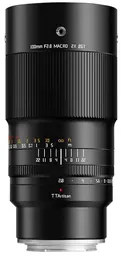
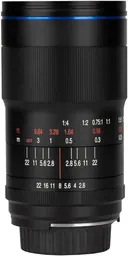
Among manual 2:1 macro lenses, the TTArtisan 100mm f/2.8 Macro 2X and the Venus Laowa 100mm F2.8 2X Ultra Macro APO cover similar ground. Autofocus macro lenses with 1:1 magnification, such as the Canon RF 100mm F2.8L Macro IS USM, offer more convenience but a lower maximum magnification and cost considerably more.
Pros and cons
Pros
- 2:1 maximum magnification
- 13-blade diaphragm and f/2.8 maximum aperture
- Clickless aperture ring for video
- Offered for five mounts including Canon EF and Leica L
- Metal body
Cons
- Manual focus and manual aperture, no electronic data transfer
- Heavy at about 790 g and 157 mm long
- Short focus rotation range for focusing from afar
- No image stabilization
Verdict
The Pergear 100mm F2.8 2X Macro suits macro shooters who want life-size and larger reproduction on a limited budget and accept a fully manual lens. Its length and weight are the price of the 2:1 magnification and the 100 mm focal length.
Technical Specifications
- min focal length
- 100 mm
- max focal length
- 100 mm
- max f (min zoom)
- f/2.8
- max f (max zoom)
- f/2.8
- min. aperture
- f/22
- Elements
- 14
- Groups
- 9
- Weight
- 790 g (1.74 lb)
- Filter diameter
- 67 mm
- min focus distance
- 30 cm (11.81 in)
- Length
- 157 mm (6.18 in)
- Diameter
- 71 mm (2.8 in)
Which cameras does the Pergear 100mm F2.8 2X Macro fit?
The Pergear 100mm F2.8 2X Macro is a full-frame lens for Canon RF cameras. On full-frame bodies it uses the whole sensor; on APS-C Canon RF cameras its field of view equals 160 mm in full-frame terms.
Canon RF cameras
- Full frame:
- Canon EOS R6 V, Canon EOS R6 Mark III, Canon EOS C50, Canon EOS R1, Canon EOS R5 Mark II, Canon EOS C400, Canon EOS C80, Canon EOS R8, Canon EOS R6 Mark II, Canon EOS R5 C, Canon EOS R3, Canon EOS R5, Canon EOS R6, Canon EOS Ra, Canon EOS RP, Canon EOS R
- APS-C:
- Canon EOS R50 V, Canon EOS R100, Canon EOS R50, Canon EOS R7, Canon EOS R10, Canon EOS C70
Pergear 100mm F2.8 2X Macro compared
Key specs side by side with the most similar Canon RF lenses.
| Lens | Pergear 100mm F2.8 2X Macro | Meyer-Optik Gorlitz Trioplan 100mm f/2.8 II | TTArtisan 100mm f/2.8 Macro 2X | Venus Laowa 100mm F2.8 2X Ultra Macro APO |
|---|---|---|---|---|
| Focal length | 100 mm | 100 mm | 100 mm | 100 mm |
| Max. aperture | f/2.8 | f/2.8 | f/2.8 | f/2.8 |
| Weight | 790 g | 390 g | 748 g | 638 g |
| Filter diameter | 67 mm | 52 mm | 67 mm | 67 mm |
| Min. focus distance | 30 cm | 90 cm | 25 cm | 25 cm |
| Length | 157 mm | 115 mm | 150 mm | 125 mm |
| Autofocus | no | no | no | no |
| Image stabilization | no | no | no | no |
This lens is also available for
Pergear 100mm F2.8 2X Macro: FAQ
Does the Pergear 100mm F2.8 2X Macro have autofocus?
No, the Pergear 100mm F2.8 2X Macro has no autofocus; you focus it manually.
Does the Pergear 100mm F2.8 2X Macro have image stabilization?
No, the Pergear 100mm F2.8 2X Macro has no stabilization of its own. On cameras with in-body image stabilization (IBIS) the image is still stabilized.
How much does the Pergear 100mm F2.8 2X Macro weigh?
The Pergear 100mm F2.8 2X Macro weighs 790 g. It is 157 mm long with a diameter of 71 mm.
What filter size does the Pergear 100mm F2.8 2X Macro use?
The Pergear 100mm F2.8 2X Macro takes 67 mm screw-in filters.
How close can the Pergear 100mm F2.8 2X Macro focus?
The minimum focus distance of the Pergear 100mm F2.8 2X Macro is 30 cm, measured from the sensor plane.
Is the Pergear 100mm F2.8 2X Macro a full-frame lens?
Yes, the Pergear 100mm F2.8 2X Macro covers full frame. On APS-C cameras its field of view equals 160 mm in full-frame terms.
Similar lenses
-
Meyer-Optik Gorlitz Trioplan 100mm f/2.8 II
100mm · f/2.8
TTArtisan 100mm f/2.8 Macro 2X
100mm · f/2.8
Venus Laowa 100mm F2.8 2X Ultra Macro APO
100mm · f/2.8
-
Venus Laowa 100mm f/2.8 Tilt-Shift 1x Macro
100mm · f/2.8

Canon RF 100mm F2.8L Macro IS USM
100mm · f/2.8
Venus Laowa 90mm f/2.8 2x Ultra Macro APO
90mm · f/2.8
AstrHori 85mm f/2.8 Macro Tilt
85mm · f/2.8
AstrHori 120mm f/2.8 2X Macro
120mm · f/2.8
Related guides
What does the f mean in camera lenses?
When it comes to photography, understanding the basics of f-stop is essential. F-stop is a critical component of a camera lens that…
How to clean a camera lens
Keeping your camera lenses clean is essential for getting clear, sharp, and high-quality images. Even the smallest speck of dust, dirt, or…
All camera lens types explained: Uses and functions
In this article, we'll explore the various types of camera lenses, their defining features, and when to use them. We'll also cover the…