

Thypoch Simera 35mm F1.4
- Focal length
- 35 mm
- Aperture
- f/1.4
- Weight
- 310 g
- Filter diameter
- 49 mm
- Min. focus distance
- 45 cm
- Length
- 62.8 mm
Overview
The Thypoch Simera 35mm F1.4 is a manual-focus full-frame prime for Leica M, Nikon Z, Canon RF and Sony E mount. It gives the classic 35mm field of view with an F1.4 aperture and belongs to Thypoch's Simera series. Thypoch describes it as a modern take on a classic close-focusing 35mm, aimed at street, documentary and portrait work.
Optical design
The construction has 9 elements in 5 groups, with 3 high-refractive-index elements and 1 aspherical element, according to Thypoch. The company says the aspherical element and the floating element design reduce field curvature and spherical aberration and keep sharpness consistent through the focusing range. The aperture has 14 blades and goes down to F16. The minimum focusing distance is 0.45 m, the image circle is 43.2 mm for full frame, and the angle of view is 64 degrees diagonally, 55 degrees horizontally and 38 degrees vertically.
Focusing and handling
Focusing is manual. The aperture ring has sun and moon symbols to switch between clicked and declicked operation. The focus ring has a tactile resistance point at 0.7 m, which warns users of a rangefinder camera that the coupling ends and they should switch to the viewfinder for closer distances. A red-dot depth-of-field scale in the style of 1950s lenses is part of the barrel. The Leica M version offers an infinity-lock tab or a crescent-shaped tab.
Build and size
The body is aluminum alloy with a 54 mm front diameter and a 49 mm filter thread. The weights listed are about 272 g for Leica M, 296 g for Sony E, 309 g for Nikon Z and 310 g for Canon RF. Lengths without hood are about 50.8 mm for M, 64.6 mm for E, 66.4 mm for Z and 62.8 mm for RF.
Where it fits
In the Leica M segment of the database, the closest comparisons are the Leica Summilux-M 35mm f/1.4 ASPH at 320 g with a 70 cm minimum distance, and the Voigtländer 35mm F1.2 Nokton VM III at 332 g and 50 cm. On the M mount, the Simera is lighter than both at 272 g. On mirrorless mounts, autofocus options such as the Nikkor Z 35mm F1.4 (415 g) or the Sony FE 35mm F1.8 (280 g) are more convenient.
Pros and cons
Pros
- F1.4 at 272 g on Leica M
- 0.45 m close focus, closer than the 0.7 m of the Summilux-M 35mm
- Click and declick aperture ring
- Four mounts available
Cons
- Manual focus only
- Heavier on mirrorless mounts than on M
- No weather sealing stated
Verdict
The Simera 35mm F1.4 combines a bright 35mm, short focusing distance and compact M-mount size with classic styling. It fits users who value that handling over autofocus.
Technical Specifications
- min focal length
- 35 mm
- max focal length
- 35 mm
- max f (min zoom)
- f/1.4
- max f (max zoom)
- f/1.4
- min. aperture
- f/16
- Elements
- 9
- Groups
- 5
- Weight
- 310 g (0.68 lb)
- Filter diameter
- 49 mm
- min focus distance
- 45 cm (17.72 in)
- Length
- 62.8 mm (2.47 in)
- Diameter
- 54 mm (2.13 in)
Which cameras does the Thypoch Simera 35mm F1.4 fit?
The Thypoch Simera 35mm F1.4 is a full-frame lens for Canon RF cameras. On full-frame bodies it uses the whole sensor; on APS-C Canon RF cameras its field of view equals 56 mm in full-frame terms.
Canon RF cameras
- Full frame:
- Canon EOS R6 V, Canon EOS R6 Mark III, Canon EOS C50, Canon EOS R1, Canon EOS R5 Mark II, Canon EOS C400, Canon EOS C80, Canon EOS R8, Canon EOS R6 Mark II, Canon EOS R5 C, Canon EOS R3, Canon EOS R5, Canon EOS R6, Canon EOS Ra, Canon EOS RP, Canon EOS R
- APS-C:
- Canon EOS R50 V, Canon EOS R100, Canon EOS R50, Canon EOS R7, Canon EOS R10, Canon EOS C70
Thypoch Simera 35mm F1.4 compared
Key specs side by side with the most similar Canon RF lenses.
| Lens | Thypoch Simera 35mm F1.4 | 7artisans Photoelectric 35mm f/1.4 Mark III | Venus Laowa Argus 35mm F0.95 FF | Canon RF 35mm F1.4 L VCM |
|---|---|---|---|---|
| Focal length | 35 mm | 35 mm | 35 mm | 35 mm |
| Max. aperture | f/1.4 | f/1.4 | f/1 | f/1.4 |
| Weight | 310 g | 274 g | 755 g | 555 g |
| Filter diameter | 49 mm | 52 mm | 72 mm | 67 mm |
| Min. focus distance | 45 cm | 33 cm | 50 cm | 28 cm |
| Length | 62.8 mm | 50 mm | 103 mm | 99 mm |
| Autofocus | no | no | no | yes |
| Image stabilization | no | no | no | no |
This lens is also available for
Thypoch Simera 35mm F1.4: FAQ
Does the Thypoch Simera 35mm F1.4 have autofocus?
No, the Thypoch Simera 35mm F1.4 has no autofocus; you focus it manually.
Does the Thypoch Simera 35mm F1.4 have image stabilization?
No, the Thypoch Simera 35mm F1.4 has no stabilization of its own. On cameras with in-body image stabilization (IBIS) the image is still stabilized.
How much does the Thypoch Simera 35mm F1.4 weigh?
The Thypoch Simera 35mm F1.4 weighs 310 g. It is 62.8 mm long with a diameter of 54 mm.
What filter size does the Thypoch Simera 35mm F1.4 use?
The Thypoch Simera 35mm F1.4 takes 49 mm screw-in filters.
How close can the Thypoch Simera 35mm F1.4 focus?
The minimum focus distance of the Thypoch Simera 35mm F1.4 is 45 cm, measured from the sensor plane.
Is the Thypoch Simera 35mm F1.4 a full-frame lens?
Yes, the Thypoch Simera 35mm F1.4 covers full frame. On APS-C cameras its field of view equals 56 mm in full-frame terms.
Similar lenses
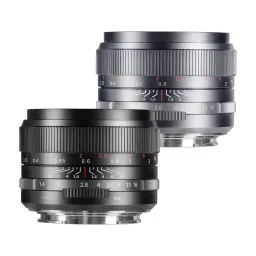
7artisans Photoelectric 35mm f/1.4 Mark III
35mm · f/1.4
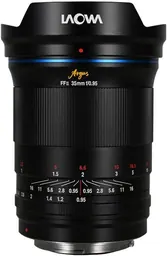
Venus Laowa Argus 35mm F0.95 FF
35mm · f/0.95
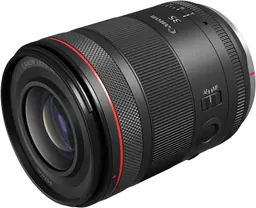
Canon RF 35mm F1.4 L VCM
35mm · f/1.4
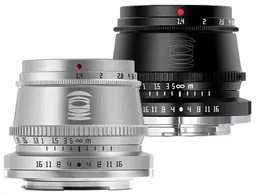
TTArtisan 35mm f/1.4
35mm · f/1.4
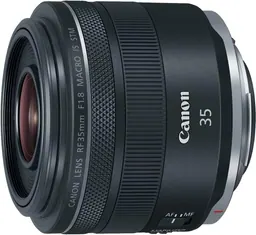
Canon RF 35mm F1.8 IS STM Macro
35mm · f/1.8
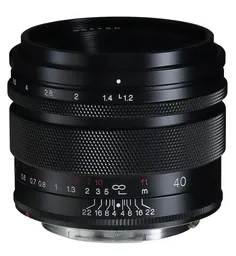
Voigtlander 40mm F1.2 Nokton
40mm · f/1.2

Meyer-Optik Gorlitz Trioplan 35mm f/2.8 II
35mm · f/2.8

Thypoch Simera 28mm F1.4
28mm · f/1.4
Related guides
What does the f mean in camera lenses?
When it comes to photography, understanding the basics of f-stop is essential. F-stop is a critical component of a camera lens that…
How to clean a camera lens
Keeping your camera lenses clean is essential for getting clear, sharp, and high-quality images. Even the smallest speck of dust, dirt, or…
All camera lens types explained: Uses and functions
In this article, we'll explore the various types of camera lenses, their defining features, and when to use them. We'll also cover the…