

Zeiss Otus ML 50mm F1.4
- Focal length
- 50 mm
- Aperture
- f/1.4
- Weight
- 697 g
- Filter diameter
- 67 mm
- Min. focus distance
- 50 cm
- Length
- 100 mm
Overview
The ZEISS Otus ML 1.4/50 is a manual focus standard prime for full frame mirrorless cameras with Sony E, Canon RF or Nikon Z mount. ZEISS unveiled it on 25 February 2025 together with the 1.4/85 as the start of the Otus ML family, which continues the Otus line for mirrorless systems. ZEISS describes it as a lens for versatile photography and for photographers who want the highest optical performance and precise mechanics.
Optical design
The lens has 14 elements in 11 groups. ZEISS lists a Distagon design with an aspherical surface and a lens made of special glass with anomalous partial dispersion. The press release describes an apochromatic design that minimizes chromatic aberration, and an aspherical design that contributes to virtually distortion-free images. The T* coating reduces reflections and flare. The aperture runs from f/1.4 to f/16 with ten blades. The minimum focus distance is 50 cm at an image ratio of 1:7.3, and the diagonal angle of view is 47 degrees.
Focusing and handling
There is no autofocus and no image stabilization. The metal focus ring uses a precision helicoid drive and turns through 259.5 degrees. The aperture is set manually with a ring that can be de-clicked for video. ZEISS marks the scales clearly in yellow, so settings can be read quickly.
Build and size
The all-metal lens weighs 677 g in E-mount, 697 g in RF-mount and 718 g in Z-mount. Length without caps is 100 mm for E and RF and 102 mm for Z. The maximum diameter is 77 mm and the filter thread is M67 x 0.75. ZEISS calls the design compact and portable for the mirrorless mounts.
Where it fits
The DSLR Otus 55mm F1.4 in our database weighs 970 g and is 141 mm long, so the ML version is roughly 250 to 290 g lighter. Autofocus rivals for E-mount are the Sony FE 50mm F1.4 GM at 516 g and the Sigma 50mm F1.4 DG DN Art at 670 g. The Voigtländer Nokton 50mm f/1 is a fast manual option at 590 g for Sony E. On Canon RF and Nikon Z, the Canon RF 50mm F1.2L USM weighs 950 g and the Nikkor Z 50mm F1.2 S 1090 g.
Pros and cons
Pros
- Fast F1.4 with a normal field of view
- All-metal build with a precise helicoid focus ring
- De-clickable aperture ring for video
- Lighter than the DSLR Otus 55mm by a large margin
- Available for E, RF and Z
Cons
- Manual focus only
- No image stabilization
- Heavier than the Sony FE 50mm F1.4 GM
- Minimum focus of 50 cm
Verdict
The Otus ML 1.4/50 is a precise manual standard lens built for photographers who value mechanics and a deliberate way of shooting. Autofocus 50 mm lenses are lighter and faster in use, but do not offer the same focusing feel.
Technical Specifications
- min focal length
- 50 mm
- max focal length
- 50 mm
- max f (min zoom)
- f/1.4
- max f (max zoom)
- f/1.4
- min. aperture
- f/16
- Elements
- 14
- Groups
- 11
- Weight
- 697 g (1.54 lb)
- Filter diameter
- 67 mm
- min focus distance
- 50 cm (19.69 in)
- Length
- 100 mm (3.94 in)
- Diameter
- 77 mm (3.03 in)
Which cameras does the Zeiss Otus ML 50mm F1.4 fit?
The Zeiss Otus ML 50mm F1.4 is a full-frame lens for Canon RF cameras. On full-frame bodies it uses the whole sensor; on APS-C Canon RF cameras its field of view equals 80 mm in full-frame terms.
Canon RF cameras
- Full frame:
- Canon EOS R6 V, Canon EOS R6 Mark III, Canon EOS C50, Canon EOS R1, Canon EOS R5 Mark II, Canon EOS C400, Canon EOS C80, Canon EOS R8, Canon EOS R6 Mark II, Canon EOS R5 C, Canon EOS R3, Canon EOS R5, Canon EOS R6, Canon EOS Ra, Canon EOS RP, Canon EOS R
- APS-C:
- Canon EOS R50 V, Canon EOS R100, Canon EOS R50, Canon EOS R7, Canon EOS R10, Canon EOS C70
Zeiss Otus ML 50mm F1.4 compared
Key specs side by side with the most similar Canon RF lenses.
| Lens | Zeiss Otus ML 50mm F1.4 | AstrHori 50mm f/1.4 Tilt | TTArtisan 50mm f/1.4 ASPH | TTArtisan Tilt 50mm f/1.4 |
|---|---|---|---|---|
| Focal length | 50 mm | 50 mm | 50 mm | 50 mm |
| Max. aperture | f/1.4 | f/1.4 | f/1.4 | f/1.4 |
| Weight | 697 g | 320 g | 457 g | 452 g |
| Filter diameter | 67 mm | 52 mm | 49 mm | 62 mm |
| Min. focus distance | 50 cm | 40 cm | 50 cm | 50 cm |
| Length | 100 mm | 70 mm | 69 mm | 68 mm |
| Autofocus | no | no | no | no |
| Image stabilization | no | no | no | no |
This lens is also available for
Zeiss Otus ML 50mm F1.4: FAQ
Does the Zeiss Otus ML 50mm F1.4 have autofocus?
No, the Zeiss Otus ML 50mm F1.4 has no autofocus; you focus it manually.
Does the Zeiss Otus ML 50mm F1.4 have image stabilization?
No, the Zeiss Otus ML 50mm F1.4 has no stabilization of its own. On cameras with in-body image stabilization (IBIS) the image is still stabilized.
How much does the Zeiss Otus ML 50mm F1.4 weigh?
The Zeiss Otus ML 50mm F1.4 weighs 697 g. It is 100 mm long with a diameter of 77 mm.
What filter size does the Zeiss Otus ML 50mm F1.4 use?
The Zeiss Otus ML 50mm F1.4 takes 67 mm screw-in filters.
How close can the Zeiss Otus ML 50mm F1.4 focus?
The minimum focus distance of the Zeiss Otus ML 50mm F1.4 is 50 cm, measured from the sensor plane.
Is the Zeiss Otus ML 50mm F1.4 a full-frame lens?
Yes, the Zeiss Otus ML 50mm F1.4 covers full frame. On APS-C cameras its field of view equals 80 mm in full-frame terms.
Similar lenses
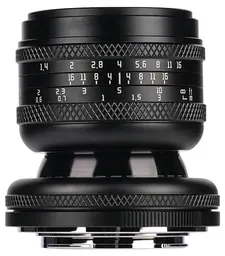
AstrHori 50mm f/1.4 Tilt
50mm · f/1.4
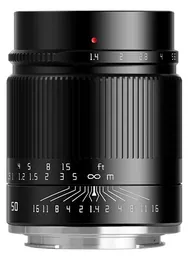
TTArtisan 50mm f/1.4 ASPH
50mm · f/1.4
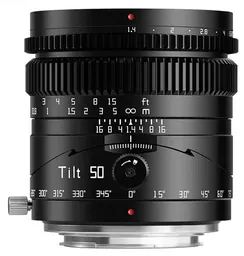
TTArtisan Tilt 50mm f/1.4
50mm · f/1.4

Pergear 50mm F1.4
50mm · f/1.4
-
SG-image MF 50mm F1.8 Shaped Aperture
50mm · f/1.8
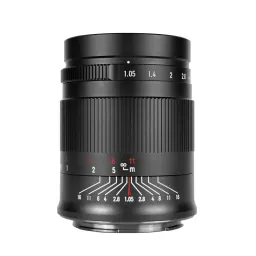
7artisans Photoelectric 50mm f/1.05
50mm · f/1.05
-
Brightin Star MF 50mm F1.05 Full Frame
50mm · f/1.05
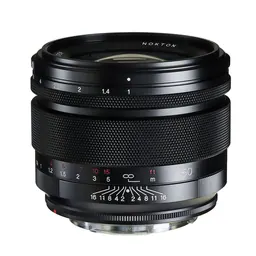
Voigtlander 50mm F1.0 Nokton
50mm · f/1
Related guides
What does the f mean in camera lenses?
When it comes to photography, understanding the basics of f-stop is essential. F-stop is a critical component of a camera lens that…
How to clean a camera lens
Keeping your camera lenses clean is essential for getting clear, sharp, and high-quality images. Even the smallest speck of dust, dirt, or…
All camera lens types explained: Uses and functions
In this article, we'll explore the various types of camera lenses, their defining features, and when to use them. We'll also cover the…