

Artra Lab Nonikkor-Nocty 50mm f/1.2
- Focal length
- 50 mm
- Aperture
- f/1.2
- Weight
- 560 g
- Filter diameter
- 52 mm
- Min. focus distance
- 35 cm
- Length
- 83 mm
Overview
The Artra Lab Nonikkor-Nocty 50mm f/1.2 is a manual focus standard prime with a very fast aperture and a retro-styled metal body. It is aimed at photographers who like the look of fast vintage-style optics on a modern mirrorless camera. According to Artra Lab, it is offered for Nikon Z, Sony E and Fujifilm X and is specified as a full frame lens. The Nikon Z version went up for pre-order in August 2024 after an announcement in late July 2024.
Optical design
Artra Lab lists 8 elements in 6 groups, an 11-blade diaphragm and an angle of view of 46 degrees. The maximum aperture is f/1.2 and the smallest is f/16. The company describes the lens as having a vintage look combined with a low reflective multilayer coating. The 46 degree angle of view corresponds to a normal 50 mm focal length on full frame. On Fujifilm X it acts like a short telephoto, because of the APS-C crop.
Focusing and handling
Focusing is entirely manual, and there are no autofocus motors or electronic contacts mentioned in the specifications. The minimum focus distance is 0.35 m, which is close for a 50 mm f/1.2 and allows tight portraits. The front takes 52 mm filters, which is a modest size for a lens of this speed.
Build and size
The body is aluminium alloy with a brass mount, according to Artra Lab. The lens is 72 mm in diameter and 83 mm long, and it weighs 560 g. That is compact next to autofocus f/1.2 designs, but it is a dense, solid lens for its size.
Where it fits
The Nocty is a character lens rather than a replacement for a native autofocus 50 mm. In this database, the TTArtisan 50mm f/1.2 offers the same focal length and aperture on many of the same mounts. Artra Lab's own Nonikkor-MC 35mm f/1.4 lenses are the maker's wider option in a similar style. Native autofocus 50 mm lenses from the camera makers are the choice when speed of handling matters more than rendering.
Pros and cons
Pros
- Very fast f/1.2 aperture for shallow depth of field and low light
- Close focusing at 0.35 m
- 11 aperture blades
- Metal body with a brass mount
- Available for three mounts
Cons
- Manual focus only
- At 560 g it is heavy for a manual 50 mm
- No weather sealing is mentioned in the specifications
- Smaller maker with limited long-term support information
Verdict
The Nonikkor-Nocty gives users of Nikon Z, Sony E and Fujifilm X a fast, solidly built manual 50 mm with a deliberate vintage styling. It suits portrait and available light work where the photographer is happy to focus by hand and values the look of the lens over automation.
Technical Specifications
- min focal length
- 50 mm
- max focal length
- 50 mm
- max f (min zoom)
- f/1.2
- max f (max zoom)
- f/1.2
- min. aperture
- f/16
- Elements
- 8
- Groups
- 6
- Weight
- 560 g (1.23 lb)
- Filter diameter
- 52 mm
- min focus distance
- 35 cm (13.78 in)
- Length
- 83 mm (3.27 in)
- Diameter
- 72 mm (2.83 in)
Which cameras does the Artra Lab Nonikkor-Nocty 50mm f/1.2 fit?
The Artra Lab Nonikkor-Nocty 50mm f/1.2 fits all Fujifilm X-Mount cameras. There its field of view equals 75 mm in full-frame terms (crop factor 1.5).
Fujifilm X-Mount cameras
- APS-C:
- Fujifilm X-T30 III, Fujifilm X-E5, Fujifilm X-M5, Fujifilm X-T50, Fujifilm X-S20, Fujifilm X-T5, Fujifilm X-H2, Fujifilm X-H2S, Fujifilm X-T30 II, Fujifilm X-E4, Fujifilm X-S10, Fujifilm X-T4, Fujifilm X-T200, Fujifilm X-Pro3, Fujifilm X-A7, Fujifilm X-T30, Fujifilm X-T3, Fujifilm X-T100, Fujifilm X-H1, Fujifilm X-A5, Fujifilm X-E3, Fujifilm X-T20, Fujifilm X-A10, Fujifilm X-A3, Fujifilm X-T2, Fujifilm X-E2S, Fujifilm X-Pro2, Fujifilm X-T10, Fujifilm X-A2, Fujifilm X-T1, Fujifilm X-E2, Fujifilm X-A1, Fujifilm X-M1, Fujifilm X-E1, Fujifilm X-Pro1
Artra Lab Nonikkor-Nocty 50mm f/1.2 compared
Key specs side by side with the most similar Fujifilm X-Mount lenses.
| Lens | Artra Lab Nonikkor-Nocty 50mm f/1.2 | AstrHori 50mm f/1.4 Tilt | TTArtisan Tilt 50mm f/1.4 | SG-image MF 50mm F1.8 Shaped Aperture |
|---|---|---|---|---|
| Focal length | 50 mm | 50 mm | 50 mm | 50 mm |
| Max. aperture | f/1.2 | f/1.4 | f/1.4 | f/1.8 |
| Weight | 560 g | 320 g | 452 g | 311 g |
| Filter diameter | 52 mm | 52 mm | 62 mm | 58 mm |
| Min. focus distance | 35 cm | 40 cm | 50 cm | 50 cm |
| Length | 83 mm | 70 mm | 68 mm | 48 mm |
| Autofocus | no | no | no | no |
| Image stabilization | no | no | no | no |
This lens is also available for
Artra Lab Nonikkor-Nocty 50mm f/1.2: FAQ
Does the Artra Lab Nonikkor-Nocty 50mm f/1.2 have autofocus?
No, the Artra Lab Nonikkor-Nocty 50mm f/1.2 has no autofocus; you focus it manually.
Does the Artra Lab Nonikkor-Nocty 50mm f/1.2 have image stabilization?
No, the Artra Lab Nonikkor-Nocty 50mm f/1.2 has no stabilization of its own. On cameras with in-body image stabilization (IBIS) the image is still stabilized.
How much does the Artra Lab Nonikkor-Nocty 50mm f/1.2 weigh?
The Artra Lab Nonikkor-Nocty 50mm f/1.2 weighs 560 g. It is 83 mm long with a diameter of 72 mm.
What filter size does the Artra Lab Nonikkor-Nocty 50mm f/1.2 use?
The Artra Lab Nonikkor-Nocty 50mm f/1.2 takes 52 mm screw-in filters.
How close can the Artra Lab Nonikkor-Nocty 50mm f/1.2 focus?
The minimum focus distance of the Artra Lab Nonikkor-Nocty 50mm f/1.2 is 35 cm, measured from the sensor plane.
Similar lenses
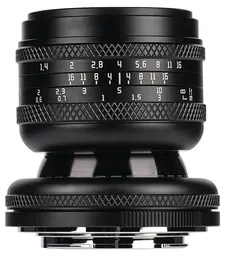
AstrHori 50mm f/1.4 Tilt
50mm · f/1.4
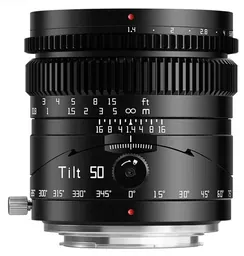
TTArtisan Tilt 50mm f/1.4
50mm · f/1.4

SG-image MF 50mm F1.8 Shaped Aperture
50mm · f/1.8
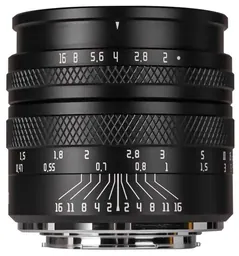
AstrHori 50mm f/2
50mm · f/2
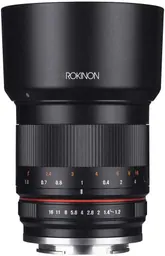
Samyang / Rokinon 50mm F1.2 ED AS UMC CS
50mm · f/1.2
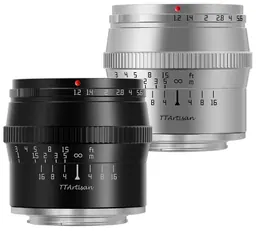
TTArtisan 50mm f/1.2
50mm · f/1.2

7artisans 50mm F1.2
50mm · f/1.2
-
Pergear 50mm F1.2
50mm · f/1.2
Related guides
What does the f mean in camera lenses?
When it comes to photography, understanding the basics of f-stop is essential. F-stop is a critical component of a camera lens that…
How to clean a camera lens
Keeping your camera lenses clean is essential for getting clear, sharp, and high-quality images. Even the smallest speck of dust, dirt, or…
All camera lens types explained: Uses and functions
In this article, we'll explore the various types of camera lenses, their defining features, and when to use them. We'll also cover the…