

Leica L-Mount Autofocus
Sigma 35mm F1.4 DG II Art
- Focal length
- 35 mm
- Aperture
- f/1.4
- Weight
- 530 g
- Filter diameter
- 67 mm
- Min. focus distance
- 28 cm
- Length
- 94 mm
Predecessor: Sigma 35mm F1.4 DG DN Art
Overview
The Sigma 35mm F1.4 DG II Art is a full-frame 35mm prime for Sony E and Leica L-Mount. It follows Sigma's 35mm F1.4 Art line, and Sigma says it was completely redesigned, with a 15-element, 12-group construction. It suits documentary, street, portrait and video work where a bright 35mm in a compact body is wanted.
Optical design
Sigma lists 15 elements in 12 groups with 2 SLD and 4 aspherical elements, plus new glass materials that were previously hard to process. According to Sigma, axial chromatic aberration is suppressed in particular, which also reduces color fringing in out-of-focus areas. The lens carries Sigma's newly developed AAC (Advanced Amorphous Coating), meant to reduce ghosting and flare. The diaphragm has 11 rounded blades, the smallest aperture is F16, the closest focus distance is 28cm and the maximum magnification is 1:5.4.
Autofocus and handling
A dual HLA (High-response Linear Actuator) system drives the large focus group. Sigma says focus breathing is minimized for video. There are two AFL buttons that can be assigned functions on selected cameras, an aperture ring, an aperture ring lock switch and a click switch. The lens has no optical stabilizer. A petal-type hood with a locking mechanism is supplied.
Build and size
Sigma quotes 525g and 96mm for Sony E and 530g and 94mm for L-Mount, with a 73mm diameter and a 67mm filter thread. According to Sigma, the lens is about 14% shorter and 20% lighter than the previous model. The body uses aluminum and TSC polycarbonate, is dust and splash resistant and has a water and oil repellent front coating.
Where it fits
The Sigma 35mm F1.4 DG DN Art is the predecessor. The Sigma 35mm F1.2 DG II Art offers an extra stop of light at a larger size, while the Sigma 35mm F2 DG DN Contemporary is the more compact option with less light. For Sony E, the Sony Distagon T* FE 35mm F1.4 ZA is another F1.4 alternative.
Pros and cons
Pros
- F1.4 aperture at 35mm in a compact body
- Per Sigma, about 14% shorter and 20% lighter than the previous model
- Dual HLA autofocus
- Dust and splash resistant, aperture ring with lock and click switch
- Smaller 67mm filter thread
Cons
- No built-in stabilization
- One stop less light than the F1.2 Art
- 525 to 530g is not light for a 35mm prime
Verdict
The Sigma 35mm F1.4 DG II Art is a good fit for photographers who want an F1.4 35mm with modern autofocus and a body that is smaller than its predecessor. It sits between the compact F2 lenses and the larger F1.2 Art.
Technical Specifications
- min focal length
- 35 mm
- max focal length
- 35 mm
- max f (min zoom)
- f/1.4
- max f (max zoom)
- f/1.4
- min. aperture
- f/16
- Elements
- 15
- Groups
- 12
- Weight
- 530 g (1.17 lb)
- Filter diameter
- 67 mm
- min focus distance
- 28 cm (11.02 in)
- Length
- 94 mm (3.7 in)
- Diameter
- 73 mm (2.87 in)
Which cameras does the Sigma 35mm F1.4 DG II Art fit?
The Sigma 35mm F1.4 DG II Art is a full-frame lens for L-Mount cameras. On full-frame bodies it uses the whole sensor; on APS-C L-Mount cameras its field of view equals 53 mm in full-frame terms.
L-Mount cameras
- Full frame:
- Leica SL3-P, Leica SL3-S, Sigma BF, Panasonic Lumix S1II, Panasonic Lumix S1IIE, Panasonic Lumix S1RII, Leica SL3, Panasonic Lumix S9, Blackmagic PYXIS 6K, Panasonic Lumix S5II, Panasonic Lumix S5IIX, Blackmagic Cinema Camera 6K, Panasonic Lumix BS1H, Leica SL2-S, Panasonic Lumix S5, Sigma fp L, Leica SL2, Panasonic Lumix S1, Panasonic Lumix S1R, Panasonic Lumix S1H, Sigma fp, Leica SL (Typ 601)
- APS-C:
- Leica CL, Leica TL2, Leica TL, Leica T (Typ 701)
Sigma 35mm F1.4 DG II Art compared
Key specs side by side with the most similar L-Mount lenses.
| Lens | Sigma 35mm F1.4 DG II Art | Sigma 35mm F1.4 DG DN Art | Sigma 35mm F1.4 DG HSM Art | Sigma 35mm F1.2 DG DN Art |
|---|---|---|---|---|
| Focal length | 35 mm | 35 mm | 35 mm | 35 mm |
| Max. aperture | f/1.4 | f/1.4 | f/1.4 | f/1.2 |
| Weight | 530 g | 645 g | 755 g | 1,090 g |
| Filter diameter | 67 mm | 67 mm | 67 mm | 82 mm |
| Min. focus distance | 28 cm | 30 cm | 30 cm | 30 cm |
| Length | 94 mm | 110 mm | 118 mm | 136 mm |
| Autofocus | yes | yes | yes | yes |
| Image stabilization | no | no | no | no |
This lens is also available for
Sigma 35mm F1.4 DG II Art: FAQ
Does the Sigma 35mm F1.4 DG II Art have autofocus?
Yes, the Sigma 35mm F1.4 DG II Art has autofocus.
Does the Sigma 35mm F1.4 DG II Art have image stabilization?
No, the Sigma 35mm F1.4 DG II Art has no stabilization of its own. On cameras with in-body image stabilization (IBIS) the image is still stabilized.
How much does the Sigma 35mm F1.4 DG II Art weigh?
The Sigma 35mm F1.4 DG II Art weighs 530 g. It is 94 mm long with a diameter of 73 mm.
What filter size does the Sigma 35mm F1.4 DG II Art use?
The Sigma 35mm F1.4 DG II Art takes 67 mm screw-in filters.
How close can the Sigma 35mm F1.4 DG II Art focus?
The minimum focus distance of the Sigma 35mm F1.4 DG II Art is 28 cm, measured from the sensor plane.
Is the Sigma 35mm F1.4 DG II Art a full-frame lens?
Yes, the Sigma 35mm F1.4 DG II Art covers full frame. On APS-C cameras its field of view equals 53 mm in full-frame terms.
Similar lenses
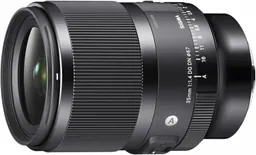
Sigma 35mm F1.4 DG DN Art
35mm · f/1.4
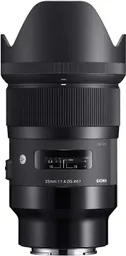
Sigma 35mm F1.4 DG HSM Art
35mm · f/1.4
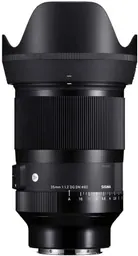
Sigma 35mm F1.2 DG DN Art
35mm · f/1.2

Sigma 35mm F1.2 DG II Art
35mm · f/1.2
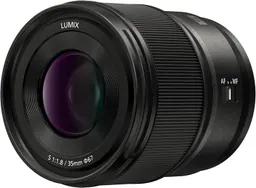
Panasonic Lumix S 35mm F1.8
35mm · f/1.8

7Artisans AF 35mm F1.8
35mm · f/1.8
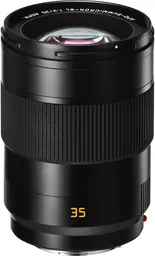
Leica APO-Summicron-SL 35mm F2 ASPH
35mm · f/2
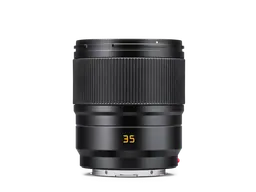
Leica Summicron-SL 35mm f/2 ASPH.
35mm · f/2
Related guides
What does the f mean in camera lenses?
When it comes to photography, understanding the basics of f-stop is essential. F-stop is a critical component of a camera lens that…
How to clean a camera lens
Keeping your camera lenses clean is essential for getting clear, sharp, and high-quality images. Even the smallest speck of dust, dirt, or…
All camera lens types explained: Uses and functions
In this article, we'll explore the various types of camera lenses, their defining features, and when to use them. We'll also cover the…