

Leica Summilux-M 50mm f/1.4 (Classic)
- Focal length
- 50 mm
- Aperture
- f/1.4
- Weight
- 417 g
- Filter diameter
- 46 mm
- Min. focus distance
- 70 cm
- Length
- 45 mm
Overview
The Leica Summilux-M 50mm f/1.4 (Classic) is a fast manual-focus standard lens for Leica M cameras. Leica presented it on 20 February 2025 as the fifth lens of the Leica Classic Line, a series of reinterpretations of historic designs. Its optical calculation is based on the second Summilux-M 50 f/1.4, which was produced almost unchanged from 1962 to 2004. It is a full-frame lens for M-mount rangefinder and mirrorless M bodies, and it is not the same lens as the Summilux-M 50mm f/1.4 ASPH in the database.
Optical design
The lens has 7 elements in 5 groups and no aspherical surface is listed in the data sheet. The maximum aperture is f/1.4, the smallest is f/16, and the diaphragm has 12 blades. According to Leica, the design delivers particularly soft bokeh at wide apertures and, when stopped down, sharper and higher-contrast images than its historical predecessor thanks to modern production techniques and special glass types.
Focusing and handling
Focusing is manual with a combined meter and feet scale. The close focus distance is 0.7 m, which Leica describes as an extension over the historical lens, and the largest scale is 1:12.5. The aperture is set with a click-stop ring with half-stop lock settings, and the lens has a Leica M bayonet with 6-bit encoding. A round click-on vintage hood is included.
Build and size
The lens is made by hand from solid brass. It weighs approximately 417 g, is about 45 mm long (71 mm with the hood) and about 58 mm wide, and takes E46 filters. The listed variant (order number 11714) has a silver chrome finish.
Where it fits
The Classic version sits beside the modern Leica Summilux-M 50mm f/1.4 ASPH and its 2023 edition, which are different optical designs with 8 elements. Other fast Leica M options in the database include the Noctilux-M 50mm f/0.95 ASPH and the APO-Summicron-M 50mm f/2 ASPH for users who want the highest correction at a slower aperture. For a more compact standard lens, the Summicron-M 50mm f/2 is an alternative.
Pros and cons
Pros
- Classic rendering from the historic Summilux design, according to Leica
- Close focus down to 0.7 m
- 12-blade diaphragm
- Compact, 417 g solid brass construction
- Includes a vintage-style round hood
Cons
- Manual focus only
- No weather sealing listed
- Heavier than the Summilux-M 50mm f/1.4 ASPH of the previous generation (335 g in the database)
- Limited to the M mount
Verdict
The Summilux-M 50mm f/1.4 (Classic) is aimed at M photographers who prefer the look of the older design with a close focus range that suits modern M cameras. It is a lens for character rather than outright correction, and the ASPH version or the APO-Summicron remain the options for maximum optical performance.
Technical Specifications
- min focal length
- 50 mm
- max focal length
- 50 mm
- max f (min zoom)
- f/1.4
- max f (max zoom)
- f/1.4
- min. aperture
- f/16
- Elements
- 7
- Groups
- 5
- Weight
- 417 g (0.92 lb)
- Filter diameter
- 46 mm
- min focus distance
- 70 cm (27.56 in)
- Length
- 45 mm (1.77 in)
- Diameter
- 58 mm (2.28 in)
Which cameras does the Leica Summilux-M 50mm f/1.4 (Classic) fit?
The Leica Summilux-M 50mm f/1.4 (Classic) fits all Leica M-Mount cameras and covers the full 35 mm format.
Leica M-Mount cameras
- Full frame:
- Leica M EV1, Leica M11-D, Leica M11-P, Leica M11 Monochrom, Leica M11, Leica M10-R, Leica M10 Monochrom, Leica M-E (Typ 240), Leica M10-P, Leica M10-D, Leica M10, Leica M-D (Typ 262), Leica M (Typ 262), Leica M Monochrom (Typ 246), Leica M-P (Typ 240), Leica M (Typ 240), Leica M-E (Typ 220), Leica M Monochrom (Typ 230), Leica M9-P, Leica M9
With the Leica M-Adapter L the lens can also be used on Leica L-Mount cameras.
Leica Summilux-M 50mm f/1.4 (Classic) compared
Key specs side by side with the most similar Leica M-Mount lenses.
| Lens | Leica Summilux-M 50mm f/1.4 (Classic) | Leica Summilux-M 50mm F/1.4 ASPH (2023) | Leica Summilux-M 50mm f/1.4 ASPH | TTArtisan 50mm f/1.4 ASPH |
|---|---|---|---|---|
| Focal length | 50 mm | 50 mm | 50 mm | 50 mm |
| Max. aperture | f/1.4 | f/1.4 | f/1.4 | f/1.4 |
| Weight | 417 g | 337 g | 335 g | 457 g |
| Filter diameter | 46 mm | 46 mm | 46 mm | 49 mm |
| Min. focus distance | 70 cm | 45 cm | 70 cm | 50 cm |
| Length | 45 mm | 59 mm | 53 mm | 69 mm |
| Autofocus | no | no | no | no |
| Image stabilization | no | no | no | no |
Leica Summilux-M 50mm f/1.4 (Classic): FAQ
Does the Leica Summilux-M 50mm f/1.4 (Classic) have autofocus?
No, the Leica Summilux-M 50mm f/1.4 (Classic) has no autofocus; you focus it manually.
Does the Leica Summilux-M 50mm f/1.4 (Classic) have image stabilization?
No, the Leica Summilux-M 50mm f/1.4 (Classic) has no stabilization of its own. On cameras with in-body image stabilization (IBIS) the image is still stabilized.
How much does the Leica Summilux-M 50mm f/1.4 (Classic) weigh?
The Leica Summilux-M 50mm f/1.4 (Classic) weighs 417 g. It is 45 mm long with a diameter of 58 mm.
What filter size does the Leica Summilux-M 50mm f/1.4 (Classic) use?
The Leica Summilux-M 50mm f/1.4 (Classic) takes 46 mm screw-in filters.
How close can the Leica Summilux-M 50mm f/1.4 (Classic) focus?
The minimum focus distance of the Leica Summilux-M 50mm f/1.4 (Classic) is 70 cm, measured from the sensor plane.
Similar lenses
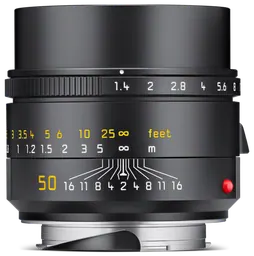
Leica Summilux-M 50mm F/1.4 ASPH (2023)
50mm · f/1.4
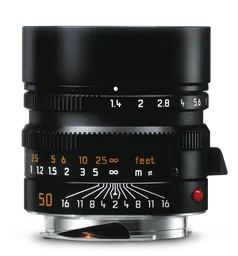
Leica Summilux-M 50mm f/1.4 ASPH
50mm · f/1.4
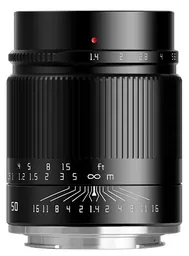
TTArtisan 50mm f/1.4 ASPH
50mm · f/1.4

Thypoch Simera 50mm F1.4
50mm · f/1.4

Mandler 50mm F1.4 E46 Pre-A
50mm · f/1.4
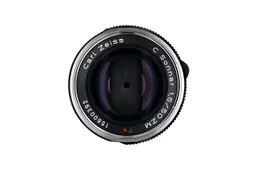
Carl Zeiss C Sonnar T* 1,5/50 ZM
50mm · f/1.5
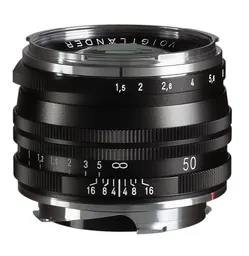
Voigtlander 50mm F1.5 Nokton VM II
50mm · f/1.5
-
Light Lens Lab 50mm F1.5 Z21
50mm · f/1.5
Related guides
What does the f mean in camera lenses?
When it comes to photography, understanding the basics of f-stop is essential. F-stop is a critical component of a camera lens that…
How to clean a camera lens
Keeping your camera lenses clean is essential for getting clear, sharp, and high-quality images. Even the smallest speck of dust, dirt, or…
All camera lens types explained: Uses and functions
In this article, we'll explore the various types of camera lenses, their defining features, and when to use them. We'll also cover the…