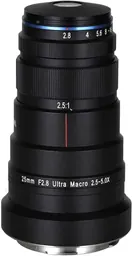
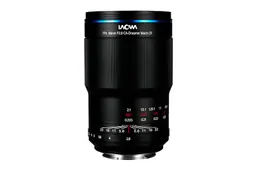
Venus Laowa 25mm F2.8 2.5-5X Ultra Macro
- Focal length
- 25 mm
- Aperture
- f/2.8
- Weight
- 400 g
- Filter diameter
- –
- Diameter
- 82 mm
- min. focus dist.
- 17 cm

240 results




When it comes to photography, understanding the basics of f-stop is essential. F-stop is a critical component of a camera lens that…
Keeping your camera lenses clean is essential for getting clear, sharp, and high-quality images. Even the smallest speck of dust, dirt, or…
In this article, we'll explore the various types of camera lenses, their defining features, and when to use them. We'll also cover the…
The Leica L-Mount is a modern, versatile lens mount system developed by Leica and now shared by the L-Mount Alliance, which includes Leica, Panasonic, and Sigma. Introduced in 2014 by Leica, the L-Mount was designed for high-performance mirrorless cameras, offering a blend of durability, adaptability, and cutting-edge optical technology.
The L-Mount’s defining feature is its shared ecosystem. Thanks to the L-Mount Alliance, lenses and cameras from Leica, Panasonic, and Sigma are cross-compatible, giving photographers access to a wide range of high-quality lenses without being locked into a single brand.
With a short flange distance of 20mm and a large diameter of 51.6mm, the L-Mount strikes a balance between compactness and flexibility. It supports both full-frame and APS-C sensors, making it a versatile choice for a variety of photography needs.
The L-Mount is built for durability, featuring:
The wide mount diameter allows lens designers to create fast, sharp lenses with minimal optical compromise, enabling photographers to achieve exceptional image quality.
The L-Mount is used across both full-frame and APS-C mirrorless cameras:
One of the biggest strengths of the L-Mount is the diverse lens selection. Photographers can choose from:
With options ranging from ultra-wide to super-telephoto and everything in between, the L-Mount system caters to all types of photography, from landscapes to portraits, wildlife, and video production.
While the L-Mount is a robust and versatile system, it has a few limitations:
The L-Mount is ideal for:
Whether you’re drawn to Leica’s craftsmanship, Panasonic’s video expertise, or Sigma’s value-packed lenses, the L-Mount system is a strong contender for anyone seeking top-tier performance and flexibility.
Leica introduced the L-Mount in 2014 with the Leica T and founded the L-Mount Alliance with Panasonic and Sigma in 2018. Members now also include Samyang, Blackmagic Design, DJI, Viltrox, Sirui, Astrodesign and Ernst Leitz Wetzlar. That is why L-Mount cameras and lenses come from several manufacturers.
Yes. Cameras and lenses from the L-Mount Alliance share one mount specification, so lenses from Leica, Panasonic and Sigma fit each other's cameras. The alliance was formed in 2018 to create a system of fully compatible cameras and lenses.
Yes, the APS-C version (TL) and the full-frame version (SL) are mechanically and electronically compatible. With a TL lens, a full-frame camera uses a crop mode from the center of the sensor. An SL lens on an APS-C camera works normally and gives a 1.5x crop factor.
Yes. Leica offers adapters for its M, R and S lenses (M-Adapter L, R-Adapter L, S-Adapter L), and Sigma's MC-21 adapts lenses with a Canon EF or Sigma SA mount. Sigma's own Global Vision EF lenses are fully supported, while other EF lenses are not guaranteed. Third-party adapters exist as well, for example the Viltrox EF-L.
They are two different, incompatible mounts. The L-Mount has a 20 mm flange distance and a 51.6 mm inner diameter and is used by Leica, Panasonic, Sigma and other alliance members. Sony's E-mount has an 18 mm flange distance and is open to many lens makers under license. Lenses cannot be swapped directly from one mount to the other.