

Sony E Autofocus
Kase AF 85mm F1.4
- Focal length
- 85 mm
- Aperture
- f/1.4
- Weight
- 580 g
- Filter diameter
- 72 mm
- Min. focus distance
- 70 cm
- Length
- 99 mm
Overview
The Kase AF 85mm F1.4 is a full frame autofocus portrait prime and the first autofocus lens from the filter maker Kase. It is offered for Sony E, Nikon Z, Fujifilm X and Leica L. Its main distinguishing feature is a magnetic filter ring built into the front of the lens, which takes Kase's Revolution and Revolution Plus magnetic filters without a separate adapter ring. Kase positions it for portraits, low-light work and video.
Optical design
Kase specifies 13 elements in 10 groups, including 5 low-dispersion elements and 2 high-refractive-index elements. The diaphragm has 13 blades, and the aperture range is f/1.4 to f/16. The closest focus distance is 0.7 m. The lens covers the full frame format. There is no image stabilization in the lens, so stabilized camera bodies are needed to compensate for shake.
Autofocus and handling
Autofocus is driven by an STM motor, with an AF/MF switch for manual focusing. The lens has two customizable function buttons: according to Kase, the second one is set to jump to the minimum focus distance with a short press and to lock the current focus distance with a long press. An aperture ring with click stops is combined with a click/declick switch, and an A position sets f/1.4. A USB-C port at the bottom allows firmware updates. Kase notes that the Sony E version comes with a clip-in Magic Filter (ND).
Build and size
The body combines aluminium alloy, polycarbonate and optical glass. Kase gives a weight of 580 g, 610 g with the hood, at 82 mm diameter and 99 mm length. The filter thread is 72 mm and comes with an inlaid adapter for the magnetic filters. A magnetic lens cap is included, and Kase specifies an operating temperature range of -40 to 60 degrees Celsius.
Where it fits
In the 85 mm f/1.4 class for these systems, the Viltrox AF 85mm F1.4 Pro (Sony E and Nikon Z), the Sirui Aurora 85mm F1.4 and the Samyang / Rokinon AF 85mm F1.4 FE are direct competitors, and the Sony FE 85mm F1.4 GM II sits at the top of the class. The Kase differs mainly through its integrated magnetic filter system.
Pros and cons
Pros
- Integrated magnetic filter ring
- 13-blade diaphragm and f/1.4 maximum aperture
- Two function buttons and a click/declick switch
- USB-C firmware updates
- Four mounts
Cons
- No image stabilization
- STM motor rather than a linear or voice coil motor
- 580 g, rather heavy for an APS-C body
- Minimum focus distance of 0.7 m
Verdict
The Kase AF 85mm F1.4 is a full frame portrait lens for photographers who use filters heavily and like the idea of a magnetic filter ring on the lens itself. Optically it follows the usual recipe of this class, so its appeal lies mostly in the handling features.
Technical Specifications
- min focal length
- 85 mm
- max focal length
- 85 mm
- max f (min zoom)
- f/1.4
- max f (max zoom)
- f/1.4
- min. aperture
- f/16
- Elements
- 13
- Groups
- 10
- Weight
- 580 g (1.28 lb)
- Filter diameter
- 72 mm
- min focus distance
- 70 cm (27.56 in)
- Length
- 99 mm (3.9 in)
- Diameter
- 82 mm (3.23 in)
Which cameras does the Kase AF 85mm F1.4 fit?
The Kase AF 85mm F1.4 is a full-frame lens for Sony E-Mount cameras. On full-frame bodies it uses the whole sensor; on APS-C Sony E-Mount cameras its field of view equals 128 mm in full-frame terms.
Sony E-Mount cameras
- Full frame:
- Sony A7R VI, Sony A7 V, Sony FX2, Sony A1 II, Sony A9 III, Sony A7C II, Sony A7CR, Sony ZV-E1, Sony A7R V, Sony A7 IV, Sony A1, Sony FX3, Sony A7S III, Sony A7C, Sony FX6, Sony A7R IV, Sony A9 II, Sony FX9, Sony A7 III, Sony A7R III, Sony A9, Sony A7R II, Sony A7S II, Sony A7 II, Sony A7S, Sony A7, Sony A7R
- APS-C:
- Sony ZV-E10 II, Sony A6700, Sony FX30, Sony ZV-E10, Sony A6600, Sony A6100, Sony A6400, Sony A6500, Sony A6300, Sony A6000, Sony A5100, Sony A5000, Sony A3000, Sony NEX-5T, Sony NEX-3N, Sony NEX-6, Sony NEX-5R, Sony NEX-F3
Kase AF 85mm F1.4 compared
Key specs side by side with the most similar Sony E-Mount lenses.
| Lens | Kase AF 85mm F1.4 | Samyang / Rokinon AF 85mm F1.4 FE | Sigma 85mm F1.4 DG HSM Art | Sirui Aurora 85mm F1.4 |
|---|---|---|---|---|
| Focal length | 85 mm | 85 mm | 85 mm | 85 mm |
| Max. aperture | f/1.4 | f/1.4 | f/1.4 | f/1.4 |
| Weight | 580 g | 568 g | 1,245 g | 540 g |
| Filter diameter | 72 mm | 77 mm | 86 mm | 67 mm |
| Min. focus distance | 70 cm | 90 cm | 85 cm | 85 cm |
| Length | 99 mm | 100 mm | 126 mm | 102 mm |
| Autofocus | yes | yes | yes | yes |
| Image stabilization | no | no | no | no |
This lens is also available for
Kase AF 85mm F1.4: FAQ
Does the Kase AF 85mm F1.4 have autofocus?
Yes, the Kase AF 85mm F1.4 has autofocus.
Does the Kase AF 85mm F1.4 have image stabilization?
No, the Kase AF 85mm F1.4 has no stabilization of its own. On cameras with in-body image stabilization (IBIS) the image is still stabilized.
How much does the Kase AF 85mm F1.4 weigh?
The Kase AF 85mm F1.4 weighs 580 g. It is 99 mm long with a diameter of 82 mm.
What filter size does the Kase AF 85mm F1.4 use?
The Kase AF 85mm F1.4 takes 72 mm screw-in filters.
How close can the Kase AF 85mm F1.4 focus?
The minimum focus distance of the Kase AF 85mm F1.4 is 70 cm, measured from the sensor plane.
Is the Kase AF 85mm F1.4 a full-frame lens?
Yes, the Kase AF 85mm F1.4 covers full frame. On APS-C cameras its field of view equals 128 mm in full-frame terms.
Similar lenses
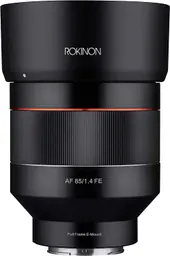
Samyang / Rokinon AF 85mm F1.4 FE
85mm · f/1.4
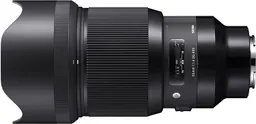
Sigma 85mm F1.4 DG HSM Art
85mm · f/1.4
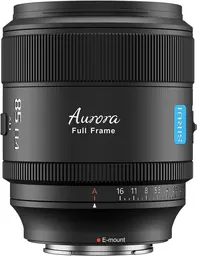
Sirui Aurora 85mm F1.4
85mm · f/1.4
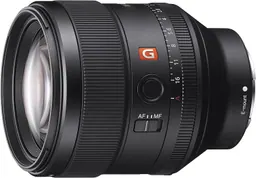
Sony FE 85mm F1.4 GM
85mm · f/1.4
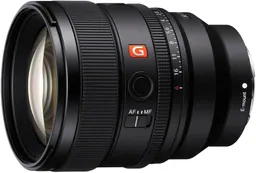
Sony FE 85mm F1.4 GM II
85mm · f/1.4

Viltrox AF 85mm F1.4 Pro
85mm · f/1.4

SongRaw AF 85mm F1.2 MS
85mm · f/1.2

Sigma 85mm F1.2 DG Art
85mm · f/1.2
Related guides
What does the f mean in camera lenses?
When it comes to photography, understanding the basics of f-stop is essential. F-stop is a critical component of a camera lens that…
How to clean a camera lens
Keeping your camera lenses clean is essential for getting clear, sharp, and high-quality images. Even the smallest speck of dust, dirt, or…
All camera lens types explained: Uses and functions
In this article, we'll explore the various types of camera lenses, their defining features, and when to use them. We'll also cover the…