
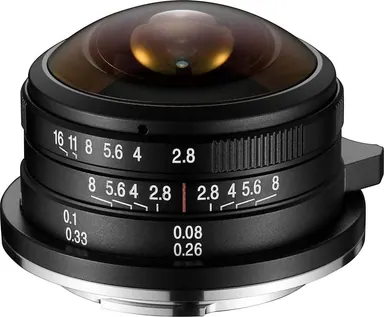
Venus Laowa 4mm F2.8 Fisheye
- Focal length
- 4 mm
- Aperture
- f/2.8
- Weight
- 135 g
- Filter diameter
- –
- Min. focus distance
- 8 cm
- Length
- 25.5 mm
At a Glance
This 4 mm fisheye is made for APS-C cameras on Sony E-mount and gives the field of view of a 6 mm lens on full frame. By design it shows a very wide view with curved lines. It opens to f/2.8 and weighs a compact 135 g. Focusing is manual, and it focuses as close as 8 cm. It suits creative, action and travel photography.
Good for
- Creative
- Action
- Travel
Worth knowing
- APS-C image circle: on full-frame cameras only usable in crop mode, at reduced resolution.
- Fisheye projection: straight lines away from the center are rendered curved.
Derived from the manufacturer data, not from our own tests. How we check
Technical Specifications
- Min. focal length
- 4 mm
- Max. focal length
- 4 mm
- Max. aperture (min. zoom)
- f/2.8
- Max. aperture (max. zoom)
- f/2.8
- Min. aperture
- f/16
- Elements
- 7
- Groups
- 6
- Weight
- 135 g (0.3 lb)
- Filter diameter
- –
- Min. focus distance
- 8 cm (3.15 in)
- Max. magnification
- 1:9.1 (0.11×)
- Length
- 25.5 mm (1 in)
- Diameter
- 45.2 mm (1.78 in)
Manufacturer data: venuslens.net
Last checked: October 13, 2026 (against the manufacturer data) · How we check
Which cameras does the Venus Laowa 4mm F2.8 Fisheye fit?
The Venus Laowa 4mm F2.8 Fisheye is designed for APS-C sensors. On APS-C Sony E-Mount cameras its field of view equals 6 mm in full-frame terms. Full-frame bodies use it in APS-C (crop) mode, recording only part of the sensor and fewer megapixels.
Sony E-Mount cameras
- Full frame (in APS-C mode):
- Sony A7R VI,Sony A7 V,Sony FX2,Sony A1 II,Sony A9 III,Sony A7C II,Sony A7CR,Sony ZV-E1,Sony A7R V,Sony A7 IV,Sony A1,Sony FX3,Sony A7S III,Sony A7C,Sony FX6,Sony A7R IV (A7R IVA),Sony A9 II,Sony FX9,Sony A7 III,Sony A7R III (A7R IIIA),Sony A9,Sony A7R II,Sony A7S II,Sony A7 II,Sony A7S,Sony A7,Sony A7R
- APS-C:
- Sony ZV-E10 II,Sony A6700,Sony FX30,Sony ZV-E10,Sony A6600,Sony A6100,Sony A6400,Sony A6500,Sony A6300,Sony QX1 (ILCE-QX1),Sony A6000,Sony A5100,Sony A3500,Sony A5000,Sony A3000,Sony NEX-5T,Sony NEX-3N,Sony NEX-6,Sony NEX-5R,Sony NEX-F3,Sony NEX-7,Sony NEX-5N,Sony NEX-C3,Sony NEX-5,Sony NEX-3
Venus Laowa 4mm F2.8 Fisheye compared
Key specs side by side with the most similar Sony E-Mount lenses.
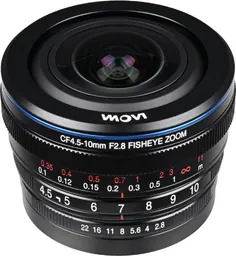
| Lens | Venus Laowa 4mm F2.8 Fisheye | Venus Laowa 4.5-10mm F2.8 CF Zoom Fisheye |
|---|---|---|
| Focal length | 4 mm | 4.5-10 mm |
| Max. aperture | f/2.8 | f/2.8 |
| Weight | 135 g | 338 g |
| Filter diameter | – | – |
| Min. focus distance | 8 cm | 10 cm |
| Length | 25.5 mm | 59.3 mm |
| Autofocus | no | no |
| Image stabilization | no | no |
This lens is also available for
Venus Laowa 4mm F2.8 Fisheye: FAQ
Does the Venus Laowa 4mm F2.8 Fisheye have autofocus?
No, the Venus Laowa 4mm F2.8 Fisheye has no autofocus; you focus it manually.
Does the Venus Laowa 4mm F2.8 Fisheye have image stabilization?
No, the Venus Laowa 4mm F2.8 Fisheye has no stabilization of its own. On cameras with in-body image stabilization (IBIS) the image is still stabilized.
How much does the Venus Laowa 4mm F2.8 Fisheye weigh?
The Venus Laowa 4mm F2.8 Fisheye weighs 135 g. It is 25.5 mm long with a diameter of 45.2 mm.
How close can the Venus Laowa 4mm F2.8 Fisheye focus?
The minimum focus distance of the Venus Laowa 4mm F2.8 Fisheye is 8 cm, measured from the sensor plane.
Is the Venus Laowa 4mm F2.8 Fisheye a full-frame lens?
No, the Venus Laowa 4mm F2.8 Fisheye is an APS-C lens. On APS-C cameras its field of view equals 6 mm in full-frame terms.
Similar lenses
Related guides
APS-C Lens on a Full-Frame Sony: Crop Mode Explained
Using an APS-C lens on a full-frame Sony: how crop mode works, how many megapixels remain on the A7 IV and A7R V, and when the combination…
What Is a Fisheye Lens? Types, Projections, Field of View
A fisheye lens covers about 180° by letting lines curve. Circular vs. diagonal, projections and field of view per sensor size, explained…
What does the f mean in camera lenses? f/2.8 explained
The f in f/2.8 is the f-number: focal length divided by aperture diameter. Learn why lower means more light and how the f-stop scale works.