
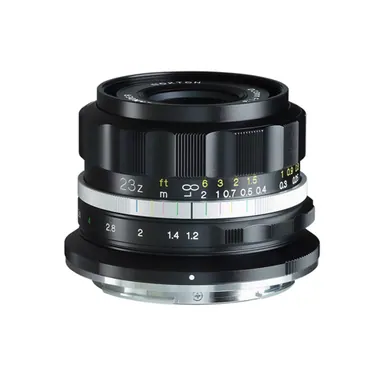
Voigtländer Nokton 23mm f/1.2
- Focal length
- 23 mm
- Aperture
- f/1.2
- Weight
- 240 g
- Filter diameter
- 46 mm
- Min. focus distance
- 18 cm
- Length
- 45 mm
Overview
The Voigtländer Nokton 23mm f/1.2 for Nikon Z mounts is a highly regarded lens among photographers who appreciate high-quality optics and unique rendering. This lens stands out not only for its impressive specifications but also for the character it brings to images. At a fast f/1.2 maximum aperture, it promises excellent low-light performance and the ability to achieve stunning background blur, making it a great option for portraits and street photography.
This compact and lightweight lens is constructed with high-quality materials that give it a robust and premium feel. With a manual focus design, it offers an engaging tactile experience, allowing you to fine-tune your focus with precision. The focus ring is well-damped, providing a smooth and satisfying operation, which is particularly useful when capturing fleeting moments in dynamic environments.
One of the key features of this lens is its sharpness, which remains impressive even wide open at f/1.2. It's capable of rendering fine details beautifully, while also providing appealing bokeh that enhances the subject separation. The lens is also well-corrected for common optical aberrations, such as distortion and chromatic aberration, ensuring that your images maintain a high level of clarity.
However, the Voigtländer Nokton 23mm f/1.2 is not without its drawbacks. As a manual focus lens, those used to autofocus may find it challenging to adapt. While manual focusing offers a deliberate style of shooting, it can be time-consuming, particularly in fast-paced environments. Additionally, the lens does not possess weather sealing, which could be a concern for photographers working in harsh conditions.
Pros and Cons
Pros
- Fast f/1.2 maximum aperture for excellent low-light performance.
- High sharpness and detail retention, even at maximum aperture.
- Aesthetic bokeh with pleasing background separation.
- Solid build quality with a premium feel.
Cons
- Manual focus only, which may be less convenient for some users.
- Lack of weather sealing may limit use in certain circumstances.
- Slightly heavier than some other lenses in this focal range.
Verdict
In conclusion, the Voigtländer Nokton 23mm f/1.2 is a remarkable lens that offers charming optical performance and a hands-on shooting experience for photographers who value creativity and precision. While it may pose some challenges due to its manual focus design and lack of weather resistance, the trade-offs are well worth it for those looking to capture beautiful, high-quality images. Whether you are a street photographer, portrait artist, or simply looking to explore wider compositions, this lens is sure to impress and elevate your photography to new heights.
Technical Specifications
- min focal length
- 23 mm
- max focal length
- 23 mm
- max f (min zoom)
- f/1.2
- max f (max zoom)
- f/1.2
- min. aperture
- f/16
- Elements
- 10
- Groups
- 6
- Weight
- 240 g (0.53 lb)
- Filter diameter
- 46 mm
- min focus distance
- 18 cm (7.09 in)
- Length
- 45 mm (1.77 in)
- Diameter
- 66 mm (2.6 in)
Which cameras does the Voigtländer Nokton 23mm f/1.2 fit?
The Voigtländer Nokton 23mm f/1.2 is designed for APS-C sensors. On APS-C Nikon Z cameras its field of view equals 35 mm in full-frame terms. Full-frame bodies use it in APS-C (crop) mode, recording only part of the sensor and fewer megapixels.
Nikon Z cameras
- Full frame (in APS-C mode):
- Nikon ZR, Nikon Z5II, Nikon Z6III, Nikon Z8, Nikon Zf, Nikon Z9, Nikon Z5, Nikon Z6II, Nikon Z7II, Nikon Z6, Nikon Z7
- APS-C:
- Nikon Z50II, Nikon Z30, Nikon Z fc, Nikon Z50
Voigtländer Nokton 23mm f/1.2 compared
Key specs side by side with the most similar Nikon Z lenses.
| Lens | Voigtländer Nokton 23mm f/1.2 | Viltrox AF 23mm F/1.4 | 7artisans Photoelectric 25mm f/0.95 | Nikon Nikkor Z DX 24mm F1.7 |
|---|---|---|---|---|
| Focal length | 23 mm | 23 mm | 25 mm | 24 mm |
| Max. aperture | f/1.2 | f/1.4 | f/1 | f/1.7 |
| Weight | 240 g | 300 g | 587 g | 135 g |
| Filter diameter | 46 mm | 52 mm | 52 mm | 46 mm |
| Min. focus distance | 18 cm | 30 cm | 25 cm | 18 cm |
| Length | 45 mm | 72 mm | 100 mm | 40 mm |
| Autofocus | no | yes | no | yes |
| Image stabilization | no | no | no | no |
This lens is also available for
Voigtländer Nokton 23mm f/1.2: FAQ
Does the Voigtländer Nokton 23mm f/1.2 have autofocus?
No, the Voigtländer Nokton 23mm f/1.2 has no autofocus; you focus it manually.
Does the Voigtländer Nokton 23mm f/1.2 have image stabilization?
No, the Voigtländer Nokton 23mm f/1.2 has no stabilization of its own. On cameras with in-body image stabilization (IBIS) the image is still stabilized.
How much does the Voigtländer Nokton 23mm f/1.2 weigh?
The Voigtländer Nokton 23mm f/1.2 weighs 240 g. It is 45 mm long with a diameter of 66 mm.
What filter size does the Voigtländer Nokton 23mm f/1.2 use?
The Voigtländer Nokton 23mm f/1.2 takes 46 mm screw-in filters.
How close can the Voigtländer Nokton 23mm f/1.2 focus?
The minimum focus distance of the Voigtländer Nokton 23mm f/1.2 is 18 cm, measured from the sensor plane.
Is the Voigtländer Nokton 23mm f/1.2 a full-frame lens?
No, the Voigtländer Nokton 23mm f/1.2 is an APS-C lens. On APS-C cameras its field of view equals 35 mm in full-frame terms.
Similar lenses
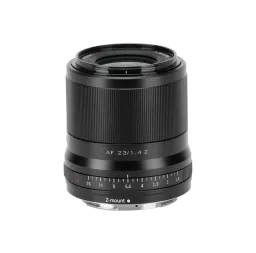
Viltrox AF 23mm F/1.4
23mm · f/1.4
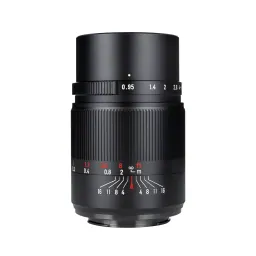
7artisans Photoelectric 25mm f/0.95
25mm · f/0.95
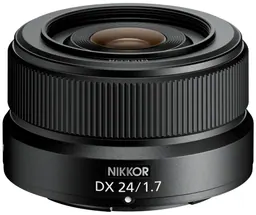
Nikon Nikkor Z DX 24mm F1.7
24mm · f/1.7
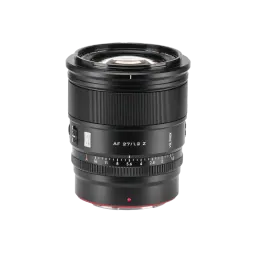
Viltrox AF 27mm F1.2 Pro
27mm · f/1.2
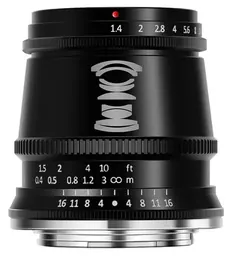
TTArtisan 17mm f/1.4
17mm · f/1.4
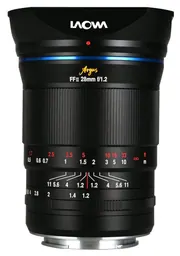
Venus Laowa Argus 28mm f/1.2 FF
28mm · f/1.2

Thypoch Simera 28mm F1.4
28mm · f/1.4
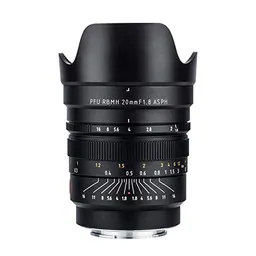
Viltrox MF 20mm F1.8
20mm · f/1.8
Related guides
What does the f mean in camera lenses?
When it comes to photography, understanding the basics of f-stop is essential. F-stop is a critical component of a camera lens that…
How to clean a camera lens
Keeping your camera lenses clean is essential for getting clear, sharp, and high-quality images. Even the smallest speck of dust, dirt, or…
All camera lens types explained: Uses and functions
In this article, we'll explore the various types of camera lenses, their defining features, and when to use them. We'll also cover the…