

SG-image MF 35mm F1.2
- Focal length
- 35 mm
- Aperture
- f/1.2
- Weight
- 200 g
- Filter diameter
- 46 mm
- Min. focus distance
- 40 cm
- Length
- 33 mm
Overview
The SG-image MF 35mm F1.2 is a manual focus APS-C prime with a very bright aperture. SG-image lists it for Sony E, Fujifilm X, Nikon Z, Micro Four Thirds, Canon EF-M, Canon RF and Leica L mounts. On APS-C the 35mm focal length corresponds to about 52.5mm on full frame, which the manufacturer calls a normal perspective close to the human eye. The lens is meant for street scenes, environmental portraits and everyday documentation where a shallow depth of field is wanted.
Optical design
SG-image gives the construction as 6 elements in 5 groups with a 44 degree angle of view. The diaphragm has 9 blades and covers F1.2 to F16 on a clicked aperture ring. The minimum focus distance is 0.4 m and the maximum magnification is 1:9.1. According to the manufacturer the F1.2 aperture produces a very shallow depth of field that isolates the subject from the background. The spec sheet does not mention special glass types or coatings.
Focusing and handling
There is no autofocus, focusing is purely manual. SG-image describes this as a slower, more deliberate approach in which you stay in full control of focus and composition. The aperture ring has click stops. At F1.2 the focus plane is thin, so careful focusing with peaking or magnified live view is the sensible way to use it, as with any manual lens of this speed.
Build and size
The barrel is metal. The lens measures 59 mm in diameter and 33 mm in length and weighs about 200 g, with a 46 mm filter thread. For an F1.2 lens that is compact, although the spec sheet gives the same values for all seven mounts and does not say whether they differ slightly by mount.
Where it fits
Within SG-image's own range, the MF 35mm F0.95 is the faster and much heavier sibling, while the MF 25mm F1.8 is the lighter, wider option. Other fast manual or autofocus 35mm class lenses in the database include the 7artisans 35mm F1.2 (Fujifilm X, Canon EF-M), the Samyang 35mm F1.2 ED AS UMC CS (Fujifilm X, Micro Four Thirds, Sony E) and, with autofocus, the Viltrox AF 33mm F1.4.
Pros and cons
Pros
- Very bright F1.2 aperture
- Compact at about 200 g and 33 mm length
- 9-blade diaphragm and clicked aperture ring
- Metal barrel
- Offered for seven mounts
Cons
- Manual focus only
- Thin depth of field at F1.2 makes focusing demanding
- No weather sealing or special glass mentioned
- Little independent measurement data so far
Verdict
The SG-image MF 35mm F1.2 is a compact, bright manual prime for APS-C cameras. It is a reasonable choice for photographers who value the look of a fast normal lens and are comfortable focusing by hand, and it is one of the lightest ways to get F1.2 on these systems.
Technical Specifications
- min focal length
- 35 mm
- max focal length
- 35 mm
- max f (min zoom)
- f/1.2
- max f (max zoom)
- f/1.2
- min. aperture
- f/16
- Elements
- 6
- Groups
- 5
- Weight
- 200 g (0.44 lb)
- Filter diameter
- 46 mm
- min focus distance
- 40 cm (15.75 in)
- Length
- 33 mm (1.3 in)
- Diameter
- 59 mm (2.32 in)
Which cameras does the SG-image MF 35mm F1.2 fit?
The SG-image MF 35mm F1.2 is designed for APS-C sensors. On APS-C Canon RF cameras its field of view equals 56 mm in full-frame terms. Full-frame bodies use it in APS-C (crop) mode, recording only part of the sensor and fewer megapixels.
Canon RF cameras
- Full frame (in APS-C mode):
- Canon EOS R6 V, Canon EOS R6 Mark III, Canon EOS C50, Canon EOS R1, Canon EOS R5 Mark II, Canon EOS C400, Canon EOS C80, Canon EOS R8, Canon EOS R6 Mark II, Canon EOS R5 C, Canon EOS R3, Canon EOS R5, Canon EOS R6, Canon EOS Ra, Canon EOS RP, Canon EOS R
- APS-C:
- Canon EOS R50 V, Canon EOS R100, Canon EOS R50, Canon EOS R7, Canon EOS R10, Canon EOS C70
SG-image MF 35mm F1.2 compared
Key specs side by side with the most similar Canon RF lenses.
| Lens | SG-image MF 35mm F1.2 | TTArtisan 35mm f/1.4 | TTArtisan Tilt APS-C 35mm f/1.4 | SG-image MF 35mm F0.95 |
|---|---|---|---|---|
| Focal length | 35 mm | 35 mm | 35 mm | 35 mm |
| Max. aperture | f/1.2 | f/1.4 | f/1.4 | f/1 |
| Weight | 200 g | 180 g | – | 393 g |
| Filter diameter | 46 mm | 39 mm | 52 mm | 52 mm |
| Min. focus distance | 40 cm | 28 cm | 35 cm | 35 cm |
| Length | 33 mm | 44 mm | 61 mm | 62 mm |
| Autofocus | no | no | no | no |
| Image stabilization | no | no | no | no |
This lens is also available for
SG-image MF 35mm F1.2: FAQ
Does the SG-image MF 35mm F1.2 have autofocus?
No, the SG-image MF 35mm F1.2 has no autofocus; you focus it manually.
Does the SG-image MF 35mm F1.2 have image stabilization?
No, the SG-image MF 35mm F1.2 has no stabilization of its own. On cameras with in-body image stabilization (IBIS) the image is still stabilized.
How much does the SG-image MF 35mm F1.2 weigh?
The SG-image MF 35mm F1.2 weighs 200 g. It is 33 mm long with a diameter of 59 mm.
What filter size does the SG-image MF 35mm F1.2 use?
The SG-image MF 35mm F1.2 takes 46 mm screw-in filters.
How close can the SG-image MF 35mm F1.2 focus?
The minimum focus distance of the SG-image MF 35mm F1.2 is 40 cm, measured from the sensor plane.
Is the SG-image MF 35mm F1.2 a full-frame lens?
No, the SG-image MF 35mm F1.2 is an APS-C lens. On APS-C cameras its field of view equals 56 mm in full-frame terms.
Similar lenses
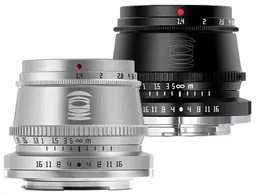
TTArtisan 35mm f/1.4
35mm · f/1.4

TTArtisan Tilt APS-C 35mm f/1.4
35mm · f/1.4
-
SG-image MF 35mm F0.95
35mm · f/0.95
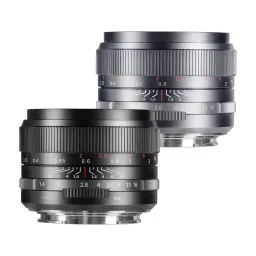
7artisans Photoelectric 35mm f/1.4 Mark III
35mm · f/1.4

Thypoch Simera 35mm F1.4
35mm · f/1.4

Zeiss Otus ML 35mm F1.4
35mm · f/1.4

Brightin Star MF 35mm F1.4 Full Frame
35mm · f/1.4
-
Voigtlander 35mm F1.4 Nokton
35mm · f/1.4
Related guides
What does the f mean in camera lenses?
When it comes to photography, understanding the basics of f-stop is essential. F-stop is a critical component of a camera lens that…
How to clean a camera lens
Keeping your camera lenses clean is essential for getting clear, sharp, and high-quality images. Even the smallest speck of dust, dirt, or…
All camera lens types explained: Uses and functions
In this article, we'll explore the various types of camera lenses, their defining features, and when to use them. We'll also cover the…