

Thypoch Eureka 28mm F2.8
- Focal length
- 28 mm
- Aperture
- f/2.8
- Weight
- 154 g
- Filter diameter
- 27 mm
- Min. focus distance
- 40 cm
- Length
- 29.3 mm
Overview
The Thypoch Eureka 28mm F2.8 is a manual-focus full-frame pancake lens for Leica M and Fujifilm X mount. Thypoch took pre-orders from November 2025 and released it on 28 April 2026 as the second lens of its Eureka series of compact, vintage-styled lenses. The 28mm focal length and the very small size are the main points: Thypoch says it was designed for shooting reversal film while traveling, with little vignetting.
Optical design
Thypoch lists 7 elements in 4 groups. The press release mentions one aspherical element and three high-refractive-index elements with modern multi-layer nano coatings, while the product page states one precision-molded aspherical element and two high-refractive-index elements, three for the X-mount version, so the exact count of the HRI elements is not consistent between Thypoch's own sources. The 8-blade aperture runs from F2.8 to F16. The minimum focusing distance is 0.4 m, the image circle is 43.2 mm for full frame, and the diagonal angle of view is 75 degrees. Thypoch says the optical design went through three versions to reach low vignetting and low distortion.
Focusing and handling
Focusing is manual. Thypoch also sells the M-mount version bundled with an M-X adapter. The body is available in Pearl White and Matte Black, and the front diameter is 28.3 mm with a 27 mm filter size.
Build and size
The body is brass with an aluminum alloy part, an anodized finish and a pearl white lacquer on the white version. The Leica M version weighs about 133 g and measures 21.9 mm at 0.4 m focus and 19.5 mm at infinity. The Fujifilm X version weighs about 154 g and is 29.3 mm at 0.4 m and 26.9 mm at infinity. The press release quotes 137 g.
Where it fits
For Leica M, other compact 28mm lenses in the database include the Leica Elmarit-M 28mm f/2.8 ASPH at 180 g and the Leica Summicron-M 28mm f/2 ASPH (2023) at 275 g. The Eureka is clearly lighter than both. On Fujifilm X, this full-frame designed lens acts as a roughly 42mm equivalent field of view on the APS-C sensor and the Simera 28mm F1.4 is the faster, larger sibling.
Pros and cons
Pros
- Very small and light at 133 g to 154 g
- Full-frame image circle on a pancake body
- Brass construction with vintage styling
- Two finishes and an optional M-X adapter bundle
Cons
- Manual focus only
- F2.8 maximum aperture is slow compared with the Simera series
- 0.4 m minimum focusing distance
- Inconsistent HRI element count in Thypoch's own material
Verdict
The Eureka 28mm F2.8 is a pocketable manual 28mm for Leica M and Fujifilm X. It suits photographers who want a very small lens with vintage handling.
Technical Specifications
- min focal length
- 28 mm
- max focal length
- 28 mm
- max f (min zoom)
- f/2.8
- max f (max zoom)
- f/2.8
- min. aperture
- f/16
- Elements
- 7
- Groups
- 4
- Weight
- 154 g (0.34 lb)
- Filter diameter
- 27 mm
- min focus distance
- 40 cm (15.75 in)
- Length
- 29.3 mm (1.15 in)
- Diameter
- 28.3 mm (1.11 in)
Which cameras does the Thypoch Eureka 28mm F2.8 fit?
The Thypoch Eureka 28mm F2.8 fits all Fujifilm X-Mount cameras. There its field of view equals 42 mm in full-frame terms (crop factor 1.5).
Fujifilm X-Mount cameras
- APS-C:
- Fujifilm X-T30 III, Fujifilm X-E5, Fujifilm X-M5, Fujifilm X-T50, Fujifilm X-S20, Fujifilm X-T5, Fujifilm X-H2, Fujifilm X-H2S, Fujifilm X-T30 II, Fujifilm X-E4, Fujifilm X-S10, Fujifilm X-T4, Fujifilm X-T200, Fujifilm X-Pro3, Fujifilm X-A7, Fujifilm X-T30, Fujifilm X-T3, Fujifilm X-T100, Fujifilm X-H1, Fujifilm X-A5, Fujifilm X-E3, Fujifilm X-T20, Fujifilm X-A10, Fujifilm X-A3, Fujifilm X-T2, Fujifilm X-E2S, Fujifilm X-Pro2, Fujifilm X-T10, Fujifilm X-A2, Fujifilm X-T1, Fujifilm X-E2, Fujifilm X-A1, Fujifilm X-M1, Fujifilm X-E1, Fujifilm X-Pro1
Thypoch Eureka 28mm F2.8 compared
Key specs side by side with the most similar Fujifilm X-Mount lenses.
| Lens | Thypoch Eureka 28mm F2.8 | Lensbaby Velvet 28mm f/2.5 | AstrHori 25mm f/2.8 2-5x Ultra Macro | Mitakon Zhongyi Creator 28mm f/5.6 |
|---|---|---|---|---|
| Focal length | 28 mm | 28 mm | 25 mm | 28 mm |
| Max. aperture | f/2.8 | f/2.5 | f/2.8 | f/5.6 |
| Weight | 154 g | 594 g | 474 g | 130 g |
| Filter diameter | 27 mm | 67 mm | – | 37 mm |
| Min. focus distance | 40 cm | 5 cm | 11 cm | 35 cm |
| Length | 29.3 mm | 89 mm | 102 mm | 44 mm |
| Autofocus | no | no | no | no |
| Image stabilization | no | no | no | no |
This lens is also available for
Thypoch Eureka 28mm F2.8: FAQ
Does the Thypoch Eureka 28mm F2.8 have autofocus?
No, the Thypoch Eureka 28mm F2.8 has no autofocus; you focus it manually.
Does the Thypoch Eureka 28mm F2.8 have image stabilization?
No, the Thypoch Eureka 28mm F2.8 has no stabilization of its own. On cameras with in-body image stabilization (IBIS) the image is still stabilized.
How much does the Thypoch Eureka 28mm F2.8 weigh?
The Thypoch Eureka 28mm F2.8 weighs 154 g. It is 29.3 mm long with a diameter of 28.3 mm.
What filter size does the Thypoch Eureka 28mm F2.8 use?
The Thypoch Eureka 28mm F2.8 takes 27 mm screw-in filters.
How close can the Thypoch Eureka 28mm F2.8 focus?
The minimum focus distance of the Thypoch Eureka 28mm F2.8 is 40 cm, measured from the sensor plane.
Similar lenses
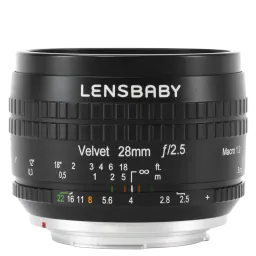
Lensbaby Velvet 28mm f/2.5
28mm · f/2.5
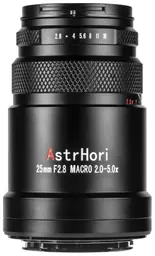
AstrHori 25mm f/2.8 2-5x Ultra Macro
25mm · f/2.8
-
Mitakon Zhongyi Creator 28mm f/5.6
28mm · f/5.6

Thypoch Simera 28mm F1.4
28mm · f/1.4
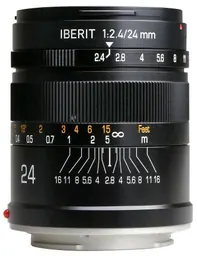
KIPON Iberit 24mm f/2.4
24mm · f/2.4
-
Meyer-Optik Gorlitz Trioplan 35mm f/2.8 II
35mm · f/2.8
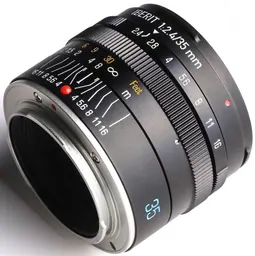
KIPON Iberit 35mm f/2.4
35mm · f/2.4
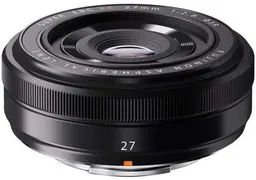
Fujifilm XF 27mm F2.8
27mm · f/2.8
Related guides
What does the f mean in camera lenses?
When it comes to photography, understanding the basics of f-stop is essential. F-stop is a critical component of a camera lens that…
How to clean a camera lens
Keeping your camera lenses clean is essential for getting clear, sharp, and high-quality images. Even the smallest speck of dust, dirt, or…
All camera lens types explained: Uses and functions
In this article, we'll explore the various types of camera lenses, their defining features, and when to use them. We'll also cover the…