
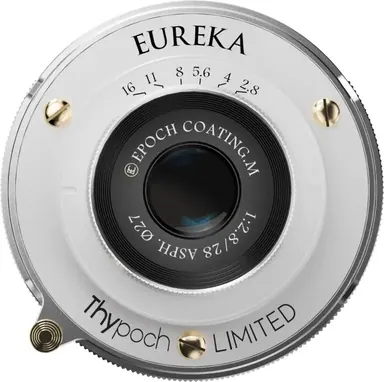
Thypoch Eureka 28mm F2.8
- Focal length
- 28 mm
- Aperture
- f/2.8
- Weight
- 133 g
- Filter diameter
- 27 mm
- Min. focus distance
- 40 cm
- Length
- 21.9 mm
Prices
Amazon.com
Currently not listed on Amazon.com
At a Glance
This 28 mm wide-angle prime for full-frame Leica M cameras is compact at just 133 g. It opens to f/2.8 and focuses as close as 40 cm. Focusing is manual. It fits landscape, reportage and travel.
Good for
- Landscape
- Reportage
- Travel
Worth knowing
- No autofocus: focusing is manual only.
Derived from the manufacturer data, not from our own tests. How we check
Technical Specifications
- Min. focal length
- 28 mm
- Max. focal length
- 28 mm
- Max. aperture (min. zoom)
- f/2.8
- Max. aperture (max. zoom)
- f/2.8
- Min. aperture
- f/16
- Elements
- 7
- Groups
- 4
- Weight
- 133 g (0.29 lb)
- Filter diameter
- 27 mm
- Min. focus distance
- 40 cm (15.75 in)
- Length
- 21.9 mm (0.86 in)
- Diameter
- 28.3 mm (1.11 in)
- Released
- April 2026
Manufacturer data: thypoch.com, thypoch.com
Which cameras does the Thypoch Eureka 28mm F2.8 fit?
The Thypoch Eureka 28mm F2.8 is a full-frame lens for Leica M-Mount cameras. On full-frame bodies it uses the whole sensor; on APS-C Leica M-Mount cameras its field of view equals 42 mm in full-frame terms.
Leica M-Mount cameras
- Full frame:
- Leica M EV1, Pixii Max, Leica M11-D, Leica M11-P, Leica M11 Monochrom, Leica M11, Leica M10-R, Leica M10 Monochrom, Leica M-E (Typ 240), Leica M10-P, Leica M10-D, Leica M10, Leica M-D (Typ 262), Leica M (Typ 262), Leica M Monochrom (Typ 246), Leica M Edition 60, Leica M-P (Typ 240), Leica M (Typ 240), Leica M-E (Typ 220), Leica M Monochrom (Typ 230), Leica M9-P, Leica M9
With the Leica M-Adapter L the lens can also be used on Leica L-Mount cameras.
Thypoch Eureka 28mm F2.8 compared
Key specs side by side with the most similar Leica M-Mount lenses.
| Lens | Thypoch Eureka 28mm F2.8 | Carl Zeiss Biogon T* 2,8/28 ZM | Leica Elmarit-M 28mm f/2.8 ASPH | Light Lens Lab 28mm F2.8 Nine Element |
|---|---|---|---|---|
| Focal length | 28 mm | 28 mm | 28 mm | 28 mm |
| Max. aperture | f/2.8 | f/2.8 | f/2.8 | f/2.8 |
| Weight | 133 g | 220 g | 175 g | 300 g |
| Filter diameter | 27 mm | 46 mm | 39 mm | 49 mm |
| Min. focus distance | 40 cm | 50 cm | 70 cm | 70 cm |
| Length | 21.9 mm | 51 mm | 31 mm | 56.8 mm |
| Autofocus | no | no | no | no |
| Image stabilization | no | no | no | no |
Open these lenses in the comparison and add more Compare the size of these lenses
This lens is also available for
Thypoch Eureka 28mm F2.8: FAQ
Does the Thypoch Eureka 28mm F2.8 have autofocus?
No, the Thypoch Eureka 28mm F2.8 has no autofocus; you focus it manually.
Does the Thypoch Eureka 28mm F2.8 have image stabilization?
No, the Thypoch Eureka 28mm F2.8 has no stabilization of its own. On cameras with in-body image stabilization (IBIS) the image is still stabilized.
How much does the Thypoch Eureka 28mm F2.8 weigh?
The Thypoch Eureka 28mm F2.8 weighs 133 g. It is 21.9 mm long with a diameter of 28.3 mm.
What filter size does the Thypoch Eureka 28mm F2.8 use?
The Thypoch Eureka 28mm F2.8 takes 27 mm screw-in filters.
How close can the Thypoch Eureka 28mm F2.8 focus?
The minimum focus distance of the Thypoch Eureka 28mm F2.8 is 40 cm, measured from the sensor plane.
Is the Thypoch Eureka 28mm F2.8 a full-frame lens?
Yes, the Thypoch Eureka 28mm F2.8 covers full frame. On APS-C cameras its field of view equals 42 mm in full-frame terms.
Similar lenses
Carl Zeiss Biogon T* 2,8/28 ZM
28mm · f/2.8
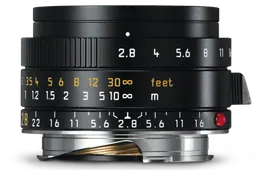
Leica Elmarit-M 28mm f/2.8 ASPH
28mm · f/2.8
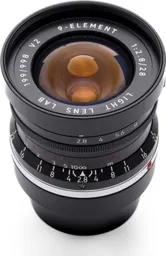
Light Lens Lab 28mm F2.8 Nine Element
28mm · f/2.8
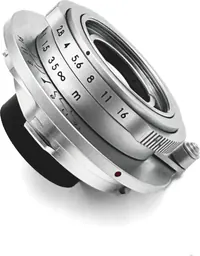
Artra Lab Phi28 28mm f/2.8
28mm · f/2.8
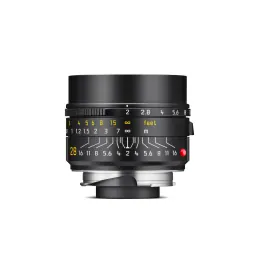
Leica Summicron-M 28mm F/2 ASPH (2023)
28mm · f/2
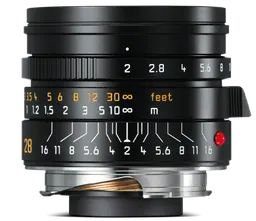
Leica Summicron-M 28mm f/2 ASPH
28mm · f/2
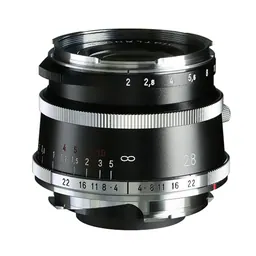
Voigtlander 28mm F2 Ultron VM II
28mm · f/2
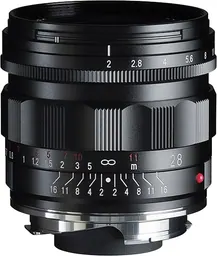
Voigtländer APO-Lanthar 28mm f/2 Aspherical
28mm · f/2
Related guides
What does the f mean in camera lenses? f/2.8 explained
The f in f/2.8 is the f-number: focal length divided by aperture diameter. Learn why lower means more light and how the f-stop scale works.
How to clean a camera lens safely, step by step
How to clean a camera lens: blow off dust, then wipe gently with a microfiber cloth or lens paper. Steps and warnings from Canon, Nikon…
Types of Camera Lenses Explained: Uses and Differences
Types of camera lenses explained: wide-angle, standard, telephoto, prime, zoom, macro and more, with focal length ranges and typical uses.