

Brightin Star MF 50mm F2 Tri-Sight
- Focal length
- 50 mm
- Aperture
- f/2
- Weight
- 429 g
- Filter diameter
- 37.5 mm
- Min. focus distance
- 70 cm
- Length
- 70 mm
Overview
The Brightin Star MF 50mm F2 Tri-Sight is a manual focus 50mm prime for full-frame mirrorless cameras with an unusual extra: a third ring that changes how the lens renders out-of-focus areas. It is available for Sony E, Canon RF, Nikon Z and Leica L. It was shown at CP+ in February 2026 and went on sale on 28 September 2026. It targets portrait, creative and video shooters who like character in their images.
Optical design
According to Brightin Star the lens has 7 elements in 6 groups, with the aperture running from F2 to F22 and 11 blades. The special ring is labeled Smooth, Prime and Foams. It shifts a floating lens group inside the barrel and changes the balance of spherical aberration. Smooth under-corrects it for softer, more diffuse highlights, Prime is the default rendering, and Foams over-corrects it for ring-shaped bubble highlights. The angle of view is 47 degrees.
Focusing and handling
Focusing is manual. Because the lens moves a group in the Tri-Sight ring, the minimum focus distance changes with the mode: 0.7 m in Foams, 0.8 m in Prime and 0.9 m in Smooth. Brightin Star describes the aperture ring as stepless and the focus ring as tactile, with a detachable focus lever. Rear bokeh inserts shaped like triangles, butterflies, clovers and stars ship with the lens. The filter size is 37.5 mm, a rare size, which means filters from other lenses will not fit.
Build and size
The weight depends on the mount: 429 g for L, 431 g for E, 433 g for RF and 454 g for Z. The diameter is about 68 mm and the length between roughly 70 and 74 mm. The maker lists an integrated lens hood.
Where it fits
No predecessor exists in the database. For character rendering, the Meyer-Optik Gorlitz Trioplan 50mm f/2.8 II and the Lensbaby Velvet 56mm f/1.6 are the closest comparisons. If you want a clean standard lens, the AstrHori 50mm f/2, the Sigma 50mm F2 DG DN | C or the Voigtländer APO-Lanthar 50mm f/2 are more conventional.
Pros and cons
Pros
- Three selectable renderings from one lens
- Rear bokeh inserts included in the box
- 11 aperture blades and a stepless aperture ring
- Four mounts, 429 to 454 g
Cons
- Manual focus only
- Close-focus distance varies with the mode and is 0.7 m at best
- Unusual 37.5 mm filter size
- Inserts have to be fitted from the rear with the lens off the camera
Verdict
The Brightin Star MF 50mm F2 Tri-Sight is a creative tool rather than a neutral standard lens. The mechanism, the inserts and the rendering modes are the reason to buy it. If you prefer clean, predictable optics, a conventional 50mm will serve better.
Technical Specifications
- min focal length
- 50 mm
- max focal length
- 50 mm
- max f (min zoom)
- f/2
- max f (max zoom)
- f/2
- min. aperture
- f/22
- Elements
- 7
- Groups
- 6
- Weight
- 429 g (0.95 lb)
- Filter diameter
- 37.5 mm
- min focus distance
- 70 cm (27.56 in)
- Length
- 70 mm (2.76 in)
- Diameter
- 68 mm (2.68 in)
Which cameras does the Brightin Star MF 50mm F2 Tri-Sight fit?
The Brightin Star MF 50mm F2 Tri-Sight is a full-frame lens for L-Mount cameras. On full-frame bodies it uses the whole sensor; on APS-C L-Mount cameras its field of view equals 75 mm in full-frame terms.
L-Mount cameras
- Full frame:
- Leica SL3-P, Leica SL3-S, Sigma BF, Panasonic Lumix S1II, Panasonic Lumix S1IIE, Panasonic Lumix S1RII, Leica SL3, Panasonic Lumix S9, Blackmagic PYXIS 6K, Panasonic Lumix S5II, Panasonic Lumix S5IIX, Blackmagic Cinema Camera 6K, Panasonic Lumix BS1H, Leica SL2-S, Panasonic Lumix S5, Sigma fp L, Leica SL2, Panasonic Lumix S1, Panasonic Lumix S1R, Panasonic Lumix S1H, Sigma fp, Leica SL (Typ 601)
- APS-C:
- Leica CL, Leica TL2, Leica TL, Leica T (Typ 701)
Brightin Star MF 50mm F2 Tri-Sight compared
Key specs side by side with the most similar L-Mount lenses.
| Lens | Brightin Star MF 50mm F2 Tri-Sight | AstrHori 50mm f/2 | SG-image MF 50mm F1.8 Shaped Aperture | KIPON Iberit 50mm f/2.4 |
|---|---|---|---|---|
| Focal length | 50 mm | 50 mm | 50 mm | 50 mm |
| Max. aperture | f/2 | f/2 | f/1.8 | f/2.4 |
| Weight | 429 g | 310 g | 311 g | 310 g |
| Filter diameter | 37.5 mm | 52 mm | 58 mm | 49 mm |
| Min. focus distance | 70 cm | 50 cm | 50 cm | 60 cm |
| Length | 70 mm | 52 mm | 48 mm | 65 mm |
| Autofocus | no | no | no | no |
| Image stabilization | no | no | no | no |
This lens is also available for
Brightin Star MF 50mm F2 Tri-Sight: FAQ
Does the Brightin Star MF 50mm F2 Tri-Sight have autofocus?
No, the Brightin Star MF 50mm F2 Tri-Sight has no autofocus; you focus it manually.
Does the Brightin Star MF 50mm F2 Tri-Sight have image stabilization?
No, the Brightin Star MF 50mm F2 Tri-Sight has no stabilization of its own. On cameras with in-body image stabilization (IBIS) the image is still stabilized.
How much does the Brightin Star MF 50mm F2 Tri-Sight weigh?
The Brightin Star MF 50mm F2 Tri-Sight weighs 429 g. It is 70 mm long with a diameter of 68 mm.
What filter size does the Brightin Star MF 50mm F2 Tri-Sight use?
The Brightin Star MF 50mm F2 Tri-Sight takes 37.5 mm screw-in filters.
How close can the Brightin Star MF 50mm F2 Tri-Sight focus?
The minimum focus distance of the Brightin Star MF 50mm F2 Tri-Sight is 70 cm, measured from the sensor plane.
Is the Brightin Star MF 50mm F2 Tri-Sight a full-frame lens?
Yes, the Brightin Star MF 50mm F2 Tri-Sight covers full frame. On APS-C cameras its field of view equals 75 mm in full-frame terms.
Similar lenses
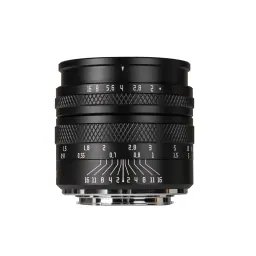
AstrHori 50mm f/2
50mm · f/2
-
SG-image MF 50mm F1.8 Shaped Aperture
50mm · f/1.8
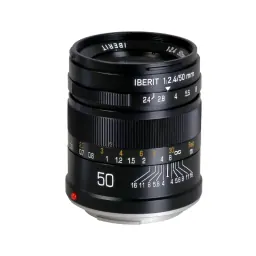
KIPON Iberit 50mm f/2.4
50mm · f/2.4
-
Meyer-Optik Gorlitz Trioplan 50mm f/2.8 II
50mm · f/2.8
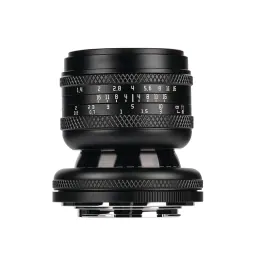
AstrHori 50mm f/1.4 Tilt
50mm · f/1.4
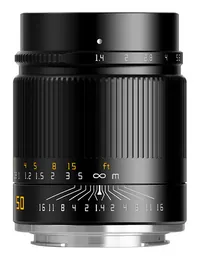
TTArtisan 50mm f/1.4 ASPH
50mm · f/1.4
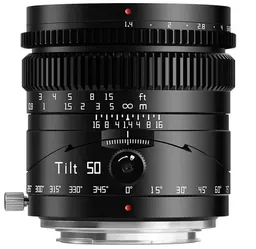
TTArtisan Tilt 50mm f/1.4
50mm · f/1.4
-
Pergear 50mm F1.4
50mm · f/1.4
Related guides
What does the f mean in camera lenses?
When it comes to photography, understanding the basics of f-stop is essential. F-stop is a critical component of a camera lens that…
How to clean a camera lens
Keeping your camera lenses clean is essential for getting clear, sharp, and high-quality images. Even the smallest speck of dust, dirt, or…
All camera lens types explained: Uses and functions
In this article, we'll explore the various types of camera lenses, their defining features, and when to use them. We'll also cover the…