

Lomography Joseph Petzval 27mm F1.7 Bokeh Control Art Lens
- Focal length
- 27 mm
- Aperture
- f/1.7
- Weight
- –
- Filter diameter
- 77 mm
- Min. focus distance
- 27 cm
- Length
- –
Overview
The Lomography Joseph Petzval 27mm f/1.7 is a manual full-frame wide-angle prime for Sony E, Canon RF and Nikon Z. According to Lomography, it is the widest lens in the Petzval series and was introduced together with the 135 mm to complete the five-lens Focus-coupled Bokeh Control line. It targets photographers and filmmakers who want a strong Petzval effect in a wide frame.
Optical design
Lomography bases the design on the original 1840 Petzval formula, recalculated for full-frame mirrorless cameras. The company says the 27 mm gives the strongest Petzval effect of the series and a curvilinear look, meaning the frame bends slightly toward the edges. It also points to a field curvature that allows tilt-shift-like compositions, where two subjects at different distances can both be in focus. A bokeh control ring adjusts the swirl across seven levels, and Lomography says the focus-coupling avoids focus shift. The maximum aperture is f/1.7 and the closest focusing distance is 0.27 m.
Focusing and handling
The lens is manual. It has a 180 degree focus throw, a Mod 0.8 follow focus gear and gear positions shared with the other lenses of the series. The iris is stopless from f/1.7 to f/22, and special shaped plates can be dropped into a second aperture system. Lomography notes that the plates for this lens are a different size from those of its other Petzval lenses. Stopless aperture, focus and bokeh rings and a built-in 1/4 inch support complete the video oriented controls.
Build and size
The body is anodized aluminium and the glass is multi-coated. The filter thread is 77 mm, larger than the 67 mm thread of the 35, 55 and 80.5 mm lenses. Lomography calls the lens compact and lightweight. The lens is made for full-frame sensors.
Where it fits
Next to the 27 mm, the 35mm f/2 is the second wide option in the series, with a larger sharp area and a longer 0.4 m minimum focus. The 27 mm is slightly faster and focuses much closer. Other wide character lenses in the database include the Lensbaby Velvet 28mm f/2.5 and the Meyer-Optik Gorlitz Trioplan 35mm f/2.8 II.
Pros and cons
Pros
- Widest Petzval so far, with the strongest effect according to Lomography
- Close focusing at 0.27 m
- f/1.7 maximum aperture
- Seven bokeh levels with focus-coupled control
- Follow focus gear and 1/4 inch support
- Three mirrorless mounts
Cons
- Manual focus only
- 77 mm filter thread is larger than on the other short Petzvals
- Curvilinear bending and field curvature are part of the look and not suited to architecture or flat subjects
Verdict
The Joseph Petzval 27mm f/1.7 is the most extreme lens of the series. It suits users who want close, wide and visibly stylised footage, and who accept manual focus and a pronounced optical signature.
Technical Specifications
- min focal length
- 27 mm
- max focal length
- 27 mm
- max f (min zoom)
- f/1.7
- max f (max zoom)
- f/1.7
- min. aperture
- f/22
- Elements
- –
- Groups
- –
- Weight
- –
- Filter diameter
- 77 mm
- min focus distance
- 27 cm (10.63 in)
- Length
- –
- Diameter
- –
Which cameras does the Lomography Joseph Petzval 27mm F1.7 Bokeh Control Art Lens fit?
The Lomography Joseph Petzval 27mm F1.7 Bokeh Control Art Lens is a full-frame lens for Nikon Z cameras. On full-frame bodies it uses the whole sensor; on APS-C Nikon Z cameras its field of view equals 41 mm in full-frame terms.
Nikon Z cameras
- Full frame:
- Nikon ZR, Nikon Z5II, Nikon Z6III, Nikon Z8, Nikon Zf, Nikon Z9, Nikon Z5, Nikon Z6II, Nikon Z7II, Nikon Z6, Nikon Z7
- APS-C:
- Nikon Z50II, Nikon Z30, Nikon Z fc, Nikon Z50
Lomography Joseph Petzval 27mm F1.7 Bokeh Control Art Lens compared
Key specs side by side with the most similar Nikon Z lenses.
| Lens | Lomography Joseph Petzval 27mm F1.7 Bokeh Control Art Lens | Voigtländer Nokton 28mm f/1.5 Aspherical | Voigtländer APO-Lanthar 28mm f/2 Aspherical | Thypoch Simera 28mm F1.4 |
|---|---|---|---|---|
| Focal length | 27 mm | 28 mm | 28 mm | 28 mm |
| Max. aperture | f/1.7 | f/1.5 | f/2 | f/1.4 |
| Weight | – | 360 g | 350 g | 368 g |
| Filter diameter | 77 mm | 52 mm | 58 mm | 49 mm |
| Min. focus distance | 27 cm | 28 cm | 28 cm | 40 cm |
| Length | – | 57 mm | 60 mm | 72.1 mm |
| Autofocus | no | no | no | no |
| Image stabilization | no | no | no | no |
This lens is also available for
Lomography Joseph Petzval 27mm F1.7 Bokeh Control Art Lens: FAQ
Does the Lomography Joseph Petzval 27mm F1.7 Bokeh Control Art Lens have autofocus?
No, the Lomography Joseph Petzval 27mm F1.7 Bokeh Control Art Lens has no autofocus; you focus it manually.
Does the Lomography Joseph Petzval 27mm F1.7 Bokeh Control Art Lens have image stabilization?
No, the Lomography Joseph Petzval 27mm F1.7 Bokeh Control Art Lens has no stabilization of its own. On cameras with in-body image stabilization (IBIS) the image is still stabilized.
What filter size does the Lomography Joseph Petzval 27mm F1.7 Bokeh Control Art Lens use?
The Lomography Joseph Petzval 27mm F1.7 Bokeh Control Art Lens takes 77 mm screw-in filters.
How close can the Lomography Joseph Petzval 27mm F1.7 Bokeh Control Art Lens focus?
The minimum focus distance of the Lomography Joseph Petzval 27mm F1.7 Bokeh Control Art Lens is 27 cm, measured from the sensor plane.
Is the Lomography Joseph Petzval 27mm F1.7 Bokeh Control Art Lens a full-frame lens?
Yes, the Lomography Joseph Petzval 27mm F1.7 Bokeh Control Art Lens covers full frame. On APS-C cameras its field of view equals 41 mm in full-frame terms.
Similar lenses

Voigtländer Nokton 28mm f/1.5 Aspherical
28mm · f/1.5
-
Voigtländer APO-Lanthar 28mm f/2 Aspherical
28mm · f/2

Thypoch Simera 28mm F1.4
28mm · f/1.4
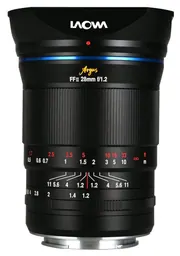
Venus Laowa Argus 28mm f/1.2 FF
28mm · f/1.2
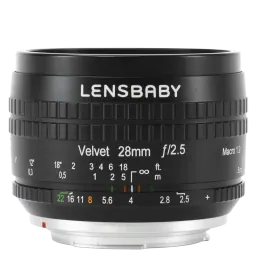
Lensbaby Velvet 28mm f/2.5
28mm · f/2.5
Viltrox AF 28mm F1.8
28mm · f/1.8
-
Artra Lab Noxika 28mm f/2.8
28mm · f/2.8
AstrHori 25mm f/2.8 2-5x Ultra Macro
25mm · f/2.8
Related guides
What does the f mean in camera lenses?
When it comes to photography, understanding the basics of f-stop is essential. F-stop is a critical component of a camera lens that…
How to clean a camera lens
Keeping your camera lenses clean is essential for getting clear, sharp, and high-quality images. Even the smallest speck of dust, dirt, or…
All camera lens types explained: Uses and functions
In this article, we'll explore the various types of camera lenses, their defining features, and when to use them. We'll also cover the…