

Voigtländer APO-Lanthar 28mm f/2 Aspherical
- Focal length
- 28 mm
- Aperture
- f/2
- Weight
- 350 g
- Filter diameter
- 58 mm
- Min. focus distance
- 28 cm
- Length
- 60 mm
Overview
The Voigtländer APO-Lanthar 28mm f/2 Aspherical is a compact manual focus wide-angle prime for full frame cameras. It exists for Leica M (VM mount) and, with electronic contacts, for Sony E and Nikon Z. The optical formula is the same across mounts, according to Cosina.
Optical design
The lens has 12 elements in 8 groups. As the APO-Lanthar name suggests, it follows an apochromatic design that aims to bring the axial chromatic aberration of red, green and blue as close to zero as possible. On the Nikon Z page Cosina states that 6 of the 12 elements are made of anomalous partial dispersion glass, 2 elements are aspherical on both sides, and a floating mechanism is used. The aperture has 12 blades, and the smallest aperture is f/16. Cosina calls it the highest-performing wide-angle lens in Voigtländer's history.
Focusing and handling
Focusing is manual with an all-metal helicoid. On Sony E and Nikon Z the closest focus distance is 0.28 m (1:6.9). The Leica M version focuses to 0.5 m: the rangefinder coupling covers infinity to 0.7 m, and beyond that the lens can be focused with live view. The Sony E version has an aperture click-stop switch, so the aperture ring can be set to move without clicks, which keeps ring noise out of video audio. On E and Z, electronic contacts record Exif data, allow focus magnification and support in-body stabilization.
Build and size
The three versions differ in size. The M version weighs 265 g and measures 55.6 x 50.0 mm with a 49 mm filter thread. The Sony E version weighs 325 g and measures 62.6 x 58.8 mm, also with 49 mm filters, and ships with a hood. The Nikon Z version weighs 350 g, measures 68.8 x 60.0 mm and takes 58 mm filters, with a reversible bayonet hood.
Where it fits
On Leica M, Voigtländer's own Ultron 28mm f/2 VM II covers the same focal length and aperture. Other 28mm options include the Leica Summicron-M 28mm f/2 ASPH on M, and the Sony FE 28mm F2, Viltrox AF 28mm F1.8 and Nikon Nikkor Z 28mm F2.8 with autofocus on E and Z.
Pros and cons
Pros
- Apochromatic design with special dispersion glass and aspherical elements
- Very compact, especially on Leica M at 265 g
- Close focus down to 0.28 m on E and Z
- 12-blade aperture and a hood included
Cons
- Manual focus only
- Leica M version needs live view below 0.7 m
- No stabilization in the lens
- Heavier and larger on Nikon Z than on the other mounts
Verdict
The APO-Lanthar 28mm f/2 is a small, carefully built wide-angle for photographers who accept manual focus and want strong control of color fringing. It makes most sense where the autofocus alternatives are larger or slower.
Technical Specifications
- min focal length
- 28 mm
- max focal length
- 28 mm
- max f (min zoom)
- f/2
- max f (max zoom)
- f/2
- min. aperture
- f/16
- Elements
- 12
- Groups
- 8
- Weight
- 350 g (0.77 lb)
- Filter diameter
- 58 mm
- min focus distance
- 28 cm (11.02 in)
- Length
- 60 mm (2.36 in)
- Diameter
- 68.8 mm (2.71 in)
Which cameras does the Voigtländer APO-Lanthar 28mm f/2 Aspherical fit?
The Voigtländer APO-Lanthar 28mm f/2 Aspherical is a full-frame lens for Nikon Z cameras. On full-frame bodies it uses the whole sensor; on APS-C Nikon Z cameras its field of view equals 42 mm in full-frame terms.
Nikon Z cameras
- Full frame:
- Nikon ZR, Nikon Z5II, Nikon Z6III, Nikon Z8, Nikon Zf, Nikon Z9, Nikon Z5, Nikon Z6II, Nikon Z7II, Nikon Z6, Nikon Z7
- APS-C:
- Nikon Z50II, Nikon Z30, Nikon Z fc, Nikon Z50
Voigtländer APO-Lanthar 28mm f/2 Aspherical compared
Key specs side by side with the most similar Nikon Z lenses.
| Lens | Voigtländer APO-Lanthar 28mm f/2 Aspherical | Lensbaby Velvet 28mm f/2.5 | Voigtländer Nokton 28mm f/1.5 Aspherical | Lomography Joseph Petzval 27mm F1.7 Bokeh Control Art Lens |
|---|---|---|---|---|
| Focal length | 28 mm | 28 mm | 28 mm | 27 mm |
| Max. aperture | f/2 | f/2.5 | f/1.5 | f/1.7 |
| Weight | 350 g | 594 g | 360 g | – |
| Filter diameter | 58 mm | 67 mm | 52 mm | 77 mm |
| Min. focus distance | 28 cm | 5 cm | 28 cm | 27 cm |
| Length | 60 mm | 89 mm | 57 mm | – |
| Autofocus | no | no | no | no |
| Image stabilization | no | no | no | no |
This lens is also available for
Voigtländer APO-Lanthar 28mm f/2 Aspherical: FAQ
Does the Voigtländer APO-Lanthar 28mm f/2 Aspherical have autofocus?
No, the Voigtländer APO-Lanthar 28mm f/2 Aspherical has no autofocus; you focus it manually.
Does the Voigtländer APO-Lanthar 28mm f/2 Aspherical have image stabilization?
No, the Voigtländer APO-Lanthar 28mm f/2 Aspherical has no stabilization of its own. On cameras with in-body image stabilization (IBIS) the image is still stabilized.
How much does the Voigtländer APO-Lanthar 28mm f/2 Aspherical weigh?
The Voigtländer APO-Lanthar 28mm f/2 Aspherical weighs 350 g. It is 60 mm long with a diameter of 68.8 mm.
What filter size does the Voigtländer APO-Lanthar 28mm f/2 Aspherical use?
The Voigtländer APO-Lanthar 28mm f/2 Aspherical takes 58 mm screw-in filters.
How close can the Voigtländer APO-Lanthar 28mm f/2 Aspherical focus?
The minimum focus distance of the Voigtländer APO-Lanthar 28mm f/2 Aspherical is 28 cm, measured from the sensor plane.
Is the Voigtländer APO-Lanthar 28mm f/2 Aspherical a full-frame lens?
Yes, the Voigtländer APO-Lanthar 28mm f/2 Aspherical covers full frame. On APS-C cameras its field of view equals 42 mm in full-frame terms.
Similar lenses
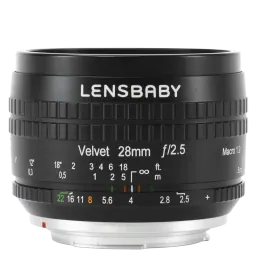
Lensbaby Velvet 28mm f/2.5
28mm · f/2.5

Voigtländer Nokton 28mm f/1.5 Aspherical
28mm · f/1.5
-
Lomography Joseph Petzval 27mm F1.7 Bokeh Control Art Lens
27mm · f/1.7
-
Artra Lab Noxika 28mm f/2.8
28mm · f/2.8

Thypoch Simera 28mm F1.4
28mm · f/1.4
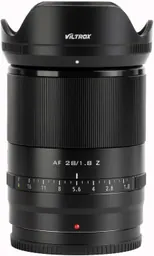
Viltrox AF 28mm F1.8
28mm · f/1.8
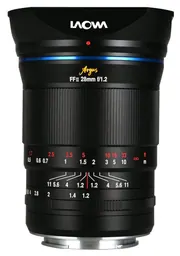
Venus Laowa Argus 28mm f/1.2 FF
28mm · f/1.2

Lensbaby Twist 28
28mm · f/3.5
Related guides
What does the f mean in camera lenses?
When it comes to photography, understanding the basics of f-stop is essential. F-stop is a critical component of a camera lens that…
How to clean a camera lens
Keeping your camera lenses clean is essential for getting clear, sharp, and high-quality images. Even the smallest speck of dust, dirt, or…
All camera lens types explained: Uses and functions
In this article, we'll explore the various types of camera lenses, their defining features, and when to use them. We'll also cover the…