
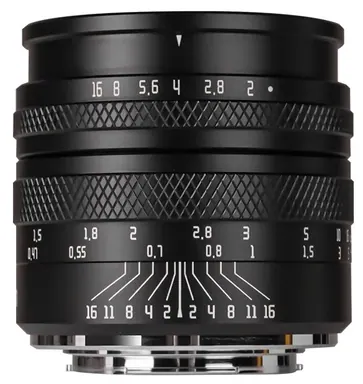
AstrHori 50mm f/2
- Focal length
- 50 mm
- Aperture
- f/2
- Weight
- 310 g
- Filter diameter
- 52 mm
- Min. focus distance
- 50 cm
- Length
- 52 mm
At a Glance
With a 50 mm focal length and an f/2 aperture, this is a manual-focus standard lens for full-frame Sony E-Mount. The aperture allows shorter shutter times in dark scenes. The lens weighs 310 g, is 52 mm long and focuses down to 50 cm. Everyday shooting, street and low-light work are among its uses.
Good for
- Everyday
- Street
- Low light
Worth knowing
- No autofocus: focusing is manual only.
Derived from the manufacturer data, not from our own tests. How we check
Technical Specifications
- Min. focal length
- 50 mm
- Max. focal length
- 50 mm
- Max. aperture (min. zoom)
- f/2
- Max. aperture (max. zoom)
- f/2
- Min. aperture
- f/16
- Elements
- 6
- Groups
- 5
- Weight
- 310 g (0.68 lb)
- Filter diameter
- 52 mm
- Min. focus distance
- 50 cm (19.69 in)
- Length
- 52 mm (2.05 in)
- Diameter
- 58 mm (2.28 in)
Manufacturer data: astrhori.cn
Last checked: October 13, 2026 (against the manufacturer data) · How we check
Which cameras does the AstrHori 50mm f/2 fit?
The AstrHori 50mm f/2 is a full-frame lens for Sony E-Mount cameras. On full-frame bodies it uses the whole sensor; on APS-C Sony E-Mount cameras its field of view equals 75 mm in full-frame terms.
Sony E-Mount cameras
- Full frame:
- Sony A7R VI,Sony A7 V,Sony FX2,Sony A1 II,Sony A9 III,Sony A7C II,Sony A7CR,Sony ZV-E1,Sony A7R V,Sony A7 IV,Sony A1,Sony FX3,Sony A7S III,Sony A7C,Sony FX6,Sony A7R IV (A7R IVA),Sony A9 II,Sony FX9,Sony A7 III,Sony A7R III (A7R IIIA),Sony A9,Sony A7R II,Sony A7S II,Sony A7 II,Sony A7S,Sony A7,Sony A7R
- APS-C:
- Sony ZV-E10 II,Sony A6700,Sony FX30,Sony ZV-E10,Sony A6600,Sony A6100,Sony A6400,Sony A6500,Sony A6300,Sony QX1 (ILCE-QX1),Sony A6000,Sony A5100,Sony A3500,Sony A5000,Sony A3000,Sony NEX-5T,Sony NEX-3N,Sony NEX-6,Sony NEX-5R,Sony NEX-F3,Sony NEX-7,Sony NEX-5N,Sony NEX-C3,Sony NEX-5,Sony NEX-3
AstrHori 50mm f/2 compared
Key specs side by side with the most similar Sony E-Mount lenses.
| Lens | AstrHori 50mm f/2 | Voigtländer APO-Lanthar 50mm f/2 | Zeiss Loxia 50mm F2 | Brightin Star MF 50mm F2 Tri-Sight |
|---|---|---|---|---|
| Focal length | 50 mm | 50 mm | 50 mm | 50 mm |
| Max. aperture | f/2 | f/2 | f/2 | f/2 |
| Weight | 310 g | 364 g | 320 g | 431 g |
| Filter diameter | 52 mm | 49 mm | 52 mm | 37.5 mm |
| Min. focus distance | 50 cm | 45 cm | 45 cm | 70 cm |
| Length | 52 mm | 61.3 mm | 59 mm | 72 mm |
| Autofocus | no | no | no | no |
| Image stabilization | no | no | no | no |
This lens is also available for
AstrHori 50mm f/2: FAQ
Does the AstrHori 50mm f/2 have autofocus?
No, the AstrHori 50mm f/2 has no autofocus; you focus it manually.
Does the AstrHori 50mm f/2 have image stabilization?
No, the AstrHori 50mm f/2 has no stabilization of its own. On cameras with in-body image stabilization (IBIS) the image is still stabilized.
How much does the AstrHori 50mm f/2 weigh?
The AstrHori 50mm f/2 weighs 310 g. It is 52 mm long with a diameter of 58 mm.
What filter size does the AstrHori 50mm f/2 use?
The AstrHori 50mm f/2 takes 52 mm screw-in filters.
How close can the AstrHori 50mm f/2 focus?
The minimum focus distance of the AstrHori 50mm f/2 is 50 cm, measured from the sensor plane.
Is the AstrHori 50mm f/2 a full-frame lens?
Yes, the AstrHori 50mm f/2 covers full frame. On APS-C cameras its field of view equals 75 mm in full-frame terms.
Similar lenses
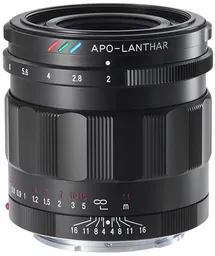
Voigtländer APO-Lanthar 50mm f/2
50mm · f/2
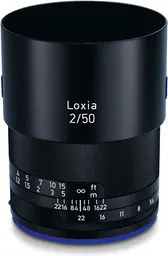
Zeiss Loxia 50mm F2
50mm · f/2
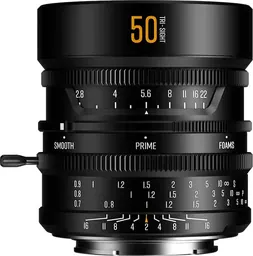
Brightin Star MF 50mm F2 Tri-Sight
50mm · f/2
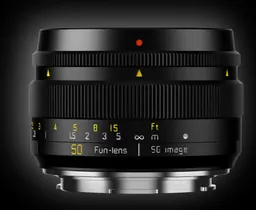
SG-image MF 50mm F1.8 Shaped Aperture
50mm · f/1.8

KIPON Iberit 50mm f/2.4
50mm · f/2.4
-
Meyer-Optik Gorlitz Trioplan 50mm f/2.8 II
50mm · f/2.8
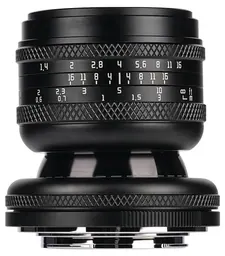
AstrHori 50mm f/1.4 Tilt
50mm · f/1.4
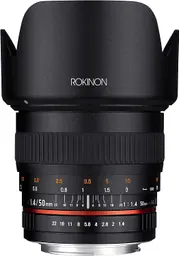
Samyang / Rokinon 50mm F1.4 AS UMC
50mm · f/1.4
Related guides
What does the f mean in camera lenses? f/2.8 explained
The f in f/2.8 is the f-number: focal length divided by aperture diameter. Learn why lower means more light and how the f-stop scale works.
How to clean a camera lens safely, step by step
How to clean a camera lens: blow off dust, then wipe gently with a microfiber cloth or lens paper. Steps and warnings from Canon, Nikon…
Types of Camera Lenses Explained: Uses and Differences
Types of camera lenses explained: wide-angle, standard, telephoto, prime, zoom, macro and more, with focal length ranges and typical uses.