

Leica Summicron-M 66mm f/2
- Focal length
- 66 mm
- Aperture
- f/2
- Weight
- 456 g
- Filter diameter
- 49 mm
- Min. focus distance
- 100 cm
- Length
- 60.1 mm
Overview
The Leica Summicron-M 66mm f/2 is a manual-focus short telephoto for Leica M cameras and a reinterpretation of the Elcan 66mm f/2. Dr. Walter Mandler developed that lens in the late 1960s at Ernst Leitz Canada for the US Navy, and only around 200 units were made. Leica announced the new lens on 3 September 2026 as an addition to the Leica Classic Line. It is a full-frame lens, and Leica is producing it as a limited edition of 660 units.
Optical design
The lens has 6 elements in 5 groups and a maximum aperture of f/2. The smallest aperture is f/16, and the diaphragm has 9 blades. According to Leica, the optical design is based on the original but has been optimised and adapted to current standards, like the lens body. Leica describes the rendering as an interplay of soft bokeh and high contrast, and says that stopped down the lens delivers maximum resolution for fine detail.
Focusing and handling
Focusing is manual with a combined meter and feet scale. The close focus distance is 1 m and the largest scale is 1:13.4. As on the Elcan, the aperture ring turns in the opposite direction to standard M lenses, and the distance scale arrangement follows military specifications according to Leica. The aperture has click stops with half-stop lock settings. The hood is a screw-on type. The focal length is engraved as the number 60 on the barrel, which stands for a measured 66.0 mm.
Build and size
The lens weighs approximately 456 g, is about 60.1 mm long, about 60 mm in diameter and takes E49 filters. The Leica M bayonet has 6-bit encoding. The serial number is engraved on the front ring along with the calculation number B1047, and the Leitz Wetzlar engraving replaces the Elcan name.
Where it fits
At 66mm the lens sits between the classic 50mm and longer portrait focal lengths. Within the database, the closest alternatives are the Summicron-M 50mm f/2, the APO-Summicron-M 50mm f/2 ASPH, the APO-Summicron-M 75mm f/2 ASPH and the Noctilux-M 75mm F1.25 ASPH. None of these has the unusual 66mm focal length or the reversed aperture ring.
Pros and cons
Pros
- Unusual 66mm focal length between 50mm and 75mm
- Compact f/2 design at 456 g
- Historical background and engravings
- 9-blade diaphragm
- Close focus down to 1 m
Cons
- Limited edition of 660 units, so availability is restricted
- Manual focus only
- Aperture ring turns in the opposite direction to standard M lenses
- Limited to the M mount
Verdict
The Summicron-M 66mm f/2 is a collector-oriented lens with a real optical purpose: a compact short telephoto with an unusual focal length. M photographers who want the 66mm perspective will find nothing else in the system, while those who mainly want a conventional portrait lens have more practical choices.
Technical Specifications
- min focal length
- 66 mm
- max focal length
- 66 mm
- max f (min zoom)
- f/2
- max f (max zoom)
- f/2
- min. aperture
- f/16
- Elements
- 6
- Groups
- 5
- Weight
- 456 g (1.01 lb)
- Filter diameter
- 49 mm
- min focus distance
- 100 cm (39.37 in)
- Length
- 60.1 mm (2.37 in)
- Diameter
- 60 mm (2.36 in)
Which cameras does the Leica Summicron-M 66mm f/2 fit?
The Leica Summicron-M 66mm f/2 fits all Leica M-Mount cameras and covers the full 35 mm format.
Leica M-Mount cameras
- Full frame:
- Leica M EV1, Leica M11-D, Leica M11-P, Leica M11 Monochrom, Leica M11, Leica M10-R, Leica M10 Monochrom, Leica M-E (Typ 240), Leica M10-P, Leica M10-D, Leica M10, Leica M-D (Typ 262), Leica M (Typ 262), Leica M Monochrom (Typ 246), Leica M-P (Typ 240), Leica M (Typ 240), Leica M-E (Typ 220), Leica M Monochrom (Typ 230), Leica M9-P, Leica M9
With the Leica M-Adapter L the lens can also be used on Leica L-Mount cameras.
Leica Summicron-M 66mm f/2 compared
Key specs side by side with the most similar Leica M-Mount lenses.
| Lens | Leica Summicron-M 66mm f/2 | Leica APO-Summicron-M 75mm f/2 ASPH | Light Lens Lab 75mm F2 SP-II | Meyer-Optik Gorlitz Primoplan 75mm f/1.9 II |
|---|---|---|---|---|
| Focal length | 66 mm | 75 mm | 75 mm | 75 mm |
| Max. aperture | f/2 | f/2 | f/2 | f/1.9 |
| Weight | 456 g | 430 g | 310 g | 360 g |
| Filter diameter | 49 mm | 49 mm | 43 mm | 52 mm |
| Min. focus distance | 100 cm | 70 cm | 70 cm | 75 cm |
| Length | 60.1 mm | 67 mm | 73 mm | 85 mm |
| Autofocus | no | no | no | no |
| Image stabilization | no | no | no | no |
Leica Summicron-M 66mm f/2: FAQ
Does the Leica Summicron-M 66mm f/2 have autofocus?
No, the Leica Summicron-M 66mm f/2 has no autofocus; you focus it manually.
Does the Leica Summicron-M 66mm f/2 have image stabilization?
No, the Leica Summicron-M 66mm f/2 has no stabilization of its own. On cameras with in-body image stabilization (IBIS) the image is still stabilized.
How much does the Leica Summicron-M 66mm f/2 weigh?
The Leica Summicron-M 66mm f/2 weighs 456 g. It is 60.1 mm long with a diameter of 60 mm.
What filter size does the Leica Summicron-M 66mm f/2 use?
The Leica Summicron-M 66mm f/2 takes 49 mm screw-in filters.
How close can the Leica Summicron-M 66mm f/2 focus?
The minimum focus distance of the Leica Summicron-M 66mm f/2 is 100 cm, measured from the sensor plane.
Similar lenses
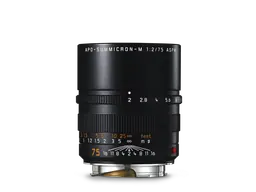
Leica APO-Summicron-M 75mm f/2 ASPH
75mm · f/2
-
Light Lens Lab 75mm F2 SP-II
75mm · f/2
-
Meyer-Optik Gorlitz Primoplan 75mm f/1.9 II
75mm · f/1.9
-
Meyer-Optik Gorlitz Primoplan 58mm f/1.9 II
58mm · f/1.9
-
DK-Optic Chiaro 76mm F1.9
76mm · f/1.9

Voigtlander 75mm F1.8 Heliar Classic
75mm · f/1.8
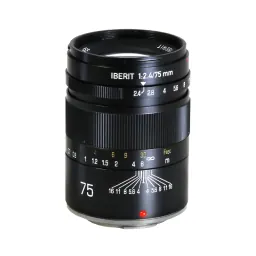
KIPON Iberit 75mm f/2.4
75mm · f/2.4
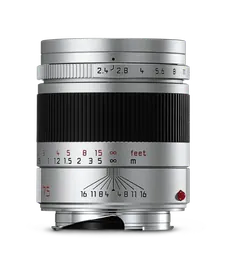
Leica Summarit-M 75mm F2.4 ASPH
75mm · f/2.4
Related guides
What does the f mean in camera lenses?
When it comes to photography, understanding the basics of f-stop is essential. F-stop is a critical component of a camera lens that…
How to clean a camera lens
Keeping your camera lenses clean is essential for getting clear, sharp, and high-quality images. Even the smallest speck of dust, dirt, or…
All camera lens types explained: Uses and functions
In this article, we'll explore the various types of camera lenses, their defining features, and when to use them. We'll also cover the…