
Nikon AF-S Nikkor 70-300mm f/4.5-5.6G VR
Nikon F (DX/FX)
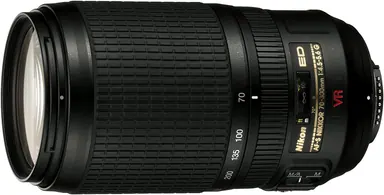
Overview
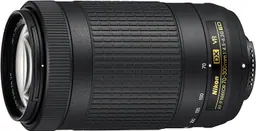
The Nikon AF-S Nikkor 70-300mm f/4.5-5.6G VR is a versatile telephoto zoom lens designed for Nikon F mount cameras, particularly appealing for those using the DX format. With an extended focal range, this lens is perfect for everything from wildlife and sports photography to portraiture and landscape images.
Build and Design
The build quality of the Nikon 70-300mm is solid, featuring a durable plastic exterior that feels reliable in hand. It is relatively lightweight for a zoom lens of its type, making it more manageable for extended shooting sessions. The lens has a rotating zoom mechanism, which may take some getting used to, as some photographers prefer a push-pull design. Overall, this lens has an ergonomic design that matches well with Nikon’s DX-format camera bodies.
Image Quality
The optical performance of the 70-300mm is generally commendable. It features a multi-coating that enhances contrast and reduces flare, leading to improved image quality in challenging lighting conditions. The lens is sharp across most of the zoom range, though it tends to soften at the edges when fully extended to 300mm. It also exhibits some vignetting, particularly at wider apertures, but this can typically be corrected in post-processing.
Autofocus and VR
One of the highlights of this lens is its Silent Wave Motor (SWM) that provides fast and accurate autofocus, which is critical for capturing fast-moving subjects. The Vibration Reduction (VR) system is efficient, allowing for sharper images even at slower shutter speeds. Users have reported success in handheld shooting, particularly at focal lengths of 300mm.
Compatibility
Designed for Nikon F mount, this lens is compatible with both FX and DX format bodies. On DX cameras, it effectively offers an equivalent focal length of 105-450mm, allowing for robust versatility in various shooting scenarios. However, it’s important to note that on full-frame bodies, the lens has a noticeable crop factor that might limit its applicability for some users.
Pros and Cons
Pros
- Versatile focal length (70-300mm) suitable for various photography types.
- Fast and accurate auto-focusing thanks to the SWM.
- Effective Vibration Reduction aids in handheld shooting.
- Solid build quality and lightweight design.
Cons
- Edge sharpness can soften at 300mm.
- Some vignetting at wider apertures.
- Rotating zoom mechanism may not appeal to everyone.
Verdict
The Nikon AF-S Nikkor 70-300mm f/4.5-5.6G VR is a solid telephoto lens for both budding and seasoned photographers. Its combination of good image quality, reliable autofocus, and versatility makes it a worthy addition to any Nikon DX camera kit. While it does have some drawbacks, such as edge softness at longer focal lengths and a rotating zoom mechanism, its advantages often outweigh these issues, making it a dependable option for a wide range of shooting scenarios.
Technical Specifications
Which cameras does the Nikon AF-S Nikkor 70-300mm f/4.5-5.6G VR fit?
The Nikon AF-S Nikkor 70-300mm f/4.5-5.6G VR is a full-frame lens for Nikon F-Mount cameras. On full-frame bodies it uses the whole sensor; on APS-C Nikon F-Mount cameras its field of view equals 105-450 mm in full-frame terms.
Nikon F-Mount cameras
- Full frame:
- Nikon D6, Nikon D780, Nikon D850, Nikon D5, Nikon D810A, Nikon D4S, Nikon D810, Nikon D750, Nikon Df, Nikon D610, Nikon D4, Nikon D800, Nikon D800E, Nikon D600, Nikon D3S, Nikon D3X, Nikon D700
- APS-C:
- Nikon D3500, Nikon D7500, Nikon D500, Nikon D3400, Nikon D5600, Nikon D5500, Nikon D7200, Nikon D3300, Nikon D7100, Nikon D5300, Nikon D3200, Nikon D5200, Nikon D5100, Nikon D7000, Nikon D3100, Nikon D300S, Nikon D5000, Nikon D3000, Nikon D90, Nikon D60
With the Nikon FTZ II / FTZ the lens can also be used on Nikon Z (DX/FX) cameras.
Nikon AF-S Nikkor 70-300mm f/4.5-5.6G VR compared
Key specs side by side with the most similar Nikon F-Mount lenses.
| Lens | Nikon AF-S Nikkor 70-300mm f/4.5-5.6G VR | Nikon AF-P Nikkor 70-300mm F4.5-5.6E ED VR | Nikon AF Nikkor 70-300mm f/4-5.6G | Sigma 70-300mm F4-5.6 APO DG Macro |
|---|---|---|---|---|
| Focal length | 70-300 mm | 70-300 mm | 70-300 mm | 70-300 mm |
| Max. aperture | f/4.5-5.6 | f/4.5-5.6 | f/4-5.6 | f/4-5.6 |
| Weight | 745 g | 680 g | 425 g | 550 g |
| Filter diameter | 67 mm | 67 mm | 62 mm | 58 mm |
| Min. focus distance | 150 cm | 125 cm | 150 cm | 95 cm |
| Length | 144 mm | 146 mm | 117 mm | 122 mm |
| Autofocus | yes | yes | yes | yes |
| Image stabilization | yes | yes | no | no |
Nikon AF-S Nikkor 70-300mm f/4.5-5.6G VR: FAQ
Does the Nikon AF-S Nikkor 70-300mm f/4.5-5.6G VR have autofocus?
Yes, the Nikon AF-S Nikkor 70-300mm f/4.5-5.6G VR has autofocus.
Does the Nikon AF-S Nikkor 70-300mm f/4.5-5.6G VR have image stabilization?
Yes, the Nikon AF-S Nikkor 70-300mm f/4.5-5.6G VR has optical image stabilization.
How much does the Nikon AF-S Nikkor 70-300mm f/4.5-5.6G VR weigh?
The Nikon AF-S Nikkor 70-300mm f/4.5-5.6G VR weighs 745 g. It is 144 mm long with a diameter of 80 mm.
What filter size does the Nikon AF-S Nikkor 70-300mm f/4.5-5.6G VR use?
The Nikon AF-S Nikkor 70-300mm f/4.5-5.6G VR takes 67 mm screw-in filters.
How close can the Nikon AF-S Nikkor 70-300mm f/4.5-5.6G VR focus?
The minimum focus distance of the Nikon AF-S Nikkor 70-300mm f/4.5-5.6G VR is 150 cm, measured from the sensor plane.
Is the Nikon AF-S Nikkor 70-300mm f/4.5-5.6G VR a full-frame lens?
Yes, the Nikon AF-S Nikkor 70-300mm f/4.5-5.6G VR covers full frame. On APS-C cameras its field of view equals 105-450 mm in full-frame terms.
Similar lenses
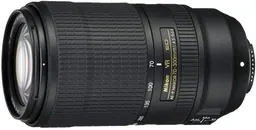
Nikon AF-P Nikkor 70-300mm F4.5-5.6E ED VR
70-300mm · f/4.5-5.6
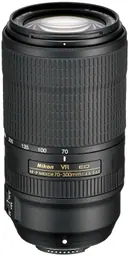
Nikon AF Nikkor 70-300mm f/4-5.6G
70-300mm · f/4-5.6
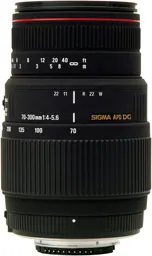
Sigma 70-300mm F4-5.6 APO DG Macro
70-300mm · f/4-5.6
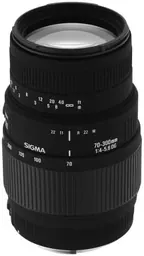
Sigma 70-300mm F4-5.6 DG Macro
70-300mm · f/4-5.6
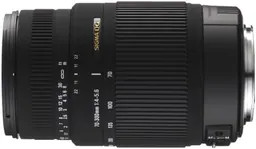
Sigma 70-300mm F4-5.6 DG OS
70-300mm · f/4-5.6
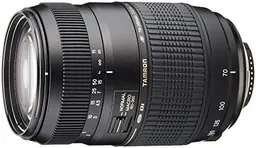
Tamron AF 70-300mm F/4-5.6 Di LD Macro
70-300mm · f/4-5.6
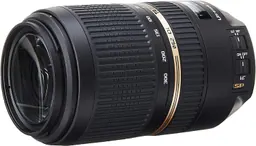
Tamron SP 70-300mm F4-5.6 Di VC USD
70-300mm · f/4-5.6
Nikon AF-P DX Nikkor 70-300mm F4.5-6.3G VR
70-300mm · f/4.5-6.3
Related guides
What does the f mean in camera lenses?
When it comes to photography, understanding the basics of f-stop is essential. F-stop is a critical component of a camera lens that…
How to clean a camera lens
Keeping your camera lenses clean is essential for getting clear, sharp, and high-quality images. Even the smallest speck of dust, dirt, or…
All camera lens types explained: Uses and functions
In this article, we'll explore the various types of camera lenses, their defining features, and when to use them. We'll also cover the…