

Nikon Z (DX/FX) Autofocus
Nikon Nikkor Z 28-135mm F4 PZ
- Focal length
- 28–135 mm
- Aperture
- f/4
- Weight
- 1120 g
- Filter diameter
- 95 mm
- Min. focus distance
- 34 cm
- Length
- 177.5 mm
Overview
The Nikon Nikkor Z 28-135mm F4 PZ is a power zoom standard zoom for full frame Nikon Z cameras. Nikon announced the development in October 2024 and presented the finished lens in February 2025. It is aimed at videographers who shoot documentaries or work alone on location, and it is Nikon's first Z lens with a zoom lever.
Optical design
The lens has 18 elements in 13 groups, including three ED elements, one aspherical ED element and four aspherical elements. Nikon applies its Meso Amorphous Coat, described as its best anti-reflection coating, and a fluorine coat on the front element. The aperture is a constant F4 and closes to F22, with 9 rounded blades. Minimum focus distance is 0.34 m at 28 mm and 0.57 m at 135 mm, with 0.25x maximum magnification between 55 and 135 mm. Nikon says the design is optimized for video and suppresses focus breathing. The filter thread is 95 mm.
Autofocus and handling
A stepping motor (STM) drives autofocus, and Nikon names linear manual focus drive support for smooth focusing. Zooming is electronic: a zoom lever offers 11 selectable speeds with ease-in and ease-out, and zoom ring angle and direction can be customized. Nikon states that shifts in focus position and center of gravity during zooming are minimized because the zoom is internal, which helps on a gimbal. With the Z9 the Hi-Res Zoom function gives an angle of view equivalent to 270 mm at 4K. Zooming can also be remote controlled with NX Tether, SnapBridge or NX Field. L-Fn buttons sit on the side and top of the lens, and professional accessories such as matte boxes and follow focus systems are supported.
Build and size
The lens weighs about 1,120 g without and 1,210 g with the tripod collar, and measures 105 mm in diameter and 177.5 mm from the mount flange. A rectangular HB-116 hood with a filter adjustment window, a front cap, a rear cap and the CL-C5 case are supplied. Nikon designed it with dust and drip resistance in mind, without a full guarantee. Nikon lists no built-in vibration reduction.
Where it fits
Among Nikon Z lenses in the database, the Z 24-120mm F4 S and Z 24-70mm F4 S are the stills-oriented F4 zooms, while the Z 28-75mm F2.8 is brighter and the Z 24-200mm F4-6.3 VR reaches further. The 28-135 is the choice when power zoom and video handling count more than weight.
Pros and cons
Pros
- Constant F4 over 28 to 135 mm
- Power zoom with 11 speeds and zoom lever
- Internal zoom with suppressed focus breathing
- Support for matte boxes, follow focus and remote control
Cons
- About 1,120 g and 95 mm filters, large for a standard zoom
- No built-in vibration reduction
- Starts at 28 mm, not wider
- Video-oriented design
Verdict
The Nikkor Z 28-135mm F4 PZ is a specialist for videographers who want a power zoom with a long standard range on the Z system. For stills or travel use, the lighter F4 zooms are the more practical choice.
Technical Specifications
- min focal length
- 28 mm
- max focal length
- 135 mm
- max f (min zoom)
- f/4
- max f (max zoom)
- f/4
- min. aperture
- f/22
- Elements
- 18
- Groups
- 13
- Weight
- 1,120 g (2.47 lb)
- Filter diameter
- 95 mm
- min focus distance
- 34 cm (13.39 in)
- Length
- 177.5 mm (6.99 in)
- Diameter
- 105 mm (4.13 in)
Which cameras does the Nikon Nikkor Z 28-135mm F4 PZ fit?
The Nikon Nikkor Z 28-135mm F4 PZ is a full-frame lens for Nikon Z cameras. On full-frame bodies it uses the whole sensor; on APS-C Nikon Z cameras its field of view equals 42-203 mm in full-frame terms.
Nikon Z cameras
- Full frame:
- Nikon ZR, Nikon Z5II, Nikon Z6III, Nikon Z8, Nikon Zf, Nikon Z9, Nikon Z5, Nikon Z6II, Nikon Z7II, Nikon Z6, Nikon Z7
- APS-C:
- Nikon Z50II, Nikon Z30, Nikon Z fc, Nikon Z50
Nikon Nikkor Z 28-135mm F4 PZ compared
Key specs side by side with the most similar Nikon Z lenses.
| Lens | Nikon Nikkor Z 28-135mm F4 PZ | Nikon Nikkor Z 24-120mm F4 S | Nikon Nikkor Z 24-105mm F4-7.1 | Nikon Nikkor Z 24-200mm F4-6.3 VR |
|---|---|---|---|---|
| Focal length | 28-135 mm | 24-120 mm | 24-105 mm | 24-200 mm |
| Max. aperture | f/4 | f/4 | f/4-7.1 | f/4-6.3 |
| Weight | 1,120 g | 630 g | 350 g | 570 g |
| Filter diameter | 95 mm | 77 mm | 67 mm | 67 mm |
| Min. focus distance | 34 cm | 35 cm | 20 cm | 50 cm |
| Length | 177.5 mm | 118 mm | 106.5 mm | 114 mm |
| Autofocus | yes | yes | yes | yes |
| Image stabilization | no | no | no | yes |
Nikon Nikkor Z 28-135mm F4 PZ: FAQ
Does the Nikon Nikkor Z 28-135mm F4 PZ have autofocus?
Yes, the Nikon Nikkor Z 28-135mm F4 PZ has autofocus.
Does the Nikon Nikkor Z 28-135mm F4 PZ have image stabilization?
No, the Nikon Nikkor Z 28-135mm F4 PZ has no stabilization of its own. On cameras with in-body image stabilization (IBIS) the image is still stabilized.
How much does the Nikon Nikkor Z 28-135mm F4 PZ weigh?
The Nikon Nikkor Z 28-135mm F4 PZ weighs 1,120 g. It is 177.5 mm long with a diameter of 105 mm.
What filter size does the Nikon Nikkor Z 28-135mm F4 PZ use?
The Nikon Nikkor Z 28-135mm F4 PZ takes 95 mm screw-in filters.
How close can the Nikon Nikkor Z 28-135mm F4 PZ focus?
The minimum focus distance of the Nikon Nikkor Z 28-135mm F4 PZ is 34 cm, measured from the sensor plane.
Is the Nikon Nikkor Z 28-135mm F4 PZ a full-frame lens?
Yes, the Nikon Nikkor Z 28-135mm F4 PZ covers full frame. On APS-C cameras its field of view equals 42-203 mm in full-frame terms.
Similar lenses
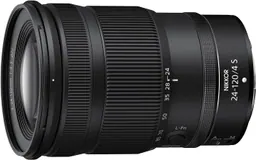
Nikon Nikkor Z 24-120mm F4 S
24-120mm · f/4

Nikon Nikkor Z 24-105mm F4-7.1
24-105mm · f/4-7.1
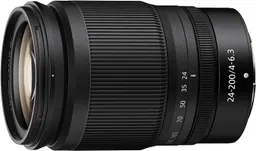
Nikon Nikkor Z 24-200mm F4-6.3 VR
24-200mm · f/4-6.3
Tamron 35-150mm F/2-2.8 Di III VXD
35-150mm · f/2-2.8

Tamron 35-100mm F/2.8 Di III VXD
35-100mm · f/2.8
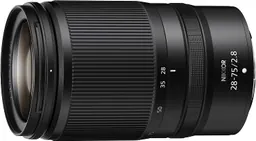
Nikon Nikkor Z 28-75mm F2.8
28-75mm · f/2.8
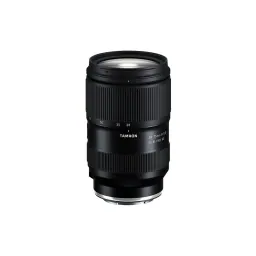
Tamron 28-75mm F/2.8 DI III VXD G2
28-75mm · f/2.8
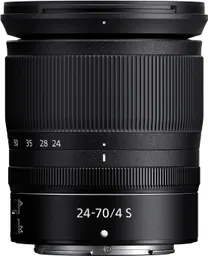
Nikon Nikkor Z 24-70mm F4 S
24-70mm · f/4
Related guides
What does the f mean in camera lenses?
When it comes to photography, understanding the basics of f-stop is essential. F-stop is a critical component of a camera lens that…
How to clean a camera lens
Keeping your camera lenses clean is essential for getting clear, sharp, and high-quality images. Even the smallest speck of dust, dirt, or…
All camera lens types explained: Uses and functions
In this article, we'll explore the various types of camera lenses, their defining features, and when to use them. We'll also cover the…