
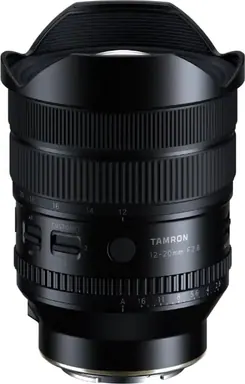
Nikon Z (DX/FX) Tamron Lenses Autofocus
Tamron 12-20mm F2.8
- Focal length
- 12–20 mm
- Aperture
- f/2.8
- Weight
- 585 g
- Filter diameter
- –
- Min. focus distance
- 18 cm
- Length
- 121.3 mm
Prices
Amazon.com
Price on the shop page
At a Glance
This full-frame ultra-wide zoom for Nikon Z covers 12-20 mm. The aperture stays at f/2.8 throughout, which helps in low light and allows short shutter times. The lens weighs 585 g and focuses as close as 18 cm. Its very wide field of view suits landscapes, architecture, interiors and the night sky.
Good for
- Landscape
- Architecture
- Interiors
- Night sky
Derived from the manufacturer data, not from our own tests. How we check
Technical Specifications
- Min. focal length
- 12 mm
- Max. focal length
- 20 mm
- Max. aperture (min. zoom)
- f/2.8
- Max. aperture (max. zoom)
- f/2.8
- Min. aperture
- f/16
- Elements
- 17
- Groups
- 12
- Weight
- 585 g (1.29 lb)
- Filter diameter
- –
- Min. focus distance
- 18 cm at 12 mm · 28 cm at 20 mm
- Max. magnification
- 1:5.9 at 12 mm · 1:9.1 at 20 mm
- Length
- 121.3 mm (4.78 in)
- Diameter
- 90 mm (3.54 in)
- Released
- August 2026
Manufacturer data: tamron.com, tamron.com, tamron.com
Last checked: October 12, 2026 (against the manufacturer data) · How we check
Which cameras does the Tamron 12-20mm F2.8 fit?
The Tamron 12-20mm F2.8 is a full-frame lens for Nikon Z cameras. On full-frame bodies it uses the whole sensor; on APS-C Nikon Z cameras its field of view equals 18-30 mm in full-frame terms.
Nikon Z cameras
- Full frame:
- Nikon Z5IIC, Nikon ZR, Nikon Z5II, Nikon Z6III, Nikon Z8, Nikon Zf, Nikon Z9, Nikon Z5, Nikon Z6II, Nikon Z7II, Nikon Z6, Nikon Z7
- APS-C:
- Nikon Z50II, Nikon Z30, Nikon Z fc, Nikon Z50
Tamron 12-20mm F2.8 compared
Key specs side by side with the most similar Nikon Z lenses.
| Lens | Tamron 12-20mm F2.8 | Nikon Nikkor Z 14-24mm F2.8 S | Nikkor Z 17-28mm F2.8 | Tamron 16-30mm F2.8 Di III VXD G2 |
|---|---|---|---|---|
| Focal length | 12-20 mm | 14-24 mm | 17-28 mm | 16-30 mm |
| Max. aperture | f/2.8 | f/2.8 | f/2.8 | f/2.8 |
| Weight | 585 g | 650 g | 450 g | 450 g |
| Filter diameter | – | 112 mm | 67 mm | 67 mm |
| Min. focus distance | 18 cm | 28 cm | 19 cm | 19 cm |
| Length | 121.3 mm | 124.5 mm | 101 mm | 103.9 mm |
| Autofocus | yes | yes | yes | yes |
| Image stabilization | no | no | no | no |
Open these lenses in the comparison and add more Compare the size of these lenses
This lens is also available for
Tamron 12-20mm F2.8: FAQ
Does the Tamron 12-20mm F2.8 have autofocus?
Yes, the Tamron 12-20mm F2.8 has autofocus.
Does the Tamron 12-20mm F2.8 have image stabilization?
No, the Tamron 12-20mm F2.8 has no stabilization of its own. On cameras with in-body image stabilization (IBIS) the image is still stabilized.
How much does the Tamron 12-20mm F2.8 weigh?
The Tamron 12-20mm F2.8 weighs 585 g. It is 121.3 mm long with a diameter of 90 mm.
How close can the Tamron 12-20mm F2.8 focus?
The minimum focus distance of the Tamron 12-20mm F2.8 is 18 cm, measured from the sensor plane.
Is the Tamron 12-20mm F2.8 a full-frame lens?
Yes, the Tamron 12-20mm F2.8 covers full frame. On APS-C cameras its field of view equals 18-30 mm in full-frame terms.
Similar lenses
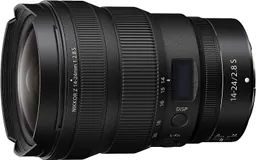
Nikon Nikkor Z 14-24mm F2.8 S
14-24mm · f/2.8
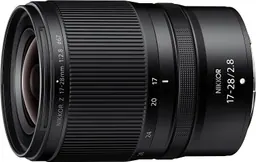
Nikkor Z 17-28mm F2.8
17-28mm · f/2.8
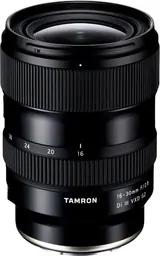
Tamron 16-30mm F2.8 Di III VXD G2
16-30mm · f/2.8
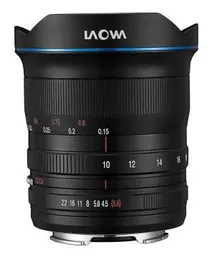
Venus Laowa 10-18mm f/4.5-5.6
10-18mm · f/4.5-5.6
Venus Laowa 12-24mm f/5.6
12-24mm · f/5.6
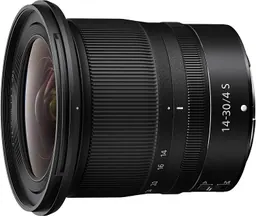
Nikon Nikkor Z 14-30mm F4 S
14-30mm · f/4
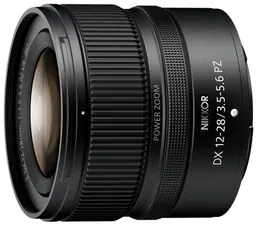
NIKKOR Z DX 12-28mm f/3.5-5.6 PZ VR
12-28mm · f/3.5-5.6
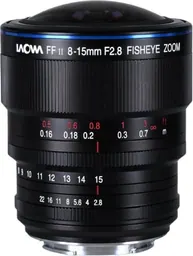
Venus Laowa 8-15mm F2.8 FF Zoom Fisheye
8-15mm · f/2.8
Related guides
What does the f mean in camera lenses? f/2.8 explained
The f in f/2.8 is the f-number: focal length divided by aperture diameter. Learn why lower means more light and how the f-stop scale works.
How to clean a camera lens safely, step by step
How to clean a camera lens: blow off dust, then wipe gently with a microfiber cloth or lens paper. Steps and warnings from Canon, Nikon…
Types of Camera Lenses Explained: Uses and Differences
Types of camera lenses explained: wide-angle, standard, telephoto, prime, zoom, macro and more, with focal length ranges and typical uses.