
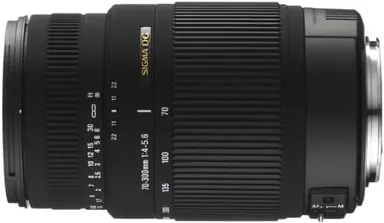
Nikon F (DX/FX) Sigma Lenses Autofocus OIS
Sigma 70-300mm F4-5.6 DG OS
- Focal length
- 70–300 mm
- Aperture
- f/4–5.6
- Weight
- 610 g
- Filter diameter
- 62 mm
- Min. focus distance
- 150 cm
- Length
- 126.5 mm
Prices
Amazon.com
Price on the shop page
At a Glance
A full-frame telephoto zoom for Nikon F-mount, the 70-300 mm offers f/4-5.6 and an optical stabilizer. At 610 g it is compact. A magnification of 0.26x at a 1.5 m minimum focus distance allows detail shots from a moderate distance. Sports, wildlife, landscapes and travel are the typical uses.
Good for
- Sports
- Wildlife
- Landscape
- Travel
Derived from the manufacturer data, not from our own tests. How we check
Technical Specifications
- Min. focal length
- 70 mm
- Max. focal length
- 300 mm
- Max. aperture (min. zoom)
- f/4
- Max. aperture (max. zoom)
- f/5.6
- Min. aperture
- f/22
- Elements
- 16
- Groups
- 11
- Weight
- 610 g (1.34 lb)
- Filter diameter
- 62 mm
- Min. focus distance
- 150 cm (59.06 in)
- Max. magnification
- 1:3.9 (0.26×)
- Length
- 126.5 mm (4.98 in)
- Diameter
- 76.5 mm (3.01 in)
Manufacturer data: sigma-global.com
Last checked: October 13, 2026 (against the manufacturer data) · How we check
Which cameras does the Sigma 70-300mm F4-5.6 DG OS fit?
The Sigma 70-300mm F4-5.6 DG OS is a full-frame lens for Nikon F-Mount cameras. On full-frame bodies it uses the whole sensor; on APS-C Nikon F-Mount cameras its field of view equals 105-450 mm in full-frame terms.
Nikon F-Mount cameras
- Full frame:
- Nikon D6, Nikon D780, Nikon D850, Nikon D5, Nikon D810A, Nikon D4S, Nikon D810, Nikon D750, Nikon Df, Nikon D610, Nikon D4, Nikon D800, Nikon D800E, Nikon D600, Nikon D3S, Nikon D3X, Nikon D700
With the Nikon FTZ II / FTZ the lens can also be used on Nikon Z (DX/FX) cameras.
Sigma 70-300mm F4-5.6 DG OS compared
Key specs side by side with the most similar Nikon F-Mount lenses.
| Lens | Sigma 70-300mm F4-5.6 DG OS | Nikon AF Nikkor 70-300mm f/4-5.6G | Sigma 70-300mm F4-5.6 APO DG Macro | Sigma 70-300mm F4-5.6 DG Macro |
|---|---|---|---|---|
| Focal length | 70-300 mm | 70-300 mm | 70-300 mm | 70-300 mm |
| Max. aperture | f/4-5.6 | f/4-5.6 | f/4-5.6 | f/4-5.6 |
| Weight | 610 g | 425 g | 550 g | 545 g |
| Filter diameter | 62 mm | 62 mm | 58 mm | 58 mm |
| Min. focus distance | 150 cm | 150 cm | 95 cm | 95 cm |
| Length | 126.5 mm | 116.5 mm | 122 mm | 122 mm |
| Autofocus | yes | yes | yes | yes |
| Image stabilization | yes | no | no | no |
Open these lenses in the comparison and add more Compare the size of these lenses
This lens is also available for
Sigma 70-300mm F4-5.6 DG OS: FAQ
Does the Sigma 70-300mm F4-5.6 DG OS have autofocus?
Yes, the Sigma 70-300mm F4-5.6 DG OS has autofocus.
Does the Sigma 70-300mm F4-5.6 DG OS have image stabilization?
Yes, the Sigma 70-300mm F4-5.6 DG OS has optical image stabilization.
How much does the Sigma 70-300mm F4-5.6 DG OS weigh?
The Sigma 70-300mm F4-5.6 DG OS weighs 610 g. It is 126.5 mm long with a diameter of 76.5 mm.
What filter size does the Sigma 70-300mm F4-5.6 DG OS use?
The Sigma 70-300mm F4-5.6 DG OS takes 62 mm screw-in filters.
How close can the Sigma 70-300mm F4-5.6 DG OS focus?
The minimum focus distance of the Sigma 70-300mm F4-5.6 DG OS is 150 cm, measured from the sensor plane.
Is the Sigma 70-300mm F4-5.6 DG OS a full-frame lens?
Yes, the Sigma 70-300mm F4-5.6 DG OS covers full frame. On APS-C cameras its field of view equals 105-450 mm in full-frame terms.
Similar lenses
Nikon AF Nikkor 70-300mm f/4-5.6G
70-300mm · f/4-5.6
Sigma 70-300mm F4-5.6 APO DG Macro
70-300mm · f/4-5.6
Sigma 70-300mm F4-5.6 DG Macro
70-300mm · f/4-5.6
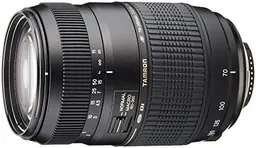
Tamron AF 70-300mm F/4-5.6 Di LD Macro
70-300mm · f/4-5.6
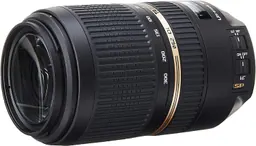
Tamron SP 70-300mm F4-5.6 Di VC USD
70-300mm · f/4-5.6
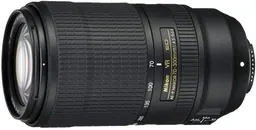
Nikon AF-P Nikkor 70-300mm F4.5-5.6E ED VR
70-300mm · f/4.5-5.6
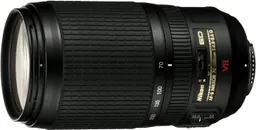
Nikon AF-S Nikkor 70-300mm f/4.5-5.6G VR
70-300mm · f/4.5-5.6
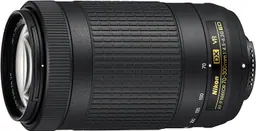
Nikon AF-P DX Nikkor 70-300mm F4.5-6.3G VR
70-300mm · f/4.5-6.3
Related guides
What does the f mean in camera lenses? f/2.8 explained
The f in f/2.8 is the f-number: focal length divided by aperture diameter. Learn why lower means more light and how the f-stop scale works.
How to clean a camera lens safely, step by step
How to clean a camera lens: blow off dust, then wipe gently with a microfiber cloth or lens paper. Steps and warnings from Canon, Nikon…
Types of Camera Lenses Explained: Uses and Differences
Types of camera lenses explained: wide-angle, standard, telephoto, prime, zoom, macro and more, with focal length ranges and typical uses.