
Fujifilm XF 18-55mm F2.8-4 R LM OIS
Fujifilm X
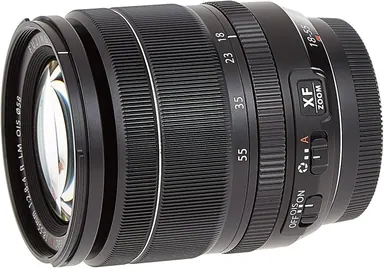
Overview
The Fujifilm XF 18-55mm F2.8-4 R LM OIS is a versatile zoom lens that has earned a solid reputation among Fujifilm X-series camera users. Offering an effective focal length equivalent to 27-84mm in the 35mm format, this lens covers a broad range of shooting scenarios, from wide landscapes to tighter portrait shots. Its blend of quality optics, solid build, and useful features makes it a strong contender as a standard zoom lens.
One of the most noteworthy features of the XF 18-55mm is its constant aperture of F2.8 at the wide end and F4 at the telephoto end. This is impressive for a zoom lens, allowing for good performance in lower light conditions and giving photographers more creative control over depth of field. The lens also includes an Optical Image Stabilization (OIS) system, helping to reduce the effects of camera shake when shooting handheld, which can be invaluable for street photography or while traveling.
The construction of the lens feels premium, made with a robust metal body that gives it both durability and a professional feel. The manual focus ring operates smoothly, allowing for precise adjustments when needed. The autofocus is powered by a linear motor, which offers fast and quiet focusing, making it suitable for various shooting situations, including video work.
However, while the lens has many strengths, it is not without its drawbacks. Some users have noted that the zoom mechanism can feel a bit stiff at times, particularly when shooting at extreme angles or in cold weather. Additionally, the maximum aperture of F4 at the telephoto end can limit performance in low light compared to other lenses that maintain a wider aperture throughout the zoom range. There may also be some slight distortion and chromatic aberration at the extreme ends of the focal range, which might require correction in post-processing.
Pros and Cons
Pros
- Versatile focal length suitable for various shooting styles.
- Constant aperture of F2.8-4 allows for good low light performance.
- Effective OIS helps in reducing camera shake.
- Solid, professional-grade build quality.
- Fast and quiet autofocus mechanism.
Cons
- Zoom mechanism can feel stiff in certain conditions.
- Maximum aperture of F4 at the telephoto end limits low light capabilities.
- Distortion and chromatic aberration may require post-processing correction.
Verdict
Overall, the Fujifilm XF 18-55mm F2.8-4 R LM OIS is a fantastic lens that offers a great balance of flexibility and performance. It is a worthy addition to any Fujifilm X-series camera kit, especially for photographers seeking a reliable walkaround lens that can handle a diverse range of situations. While it has a few minor weaknesses, its positives far outweigh any negatives, making it an excellent choice for both amateur and professional photographers alike.
Technical Specifications
Which cameras does the Fujifilm XF 18-55mm F2.8-4 R LM OIS fit?
The Fujifilm XF 18-55mm F2.8-4 R LM OIS fits all Fujifilm X-Mount cameras. There its field of view equals 27-83 mm in full-frame terms (crop factor 1.5).
Fujifilm X-Mount cameras
- APS-C:
- Fujifilm X-T30 III, Fujifilm X-E5, Fujifilm X-M5, Fujifilm X-T50, Fujifilm X-S20, Fujifilm X-T5, Fujifilm X-H2, Fujifilm X-H2S, Fujifilm X-T30 II, Fujifilm X-E4, Fujifilm X-S10, Fujifilm X-T4, Fujifilm X-T200, Fujifilm X-Pro3, Fujifilm X-A7, Fujifilm X-T30, Fujifilm X-T3, Fujifilm X-T100, Fujifilm X-H1, Fujifilm X-A5, Fujifilm X-E3, Fujifilm X-T20, Fujifilm X-A10, Fujifilm X-A3, Fujifilm X-T2, Fujifilm X-E2S, Fujifilm X-Pro2, Fujifilm X-T10, Fujifilm X-A2, Fujifilm X-T1, Fujifilm X-E2, Fujifilm X-A1, Fujifilm X-M1, Fujifilm X-E1, Fujifilm X-Pro1
Fujifilm XF 18-55mm F2.8-4 R LM OIS compared
Key specs side by side with the most similar Fujifilm X-Mount lenses.
| Lens | Fujifilm XF 18-55mm F2.8-4 R LM OIS | Sigma 18-50mm F2.8 DC DN | C for Fujifilm X Mount | Fujifilm XF 16-55mm F2.8 R LM WR | Fujifilm XF 16-55mm F2.8 R LM WR II |
|---|---|---|---|---|
| Focal length | 18-55 mm | 18-50 mm | 16-55 mm | 16-55 mm |
| Max. aperture | f/2.8-4 | f/2.8 | f/2.8 | f/2.8 |
| Weight | 310 g | 285 g | 655 g | 410 g |
| Filter diameter | 58 mm | 55 mm | 77 mm | 72 mm |
| Min. focus distance | 40 cm | 12 cm | 30 cm | 30 cm |
| Length | 70 mm | 77 mm | 106 mm | 95 mm |
| Autofocus | yes | yes | yes | yes |
| Image stabilization | yes | no | no | no |
Comparisons with this lens
Fujifilm XF 18-55mm F2.8-4 R LM OIS: FAQ
Does the Fujifilm XF 18-55mm F2.8-4 R LM OIS have autofocus?
Yes, the Fujifilm XF 18-55mm F2.8-4 R LM OIS has autofocus.
Does the Fujifilm XF 18-55mm F2.8-4 R LM OIS have image stabilization?
Yes, the Fujifilm XF 18-55mm F2.8-4 R LM OIS has optical image stabilization.
How much does the Fujifilm XF 18-55mm F2.8-4 R LM OIS weigh?
The Fujifilm XF 18-55mm F2.8-4 R LM OIS weighs 310 g. It is 70 mm long with a diameter of 65 mm.
What filter size does the Fujifilm XF 18-55mm F2.8-4 R LM OIS use?
The Fujifilm XF 18-55mm F2.8-4 R LM OIS takes 58 mm screw-in filters.
How close can the Fujifilm XF 18-55mm F2.8-4 R LM OIS focus?
The minimum focus distance of the Fujifilm XF 18-55mm F2.8-4 R LM OIS is 40 cm, measured from the sensor plane.
Similar lenses
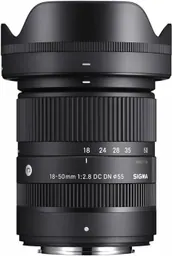
Sigma 18-50mm F2.8 DC DN | C for Fujifilm X Mount
18-50mm · f/2.8
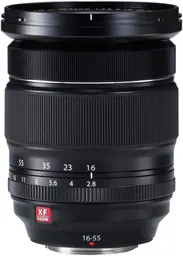
Fujifilm XF 16-55mm F2.8 R LM WR
16-55mm · f/2.8
-
Fujifilm XF 16-55mm F2.8 R LM WR II
16-55mm · f/2.8
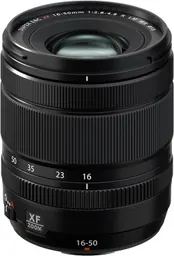
Fujifilm XF 16-50mm F2.8-4.8 R LM WR
16-50mm · f/2.8-4.8
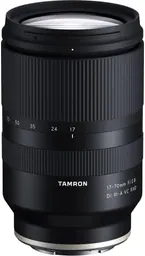
Tamron 17–70mm F2.8 Di III-A VC RXD
17-70mm · f/2.8
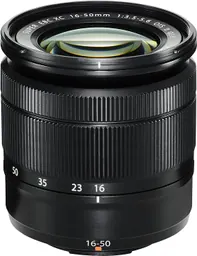
Fujifilm XC 16-50mm F3.5-5.6 OIS
16-50mm · f/3.5-5.6
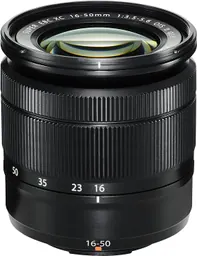
Fujifilm XC 16-50mm F3.5-5.6 OIS II
16-50mm · f/3.5-5.6
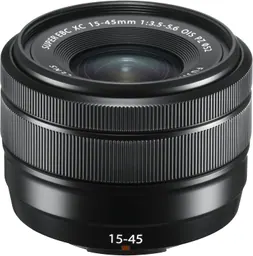
Fujifilm XC 15-45mm F3.5-5.6 OIS PZ
15-45mm · f/3.5-5.6
Related guides
What does the f mean in camera lenses?
When it comes to photography, understanding the basics of f-stop is essential. F-stop is a critical component of a camera lens that…
How to clean a camera lens
Keeping your camera lenses clean is essential for getting clear, sharp, and high-quality images. Even the smallest speck of dust, dirt, or…
All camera lens types explained: Uses and functions
In this article, we'll explore the various types of camera lenses, their defining features, and when to use them. We'll also cover the…