
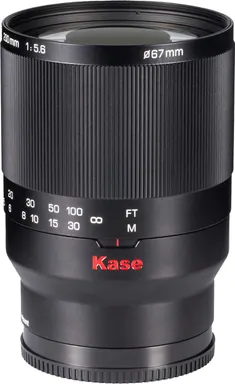
Kase 200mm F5.6 MC Reflex
- Focal length
- 200 mm
- Aperture
- f/5.6
- Weight
- 424 g
- Filter diameter
- 67 mm
- Min. focus distance
- 200 cm
- Length
- 116 mm
Prices
Amazon.com
Price on the shop page
At a Glance
As a mirror lens, this 200 mm telephoto for Nikon Z has a fixed f/5.6 aperture, so exposure is set via shutter time and ISO. At 424 g it counts as compact, and it is focused manually only. Minimum focus distance is 2 m. On full-frame it keeps the 200 mm field of view. It suits landscape and travel.
Good for
- Landscape
- Travel
Worth knowing
- No autofocus: focusing is manual only.
- Mirror lens: the aperture is fixed, exposure is set via shutter time and ISO.
Derived from the manufacturer data, not from our own tests. How we check
Technical Specifications
- Min. focal length
- 200 mm
- Max. focal length
- 200 mm
- Max. aperture (min. zoom)
- f/5.6
- Max. aperture (max. zoom)
- f/5.6
- Min. aperture
- f/5.6
- Elements
- 6
- Groups
- 5
- Weight
- 424 g (0.93 lb)
- Filter diameter
- 67 mm
- Min. focus distance
- 200 cm (78.74 in)
- Length
- 116 mm (4.57 in)
- Diameter
- 71 mm (2.8 in)
- Announced
- February 2024
Manufacturer data: kaseoptics.com, kasefilters.eu
Last checked: October 12, 2026 (against the manufacturer data) · How we check
Which cameras does the Kase 200mm F5.6 MC Reflex fit?
The Kase 200mm F5.6 MC Reflex is a full-frame lens for Nikon Z cameras. On full-frame bodies it uses the whole sensor; on APS-C Nikon Z cameras its field of view equals 300 mm in full-frame terms.
Nikon Z cameras
- Full frame:
- Nikon Z5IIC, Nikon ZR, Nikon Z5II, Nikon Z6III, Nikon Z8, Nikon Zf, Nikon Z9, Nikon Z5, Nikon Z6II, Nikon Z7II, Nikon Z6, Nikon Z7
- APS-C:
- Nikon Z50II, Nikon Z30, Nikon Z fc, Nikon Z50
Kase 200mm F5.6 MC Reflex compared
Key specs side by side with the most similar Nikon Z lenses.
| Lens | Kase 200mm F5.6 MC Reflex | Mitakon Zhongyi 200mm f/4 1x Macro | NiSi 250mm f/5.6 Reflex | Venus Laowa 180mm F4.5 1.5X Ultra Macro APO |
|---|---|---|---|---|
| Focal length | 200 mm | 200 mm | 250 mm | 180 mm |
| Max. aperture | f/5.6 | f/4 | f/5.6 | f/4.5 |
| Weight | 424 g | 1,300 g | – | – |
| Filter diameter | 67 mm | 67 mm | 62 mm | 62 mm |
| Min. focus distance | 200 cm | 48 cm | 200 cm | 30 cm |
| Length | 116 mm | 186 mm | – | – |
| Autofocus | no | no | no | yes |
| Image stabilization | no | no | no | no |
Open these lenses in the comparison and add more Compare the size of these lenses
This lens is also available for
Kase 200mm F5.6 MC Reflex: FAQ
Does the Kase 200mm F5.6 MC Reflex have autofocus?
No, the Kase 200mm F5.6 MC Reflex has no autofocus; you focus it manually.
Does the Kase 200mm F5.6 MC Reflex have image stabilization?
No, the Kase 200mm F5.6 MC Reflex has no stabilization of its own. On cameras with in-body image stabilization (IBIS) the image is still stabilized.
How much does the Kase 200mm F5.6 MC Reflex weigh?
The Kase 200mm F5.6 MC Reflex weighs 424 g. It is 116 mm long with a diameter of 71 mm.
What filter size does the Kase 200mm F5.6 MC Reflex use?
The Kase 200mm F5.6 MC Reflex takes 67 mm screw-in filters.
How close can the Kase 200mm F5.6 MC Reflex focus?
The minimum focus distance of the Kase 200mm F5.6 MC Reflex is 200 cm, measured from the sensor plane.
Is the Kase 200mm F5.6 MC Reflex a full-frame lens?
Yes, the Kase 200mm F5.6 MC Reflex covers full frame. On APS-C cameras its field of view equals 300 mm in full-frame terms.
Similar lenses
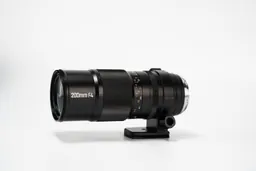
Mitakon Zhongyi 200mm f/4 1x Macro
200mm · f/4
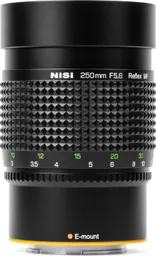
NiSi 250mm f/5.6 Reflex
250mm · f/5.6
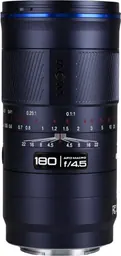
Venus Laowa 180mm F4.5 1.5X Ultra Macro APO
180mm · f/4.5
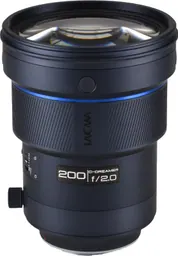
Venus Laowa 200mm F2 AF FF
200mm · f/2
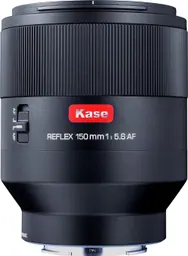
Kase AF 150mm F5.6 Reflex
150mm · f/5.6
Nikon Nikkor Z 180-600mm F5.6-6.3 VR
180-600mm · f/5.6-6.3
Tamron 150-500mm f/5-6.7 Di III VC VXD
150-500mm · f/5-6.7
Nikon Nikkor Z 120-300mm F2.8 TC VR S
120-300mm · f/2.8
Related guides
What does the f mean in camera lenses? f/2.8 explained
The f in f/2.8 is the f-number: focal length divided by aperture diameter. Learn why lower means more light and how the f-stop scale works.
How to clean a camera lens safely, step by step
How to clean a camera lens: blow off dust, then wipe gently with a microfiber cloth or lens paper. Steps and warnings from Canon, Nikon…
Types of Camera Lenses Explained: Uses and Differences
Types of camera lenses explained: wide-angle, standard, telephoto, prime, zoom, macro and more, with focal length ranges and typical uses.